
If your home golf practice currently means a few carpet putts, a half-swing near the hallway wall, and maybe some net balls when you remember, the problem is probably not effort. It is shape. The useful answer is a week that tells each session what job it has: four skill-drill days, two strength and mobility days, and one full rest day, all built for 10- to 40-minute windows.
No single source supplies this combined plan. The home golf practice drills come from instruction sources such as MyGolfSpy, HackMotion, V1 Sports, Golfzon Leadbetter, BirdieBall, and Practical Golf; the body-work pieces come from golf fitness sources including MyGolfSpy, Fit For Golf, TPI, and Men’s Health. The value is in putting them into a week that alternates feedback-heavy skill work with the mobility and strength that make those skills easier to repeat.
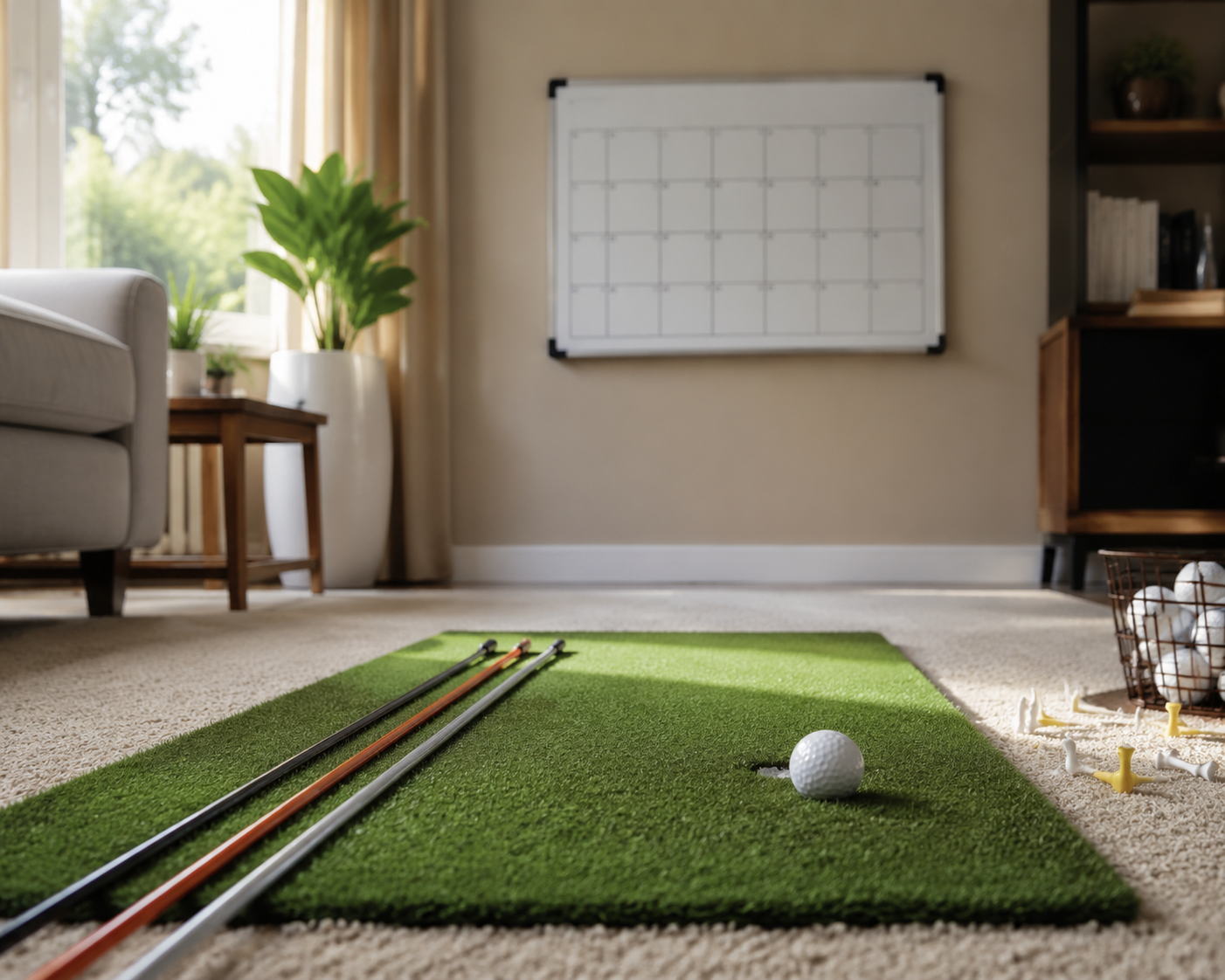
The Week at a Glance
| Day | Session | Time | Main job |
|---|---|---|---|
| Monday | Skill drills: putting and chipping | 20–30 minutes | Build face control, low-point awareness, and short-game touch with visible feedback |
| Tuesday | Strength and mobility | 20–30 minutes | Train the body positions that support balance, rotation, and repeatable speed |
| Wednesday | Active recovery or light putting | 10 minutes | Keep touch alive without turning recovery into another workout |
| Thursday | Skill drills: swing mechanics | 20–30 minutes | Work on pivot, plane, release feel, and strike feedback without chasing ball flight |
| Friday | Strength and mobility | 20–30 minutes | Emphasize mobility, control, and optional bodyweight power |
| Saturday | Combined mini-session | 40 minutes | Blend warm-up, one priority skill, and a short finisher |
| Sunday | Rest | Off | Let the week absorb; no guilt practice required |
This is not a moral test. If you miss Tuesday, you do not owe the golf gods 60 minutes on Wednesday. Keep the order when you can, because alternating skill and body work prevents every session from becoming the same stale rehearsal. But the rule that matters most is simpler: do fewer reps with feedback.
A home session has to create its own consequences. On grass, a fat chip, pulled putt, or over-the-top move gives you evidence. Indoors, you need gates, tape, towels, walls, tees, and targets to replace what the course normally tells you.
Why Skill and Body Work Belong on Different Days
Putting a strength circuit, a mobility flow, full-swing mechanics, and chipping practice into one ambitious home session looks efficient on paper. In a living room, it usually becomes rushed. You warm up poorly, skim the drills, take too many careless swings, and finish with the same question: did any of that transfer?
Separating the week gives each day a cleaner purpose. Skill days ask the ball, club, or household feedback station to judge the movement. Strength and mobility days ask whether your hips, trunk, shoulders, and balance can actually support the movement you keep trying to make. For readers who want a deeper standalone fitness progression beyond the shorter sessions here, Build a Home Golf Workout Routine With Mobility, Strength, and Power expands that side of the plan.
The split also keeps home practice honest. Indoor drills can improve feel, setup, low-point awareness, and mechanical consistency, but they do not fully recreate turf interaction, uneven lies, wind, pressure, or changing targets. The goal is to arrive at the range or course with cleaner patterns, not to pretend the carpet is a fairway.
Monday: Putting and Chipping With Consequences
Monday starts small on purpose. Putting and chipping are easy to practice badly at home because the ball rolls, the club moves, and it feels like work. The session only counts if the setup tells you something.
Pick two or three drills. Give each one 20–30 careful reps or 5-ball groups, depending on the drill. Stop before the reps become automatic.
| Drill | Setup | Feedback to watch | Best use |
|---|---|---|---|
| Towel-under-feet putting | Stand on a folded towel while putting | Lower body stays quiet; stroke feels arms-and-shoulders driven | When your putting stroke gets handsy or your body drifts |
| Gate putting | Place two tees slightly wider than the putter head and roll putts through the gate | Putter clips a tee when the path or face control gets sloppy | When start line is the priority |
| Quarter game | Putt 5-ball groups toward a quarter on the carpet from short indoor distances | Track how often the ball finishes on or over the coin | When you need target focus instead of stroke tinkering |
| Tee-gate chipping | Place one tee just outside the ball and one just inside it, then chip without striking either | Hitting a tee exposes a poor strike pattern or unstable low point | When your indoor chipping needs more than a pillow target |
The towel-under-feet putting drill comes from MyGolfSpy’s home drill list: the folded towel under both feet discourages lower-body movement and pushes the stroke toward an arms-and-shoulders motion.[1] Practical Golf describes a gate drill using two tees set slightly wider than the putter head, giving the putter a clear pass-or-fail lane.[2] BirdieBall describes a quarter-style putting game built around rolling balls to cover a coin-sized target on carpet.[3]
For chipping, Golfzon Leadbetter’s Robin Symes uses a low-point control drill with tees placed just inside and outside the ball; the goal is to chip without hitting either tee.[4] That is exactly the kind of indoor drill worth keeping, because a carpet chip without feedback can look fine while the strike pattern quietly gets worse.
Putting and chipping share Monday because they reward touch, start line, and contact more than speed. They also keep the first day of the week from becoming a full-swing project before your setup, tempo, and attention are back online.
Tuesday: Strength Without Turning the Living Room Into a Gym
Tuesday is not there to make you tired. It is there to make the golf positions you want less fragile. A golfer who cannot control a split squat, rotate through the upper back, or stabilize the trunk during a bird dog should be careful about blaming every bad strike on technique.
Use a 20–30 minute circuit. Choose the version you can perform cleanly, then progress only when the movement stays controlled.
| Exercise | Zero-equipment version | Progression option | Why it belongs |
|---|---|---|---|
| Split squat | Bodyweight split squat | Slower tempo or longer range | Single-leg control for balance and lower-body stability |
| Push-up | Incline or floor push-up | Lower incline or slower eccentric | Upper-body strength without needing a bench or machine |
| Bird dog | Bodyweight bird dog | Longer holds | Trunk control while the limbs move |
| IYT | Prone or standing IYT pattern | Longer holds or light household load if appropriate | Scapular stability for shoulder control |
| Glute bridge | Two-leg glute bridge | Single-leg glute bridge | Hip extension and posterior-chain control |
MyGolfSpy’s bodyweight strength article, written with Jason Noble, CSCS, includes no-equipment exercises such as split squats, push-ups, bird dogs, and IYTs for golfers.[5] Fit For Golf’s home workout approach uses progressions, including glute bridge variations that can move from a beginner version to a single-leg or weighted version.[6] The useful part for a small-space golfer is not the idea that one perfect exercise fixes the swing; it is the progression logic.
A simple Tuesday structure works well: two rounds if you have 20 minutes, three rounds if you have closer to 30. Leave a little in reserve. A shaky final set may feel satisfying, but it rarely helps Thursday’s swing work.
Wednesday: Ten Minutes Is Enough
Wednesday is active recovery or light putting. That means one putting game, not a secret full practice session. Use the quarter game or the gate drill, record a small result if you like, then stop.
This short day matters because it keeps a club in your hands without adding much fatigue or mental clutter. If your week is busy, Wednesday can also be the first day you cut. The schedule is meant to survive real life.
Thursday: Swing Mechanics Without Guessing
Thursday is the day most home golfers want to start with: full-swing mechanics. It comes after short game and strength work because mechanics are easier to rehearse when you are not also asking the session to solve touch, fitness, and speed.
Choose two or three drills. Keep them slow enough that you can notice the feedback. If you are hitting into a net, the ball flight is gone, so contact, balance, and checkpoints become the evidence.
| Drill | Setup | Feedback to watch | Best use |
|---|---|---|---|
| Wall drill | Stand about 6 inches from a wall and make slow backswings without contacting it | Touching the wall signals a backswing shape or plane problem | When you fight steep, over-the-top patterns |
| Tape strike drill | Place masking tape on the mat behind the ball | Clean strike leaves tape undisturbed; fat contact scuffs it | When low point is the priority |
| Alignment-stick plane drill | Use an alignment stick through belt loops or along the spine | Stick shows turn, tilt, and body orientation | When pivot awareness is vague |
| Chair drill | Set up from the edge of a chair, then make half-swings without re-sitting | Re-contacting the chair exposes sway or loss of posture | When centered pivot needs work |
| Tennis-ball toss | Underhand toss a tennis ball at a target | Release feels athletic and directed rather than forced | When clubface and release work feels too technical |
V1 Sports describes a wall drill in which the golfer stands 6 inches from a wall and makes slow backswings without contacting it, using the wall to discourage an over-the-top pattern and rehearse a better plane.[7] HackMotion’s indoor drill list includes a tape strike drill associated with Bryson DeChambeau’s practice style: masking tape behind the ball gives immediate feedback when a fat strike scuffs it.[8]
MyGolfSpy’s home drill list includes alignment-stick work for monitoring turn and tilt, along with a chair drill that uses the edge of a chair to train a more centered pivot.[1] HackMotion also includes Danny Maude’s tennis-ball toss drill, which removes the club and uses an underhand throw to build release feel toward a target.[8]
The order inside the session can change, but the best version usually starts with body-position feedback, moves to strike feedback, and ends with a feel drill. For example: wall drill, tape strike, then tennis-ball toss. That sequence moves from constraint to contact to motion.
Friday: Mobility First, Power Only If It Stays Clean
Friday should feel different from Tuesday. Instead of another strength circuit, start with mobility and control: hips, thoracic spine, shoulders, and trunk. The payoff is not a dramatic sweat. It is the ability to make Saturday’s blended session without your body arguing with every turn.
| Block | Movements | Time | Notes |
|---|---|---|---|
| Mobility | 90/90 hip rotations, cat-cow, thoracic rotations | 10–15 minutes | Move slowly enough to find restrictions instead of skipping past them |
| Shoulder and upper-back control | Wall angels or furniture-assisted variations | 5–8 minutes | Use pain-free range; do not force overhead positions |
| Optional power | Squat jumps or skater lunges | 5 minutes | Keep reps low and crisp; stop when landings get noisy or uncontrolled |
TPI’s home workout material from Dr. Ben Langdown and Jennifer Fleischer includes mobility work such as 90/90 hip rotations, wall angels, cat-cow, thoracic spine rotations, and household-assisted options.[9] Men’s Health’s 4-week golf workout from Milo Bryant, CSCS, includes bodyweight power moves such as squat jumps and skater lunges, though the broader program also uses equipment such as kettlebells and medicine balls.[10]
For this weekly home plan, strip that power work down to the bodyweight pieces unless you already own and know how to use the equipment. A small room is a poor place to learn sloppy loaded speed. If your knees, hips, or back complain during drills or workouts, use a recovery resource such as Golf Leg Pain Relief Exercises at Home by Pain Location rather than pushing through a movement that keeps getting worse.
Saturday: Blend the Week, Do Not Cram It
Saturday is the longest session, but it should not become a warehouse for everything you skipped. Think of it as a test blend: can you warm up, choose one priority skill, and finish with a little strength or power without turning the whole thing into noise?
| Part | Time | What to do |
|---|---|---|
| Mobility warm-up | 15 minutes | Use 90/90 rotations, cat-cow, thoracic rotations, and wall angels |
| Priority skill | 15 minutes | Choose one: gate putting, tee-gate chipping, wall drill, tape strike, or chair drill |
| Finisher | 10 minutes | Use split squats and bird dogs, or low-volume squat jumps/skater lunges if landings stay controlled |
The priority skill should be chosen from the week’s evidence. If the tape kept getting scuffed on Thursday, use tape strike again. If the putter kept clipping the gate, return to start-line work. If both were fine, choose the drill that matches your next range session so the home work has somewhere to go.
If you prefer following a structured instructor on screen, Golf Lesson DVD Comparison for Home Practice covers small-space options. The same rule still applies: use the video to guide the session, then add feedback so you know whether the movement actually changed.
Sunday: Rest Is Part of the Schedule
Sunday is off. No emergency carpet putting, no guilty mobility flow, no squeezing in the drill you forgot. If you want to watch golf or plan the next week, fine. But the body and the attention span both get a break.
How to Choose Drills Without Collecting Too Many
The mistake with home golf practice drills is treating every clever idea as something to add. A better filter is transfer. Does the drill make a later stroke, strike, pivot, mobility pattern, or speed move more usable?
- Use putting gates when the start line is the issue.
- Use the quarter game when target focus and pace need a simple score.
- Use tee-gate chipping when contact quality is vague.
- Use tape behind the ball when low point is the main problem.
- Use wall, chair, and alignment-stick drills when the pivot or plane needs a constraint.
- Use tennis-ball tosses when the release feels over-coached and needs an athletic target.
Do not rotate all of them every week just to feel complete. Two putting/chipping drills and two swing-mechanics drills can carry a month if they keep giving you useful information.
Equipment: What You Need, What You Can Skip
The minimum setup is modest: a putter, a few balls, tees or small objects for gates, masking tape, a towel, a safe wall, and enough floor space for half-swings. An alignment stick helps, but a club laid on the floor can handle some alignment jobs. A mat is useful if you chip or make strike drills indoors, but the feedback tool matters more than the brand of mat.
Fitness equipment is optional in this schedule. MyGolfSpy’s bodyweight strength work genuinely fits a no-equipment home setup.[5] TPI’s home workout material uses household-style modifications in places.[9] Fit For Golf’s progression model can include loading as you advance, but the important principle here is choosing the right level before adding resistance.[6] Men’s Health’s broader program includes equipment, so only the bodyweight power moves are being pulled into this small-space plan.[10]
That distinction matters because equipment creep can hide the real issue. Most intermediate golfers do not need a more elaborate home station before they need cleaner feedback, more consistent scheduling, and fewer throwaway reps.
Make the Week Flexible Without Making It Random
The schedule is firm enough to prevent drifting, but it should flex around actual life. If you only have three days, keep one putting/chipping day, one strength or mobility day, and one swing-mechanics day. If you have four days, add Saturday’s blended session. If you have all six practice days, keep the sessions short enough that you still want to repeat them next week.
For a broader example of how weekly home plans can be structured around limited time, see how we structure weekly plans for other home fitness goals in A 4-Week Home Workout Plan for Busy Parents. The useful overlap is not the exercises; it is the idea that a repeatable week beats a heroic one-off session.
The last piece is range or course transfer. Bring one indoor checkpoint with you, not five. If Thursday’s tape drill was about low point, make your next range session partly about brushing the turf in the right place. If Monday’s gate putting exposed start-line problems, spend part of your next putting green session on start line before worrying about long lag putts.
Home practice improves fastest when the week forces feedback, alternates skill stress with mobility and strength, and leaves room for real golf to test the work.
References
- 5 Golf Drills You Can Do at Home (No Simulator Required), MyGolfSpy
- How to Practice Golf at Home [Complete Guide], Practical Golf
- What Are the Best Golf Drills to Do at Home?, BirdieBall
- Golf Practice at Home Made Easy, Golfzon Leadbetter
- Bodyweight Strength Training for Golf, MyGolfSpy
- Golf Workout at Home — Build Strength & Increase Swing Speed, Fit For Golf
- Essential No-Equipment Golf Drills, V1 Sports
- Golf Drills at Home: The 9 Best Indoor Drills to Improve, HackMotion
- The Home Workout, TPI
- 4-Week Golf Workout Program for Strong Swings, Men’s Health
Comments
Join the discussion with an anonymous comment.