
The most useful Jason Statham workout for home training is not the famous film-prep split with rowing machines, Olympic bars, and heavy kettlebells. It is the plain one he shared himself: 20 squats, 15 push-ups, 30 sit-ups, 15 towel rows, and 20 dips, done as a bodyweight session that could fit in a living room, garage, or hotel room.[1]
That matters because the search for a Jason Statham workout routine and diet at home usually runs into two bad options. One treats his physique as movie-star mythology. The other copies a gym plan that assumes equipment most people do not own. The bodyweight session is a better entry point: it proves the home version is not invented, while still needing a caveat. One Instagram Reel is not a complete verified program. It is a useful snapshot of the kind of work that fits his public training standards.

Statham’s commonly cited build is around 5 feet 10 inches and 185 pounds, although published height and weight figures vary by source.[2] That is worth one sentence, not a shrine. For home training, the more useful question is whether the methods behind that look can survive without a commercial gym. A surprising amount of them can.
The Home Version Starts With Principles, Not Equipment
The widely circulated Statham training split is the film-prep version. It has its place. It also comes from a context with coaching, equipment, recovery control, and a job that sometimes requires looking ready for a fight scene. That version uses tools like rowing machines, barbells, and heavy kettlebells, so copying it at home usually turns into either compromise or frustration.[3]
The home-adaptable version is built from four ideas Statham has repeated in interviews: change the workout often, keep sessions short and hard, move through full ranges of motion, and adjust based on how the body feels. He told Men’s Health, “My workout is constantly changing, which for me is the best thing in the world,” and added that “the body is like an adaptation machine.”[4]
He also told Men’s Health that he keeps sessions to 30–40 minutes: “I don’t like spending 90 minutes working out.”[4] That one line is friendlier to home trainees than almost any celebrity routine. A hard half-hour is realistic before work, during lunch, or after the house quiets down. A heroic 90-minute plan is usually a plan people admire for three days and abandon by week two.
The mobility piece is not decorative. Statham has emphasized shoulder mobility and uses tools such as rings and stretching work; in a separate Men’s Health feature, he described setting up gymnastic rings in available spaces, including a rented backyard in New Zealand during a film shoot.[3][4] That is the useful lesson: he is not waiting for the perfect gym. He is finding a way to pull, press, squat, hinge, brace, and move well in the space he has.
What “Never Repeat” Should Mean in a Living Room
“Never repeat a workout” sounds exciting until a home trainee turns it into random exhaustion. Variety has to be controlled. The exercises can change, the rep scheme can change, or the time limit can change, but the body still needs enough repeated patterns to get better.
For home use, keep the movement categories steady and rotate the session format. That gives you Statham-style variety without losing the thread.
| Training Principle | Home Translation | What Changes |
|---|---|---|
| Constant variation | Rotate formats across the week | Ladders, circuits, density blocks, tempo work |
| Short and intense | Train for 30–40 minutes including warm-up | Rest periods, pace, and exercise difficulty |
| Full-range mobility | Use controlled reps you can actually own | Depth, tempo, pauses, and joint-friendly substitutions |
| Train by feel | Adjust the day before form breaks | Volume, exercise choice, and finishers |
A good home week might use the same five movement patterns three times: squat, push, pull, trunk, and dip or hinge. Monday could be a descending ladder. Wednesday could be a timed circuit. Friday could be slower tempo strength work. The pattern is familiar enough to progress, but the stress is different enough to avoid sleepwalking through the same routine.
If you want a longer progression after this Statham-style session, a structured guide to progressive overload at home is a better next step than adding random punishment.
The Statham-Inspired Bodyweight Workout You Can Do Today
This session borrows the spirit of Dan John’s “Big Five 55” descending ladder, a protocol commonly linked to Statham-style training: five exercises performed from 10 reps down to 1 rep.[5] The original version is not a no-equipment living room plan, so the exercise choices below are adapted. The structure is the part worth keeping.
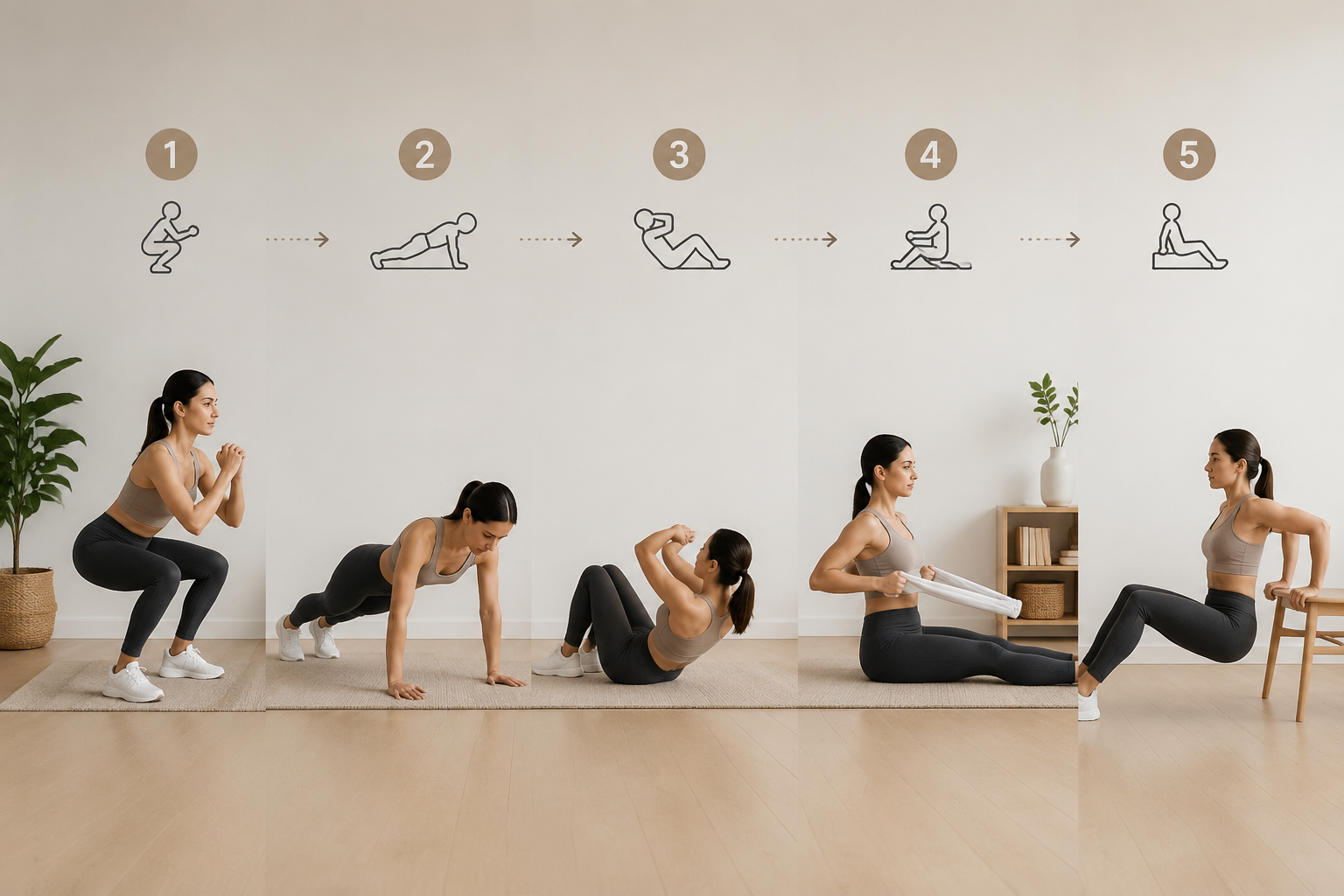
| Movement | Main Exercise | Easier Option | Harder Option |
|---|---|---|---|
| Squat | Bodyweight squat | Box squat to a chair | Pause squat or jump squat |
| Push | Push-up | Hands-elevated push-up | Feet-elevated push-up |
| Core | Sit-up | Dead bug or crunch | V-up or slow eccentric sit-up |
| Pull | Towel row | Doorframe-assisted row pattern or band row | Inverted row or pull-up |
| Dip | Chair dip | Bench-supported triceps dip with bent knees | Ring dip or parallel-bar dip |
Here is the workout.
- Warm up for 5–7 minutes: easy squats, arm circles, hip hinges, plank shoulder taps, and a few slow push-ups.
- Do 10 reps of each exercise: squats, push-ups, sit-ups, towel rows, and dips.
- Then do 9 reps of each, then 8, then 7, continuing down to 1.
- Rest only as needed to keep clean reps. If form changes, rest longer or use the easier option.
- Stop the main work at 30 minutes even if you have not finished. Cool down for 3–5 minutes.
If you complete the full ladder, each exercise totals 55 reps. Across five movements, that is 275 working reps. That is plenty. The goal is not to make the floor sweatier; it is to keep the session dense while the reps still look like training.
How to Handle the Pulling Problem
Pulling is the hardest part of no-gym training. Push-ups and squats are easy to find. Rows take more thought. Statham’s Instagram session used towel rows, which are practical if you have a sturdy setup and know how to control your body.[1] If you do not trust the anchor point, do not improvise with a weak door, slippery table, or furniture that can tip.
Safer substitutions include resistance-band rows, a sturdy inverted-row setup, a pull-up bar, or slow prone back extensions if no pulling option exists that day. The last one is not a true row, but it keeps the back involved until you solve the equipment problem. For more options, use a dedicated no-equipment upper-body workout to build pulling alternatives around your space.
How Hard It Should Feel
The first round should feel controlled, not heroic. The middle rounds should start asking questions. The last few rounds should move quickly because the reps are low, but they should not turn into sloppy half-reps. If your shoulders pinch on dips, swap to close-grip push-ups. If sit-ups bother your back, use dead bugs. If towel rows feel unsafe, change the pull.
Training by feel is not permission to quit early because the session got uncomfortable. It is permission to make the right adjustment before a joint, tendon, or lower back pays for your ego. Statham can push hard because he also treats movement quality as part of the work.
A Simple Weekly Rotation
Do the ladder once or twice before you start modifying it. After that, keep the same movement categories and rotate the format. This is how you honor the “constantly changing” idea without turning training into a dice roll.
| Day | Session | Purpose |
|---|---|---|
| Monday | Descending ladder: 10 to 1 across five movements | Dense full-body strength conditioning |
| Wednesday | 20-minute circuit: 8–12 reps per move, repeat at steady pace | Conditioning without racing bad reps |
| Friday | Tempo session: 3-second lowering on squats, push-ups, rows, and dips | Control, range of motion, and joint tolerance |
| Optional weekend | Walk, mobility, easy shadowboxing, or zone 2 cardio | Recovery and aerobic base |
The optional day should feel like it gives something back. A long walk, easy mobility, or beginner-friendly zone 2 cardio without equipment fits better than another max-effort circuit.
Beginners should cut the ladder to 5 down to 1, use easier exercise versions, or follow a 4-week no-equipment workout plan first. Intermediate trainees can add a pull-up bar, rings, or a single kettlebell later. The upgrade should solve a training need, not decorate the apartment.
Mobility Is Where the Home Routine Either Ages Well or Breaks Down
Full range of motion is easy to praise and hard to keep when fatigue arrives. In a small apartment, the temptation is to make every workout about breathlessness because breathlessness feels serious. Statham’s training history points in a different direction: rings, shoulder mobility, stretching protocols, and exercises that demand control through space.[3][4]
For the bodyweight ladder, that means the squat reaches the deepest position you can control with your heels down. The push-up lowers until the chest nearly reaches the floor or the elevated surface. The row finishes with the shoulder blades moving, not just the elbows bending. The dip stops before the shoulder rolls forward. The sit-up does not become a neck yank.
A short mobility block before training is enough for most home sessions: ankle rocks, hip hinges, thoracic rotations, scapular push-ups, and a few controlled squats. If that sounds too ordinary for a celebrity workout, good. Ordinary preparation is one reason intense training stays available.
The Diet: Use the 95/5 Rule Before You Chase a Meal Plan
Statham’s home diet is easier to copy than his film schedule. The most practical rule is his 95/5 approach. He told Men’s Health, “95% of my food is good,” and framed it as “just reprogramming your head.”[4] That is more useful than pretending every meal needs to look like a movie-prep kitchen.

Reports of his diet commonly include no eating after 7 p.m., no carbs after lunch, at least 3 liters of water per day, and staple foods such as eggs, oats, brown rice, chicken, beef, fish, vegetables, and nuts.[2][6] Those rules do not require exotic ingredients. They require repetition at the grocery store.
| Rule | Home Version |
|---|---|
| 95/5 food quality | Most meals are lean protein, vegetables, slow carbs, fruit, and simple fats; small treats stay small. |
| No eating after 7 p.m. | Set a kitchen cutoff that fits your schedule instead of grazing through the evening. |
| No carbs after lunch | Put oats, rice, potatoes, or fruit earlier in the day; keep dinner protein-and-vegetable focused. |
| 3L water minimum | Use bottles or a marked jug so hydration is measured, not guessed. |
| Batch-cook staples | Cook chicken, rice, eggs, vegetables, or lean beef in advance so the good option is the easy option. |
The calorie number sometimes attached to Statham online is less reliable than the behavior pattern. Some estimates come from fan reconstructions, not confirmed nutrition records, so they should not be treated as his actual intake. The better home target is consistency: protein at each meal, vegetables most meals, carbohydrates placed where they support training, and enough water that thirst is not being mistaken for hunger.
His diet also appears to have changed across training phases. A stricter film-prep approach is not the same thing as a sustainable home routine. The later, more moderate pattern with basic whole foods is the one worth adapting because it can survive normal workdays, family dinners, and ordinary supermarkets.[6]
What to Copy, and What to Leave in the Film Gym
Copy the 30–40 minute ceiling. Copy the discomfort of dense work. Copy the movement standards. Copy the habit of changing the format before the body adapts. Copy the 95/5 food rule and the boring usefulness of eggs, rice, fish, chicken, vegetables, oats, nuts, and water.
Leave behind the need for a rowing machine, a film-prep calendar, and a heavy-equipment split if those do not match your home. A living room does not have to imitate a studio gym to produce serious training. It just has to give you enough floor space to squat, press, pull safely, brace, and repeat the work with control.
Do the ladder. Keep the reps honest. Rotate the next session instead of repeating it blindly. Eat like the 95% matters. That is the home version of training like Jason Statham: not the costume, not the myth, but the parts a person can actually repeat on a Tuesday.
References
- Instagram Reel, Instagram.
- Jason Statham Workout Routine, Diet Plan, Exercise, Body Measurements, Fitness Volt.
- The Complete Jason Statham Workout, Men’s Health UK.
- Jason Statham: Fitness After 50, Men’s Health UK.
- Jason Statham’s Real Workout Routine, Steel Supplements.
- Jason Statham’s Diet and Workout Plan, Man of Many.
Comments
Join the discussion with an anonymous comment.