
By the time most people search for the best home exercise bike, they have already compared the clean numbers: the sale price, delivery fee, app subscription, and maybe a financing offer. That is the easy part. The harder question is what the bike costs after the first exciting year, when the resistance starts slipping, the console goes dark, a pedal thread fails, or a warranty claim turns into a labor bill.
This is the maintenance side of total cost of ownership. If you want the subscription math, start with the five-year home exercise bike TCO breakdown or the separate guide to exercise bike subscription lock-in. Here, the question is more physical: which bike is still usable in year five, and which one has already asked you to pay for parts, labor, or replacement?
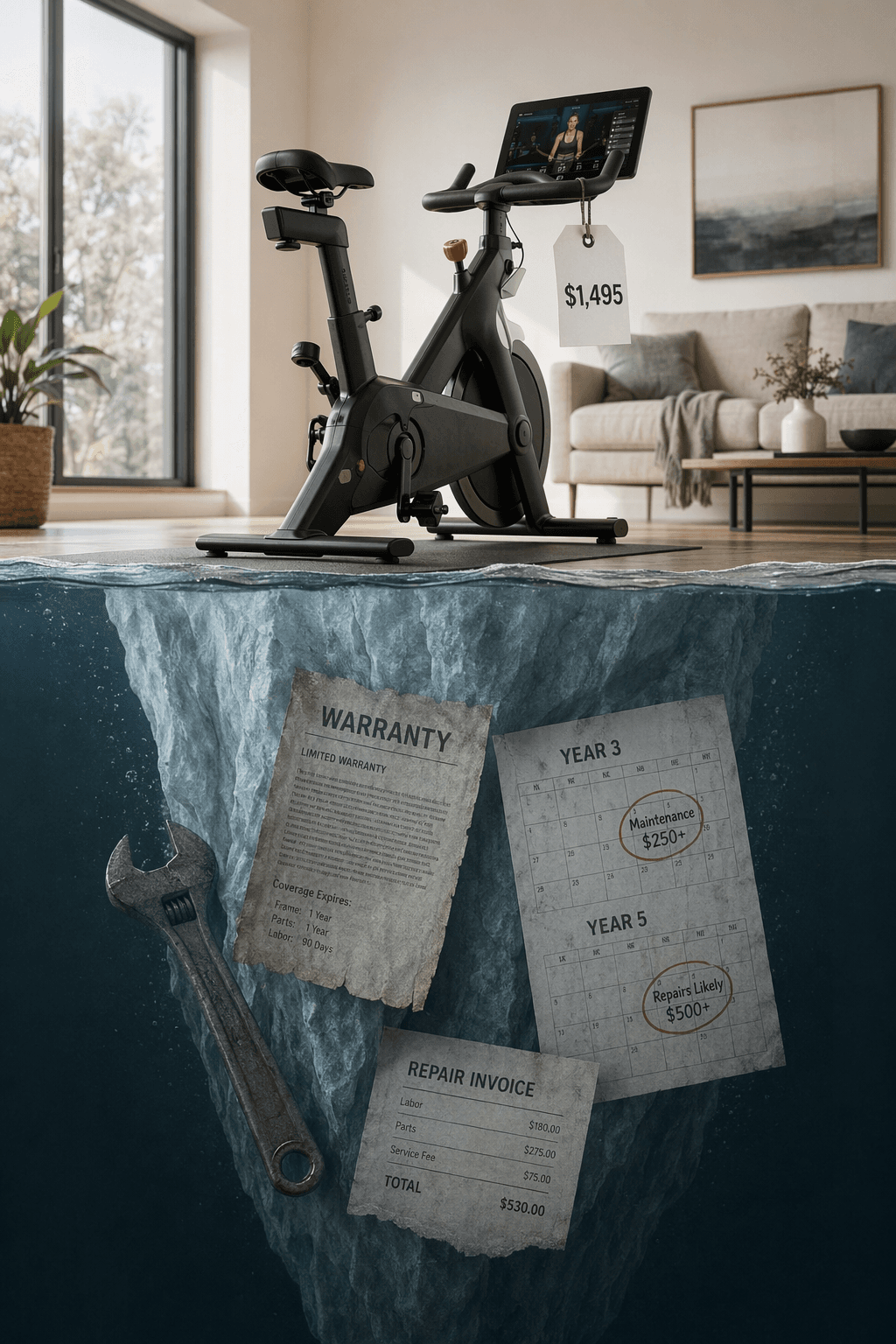
The Five-Year Cost Question Starts With What Can Fail
An exercise bike is not a couch with pedals. It has a resistance system, bearings, belt or drive components, pedals, cranks, adjustment hardware, sensors, wiring, and, on connected models, a screen that may cost more to replace than many entry-level bikes. A frame warranty does not protect all of that. In many cases, it protects the least likely thing to fail.
A practical five-year comparison should separate four questions before any brand loyalty enters the room:
- Resistance system: Does the bike use friction resistance, which relies on contact and wear, or magnetic resistance, which avoids direct contact with the flywheel?
- Warranty scope: Does the warranty cover only the frame for a long time, or does it also cover parts, labor, electronics, and mechanical components for a meaningful period?
- Parts access: Can an owner buy pedals, belts, seats, cranks, or other replacement parts directly, or does the brand push most repairs through service appointments?
- Repair economics: If a common repair costs a few hundred dollars, is that normal maintenance, or is the bike cheap enough that replacement makes more sense?
That last question matters more on budget bikes than premium ones. A $90 belt replacement may be an irritating but rational repair on a $1,500 bike. The same repair on a very cheap bike can become the start of a replacement decision, especially if a second problem is already developing.
Resistance Type Is the First Maintenance Filter
If low maintenance is a priority, resistance type is the cleanest early filter. Friction resistance systems create resistance by pressing a pad against the flywheel. That contact is the point of the design, and it is also the source of wear. Pads can glaze, shed material, lose consistency, squeak, or need replacement sooner under heavy use. Magnetic resistance systems use magnets near the flywheel rather than direct contact, so the resistance mechanism is widely treated as near-maintenance-free over the bike’s lifespan.[1]
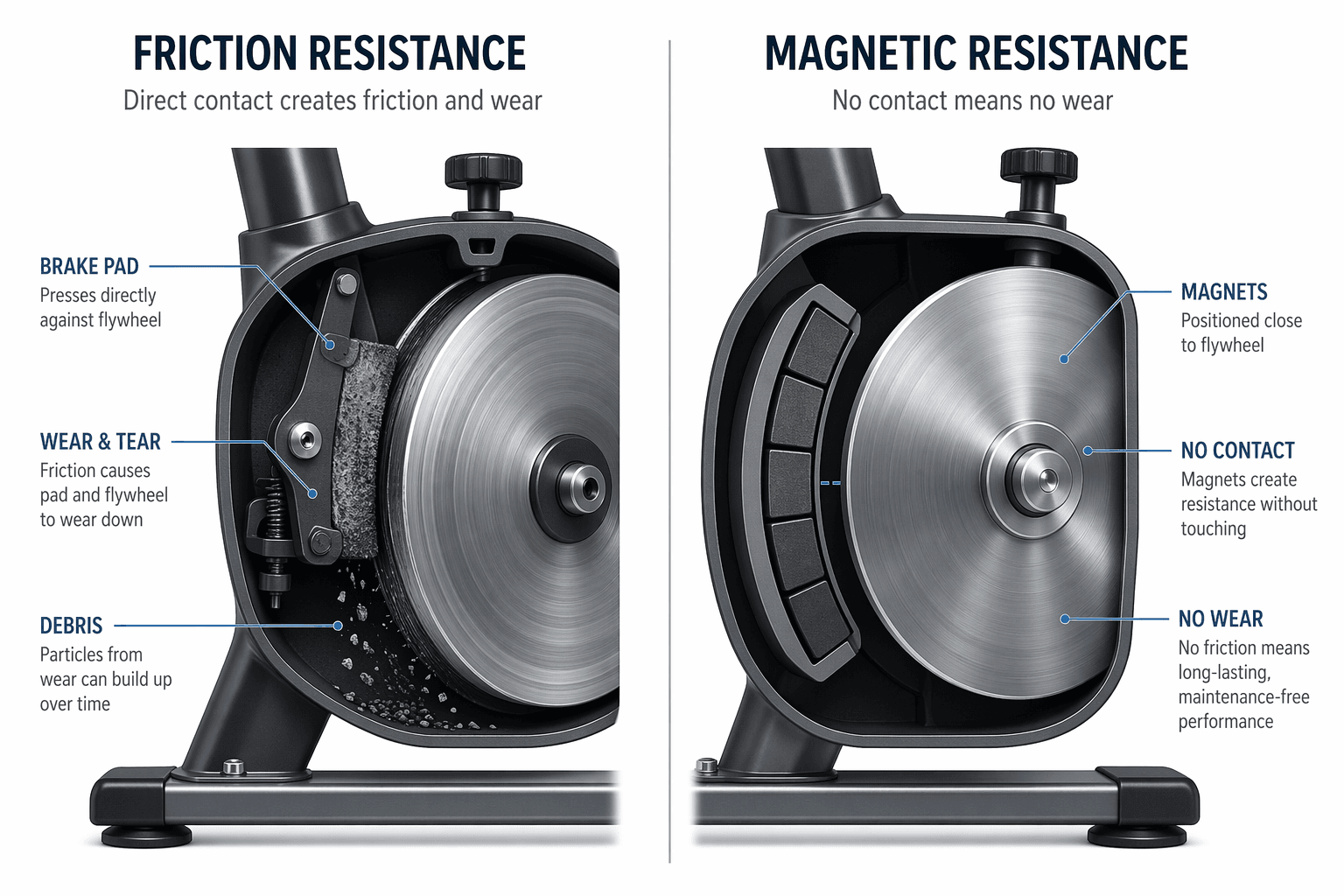
That does not mean every friction bike is bad or every magnetic bike is excellent. A well-built friction bike can still be a reasonable low-cost choice for light use. But the maintenance direction is different. Friction resistance builds a consumable part into the workout experience. Magnetic resistance removes that wear point from the resistance mechanism itself.
For someone riding several times a week, that difference is not theoretical. A friction pad that needs replacement is usually not catastrophic, but it is one more part to source, one more adjustment to get right, and one more reason the bike may sit unused while you decide whether the repair is worth your time. A magnetic system does not make the whole bike immune to failure; pedals, belts, consoles, bearings, and electronics can still create problems. It simply removes one predictable wear item.
If you are still comparing basic specs such as resistance type, flywheel weight, adjustability, and drive style, the exercise bike specs guide is the better place to start. For ownership cost, the key point is narrower: magnetic resistance usually lowers the odds of recurring resistance-system maintenance.
A Long Frame Warranty Can Hide a Short Ownership Promise
Warranty marketing loves the frame because it sounds reassuring and rarely tells you what your likely repair will cost. A frame is important, but most owners are not calling support because the steel triangle quietly gave up. They are calling about a screen, a resistance problem, a belt, a crank, a pedal, a sensor, or an adjustment part.
| Brand | Warranty Signal to Read Carefully | Why It Matters After Purchase |
|---|---|---|
| NordicTrack | 10-year frame / 2-year parts / 1-year labor | The frame term sounds strong, but parts and labor have much shorter protection windows. |
| Peloton | 5-year frame / 1-year parts and labor | The full parts-and-labor window is short relative to a five-year ownership plan. |
| Sole | Lifetime frame warranty with limited parts coverage | The frame promise is generous, but buyers still need to check which parts are covered and for how long. |
| Schwinn | 10-year frame with 2-year mechanical parts | Mechanical coverage is more relevant than the headline frame term for common ownership repairs. |
The useful warranty question is not “How long is the warranty?” It is “Which part is likely to fail, who pays for the part, who pays for the labor, and can I get the part without turning the bike into a service-ticket project?”
Labor is where many buyers get surprised. A warranty that covers a part but not the technician can still leave you with a bill. A warranty that covers labor for only the first year may be thin protection against the kind of failures people discover after regular use. And wear items often sit outside the most comforting parts of a warranty, which is exactly why resistance type and parts availability belong in the same conversation as warranty length.
Parts Availability Is the Difference Between Maintenance and Captivity
Some exercise bikes are friendlier to owners who are willing to handle basic repairs. Available manufacturer and aggregator sources identify Schwinn, Sole, and Concept2 as brands where replacement components are more accessible for owner purchase and swapping. Peloton, NordicTrack, and Echelon are described as more likely to route repairs through service calls or to make replacement more practical than self-repair in some situations.[3]
That distinction will not matter to everyone. If you want a premium connected bike and prefer official service for anything more complicated than replacing a pedal, a controlled repair channel may feel acceptable. But if the budget assumes the bike will last five years without becoming a service subscription in disguise, parts access deserves real weight.
Owner-serviceable design does not mean every repair is easy. A belt replacement can still be awkward. Crank problems can require the right tool. Electronics can be a dead end for a home user. But there is a meaningful difference between “I can order the part and try” and “I have to wait for the brand’s repair path before I even know the real cost.”
The Repair Bill Makes the Choice Less Abstract
Service-provider repair ranges give the five-year question a more useful shape. Resistance system failures are listed at $150 to $300. Display console failures are listed at $75 to $150. Belt or drive replacements are listed at $50 to $100. Pedal and crank repairs are listed at $75 to $200.[4]
| Repair Type | Reported Repair Range | Ownership Reading |
|---|---|---|
| Resistance system failure | $150-$300 | Painful on an inexpensive bike; easier to justify on a higher-quality bike with otherwise strong parts. |
| Display console failure | $75-$150 | Less expensive than many buyers fear, unless proprietary screens or service limits change the path. |
| Belt or drive replacement | $50-$100 | Often a normal ownership repair if the bike is otherwise sound. |
| Pedal or crank repair | $75-$200 | Worth pricing quickly because bad threads or crank issues can make the bike unusable. |
These ranges are not a quote for your bike. Geography, technician availability, shipping, diagnosis fees, proprietary parts, and warranty status can all change the bill. Their value is that they set a rough threshold for what counts as routine versus questionable.
The same repair source uses a 50% rule: if the repair costs more than half the price of a comparable new bike, replacement is usually the smarter financial choice.[4] That rule is blunt, but useful. It keeps a buyer from spending $250 to revive a bike that can be replaced for not much more, while also preventing needless replacement of a better bike that only needs a belt, pedal, or simple mechanical part.
Peloton’s Seat-Post Recalls Are a Reminder to Price Ownership Risk
Peloton is not the only connected-bike brand with post-purchase risk, and a recall is not the same thing as saying every unit will fail. Still, the seat-post recalls are too concrete to treat as a footnote. In 2023, Peloton recalled approximately 2 million original Bikes because the seat post could break during use. In November 2025, the company recalled about 833,000 Bike+ units for a seat-post issue.[5]
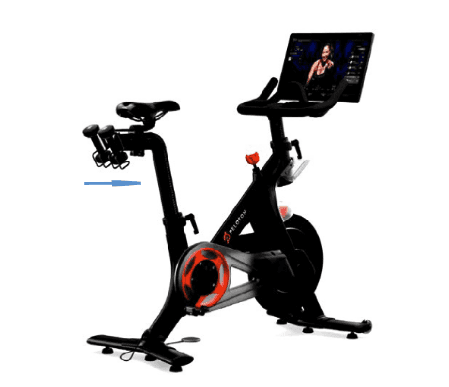
That kind of event changes how a buyer should think about a premium bike. A polished interface, strong class library, and quiet magnetic drive do not remove the need to ask what happens when a critical physical component becomes the problem. The recall remedy process should always be checked at the time of purchase or resale because manufacturer procedures can change after a recall notice is issued.
The lesson is not “never buy Peloton.” That would be too simple and not supported by the evidence here. The better lesson is that a bike’s ownership cost includes repair logistics, safety notices, parts campaigns, and time without a working machine. Those are real costs even when the brand eventually provides a remedy.
How to Compare a Shortlist Before You Buy
Once the bikes on your shortlist are close enough on price, the maintenance comparison should be direct. Do not rank them by the longest warranty phrase on the product page. Rank them by the parts most likely to affect years three through five.
- Prefer magnetic resistance if low maintenance is a major buying criterion.
- Read the warranty by category: frame, mechanical parts, electronics, wear items, and labor.
- Search for replacement parts before buying, not after something breaks.
- Ask whether pedals, belts, seats, cranks, and consoles can be purchased directly by owners.
- Use the 50% repair threshold before approving a major repair on a low-cost bike.
- Check recall history and current remedy status, especially when buying used or refurbished.
This approach may lead to a less glamorous pick. A bike with a simpler screen, available parts, magnetic resistance, and a clear mechanical warranty may be easier to own than a more exciting connected model with a short labor window and proprietary repair path. But the opposite can also be true for the right buyer: a premium connected bike can be worth the risk if the classes, interface, and ecosystem are the reason it will actually get used.
The best home exercise bike is not automatically the cheapest to maintain. It is the bike whose likely failures you can tolerate. If you are comfortable paying for official service, a more closed ecosystem may be acceptable. If you want the bike to remain boringly usable in year five, give more weight to magnetic resistance, honest parts coverage, accessible replacement components, and repair costs that do not make replacement look like the rational move.
References
- Friction vs. Magnetic Resistance Longevity, Garage Gym Reviews and Consumer Reports, link
- Exercise Bike Warranty Comparison Data, Manufacturer Pages, Garage Gym Reviews, and Consumer Reports, link
- Exercise Bike Parts Availability Notes, Manufacturer Pages and Aggregator Sources, link
- Exercise Bike Repair Cost Ranges, Heartbeat Fitness Blog, link
- Peloton Bike Seat Post Recall Notices, CPSC.gov, 2023 and November 2025, link

Comments
Join the discussion with an anonymous comment.