The first test for any piece of leg exercise equipment for home is not how good it looks in a product photo. It is whether the thing can live on your floor after the plates, handles, safety arms, walking space, and everyone else’s stuff are accounted for. If you already own a rack, barbell, plates, and dumbbells, your gym already covers squats, hinges, lunges, split squats, Romanian deadlifts, step-ups, and loaded carries. A dedicated leg machine has to buy something more specific than “more leg training.”
Usually that “something” is one of three things: extra quad volume without the same balance demand, hard leg work with less spinal loading, or isolation work that your rack cannot reproduce cleanly. If the machine does not give you one of those, it is probably not training equipment. It is a storage decision.
Start With What the Rack Does Not Already Solve
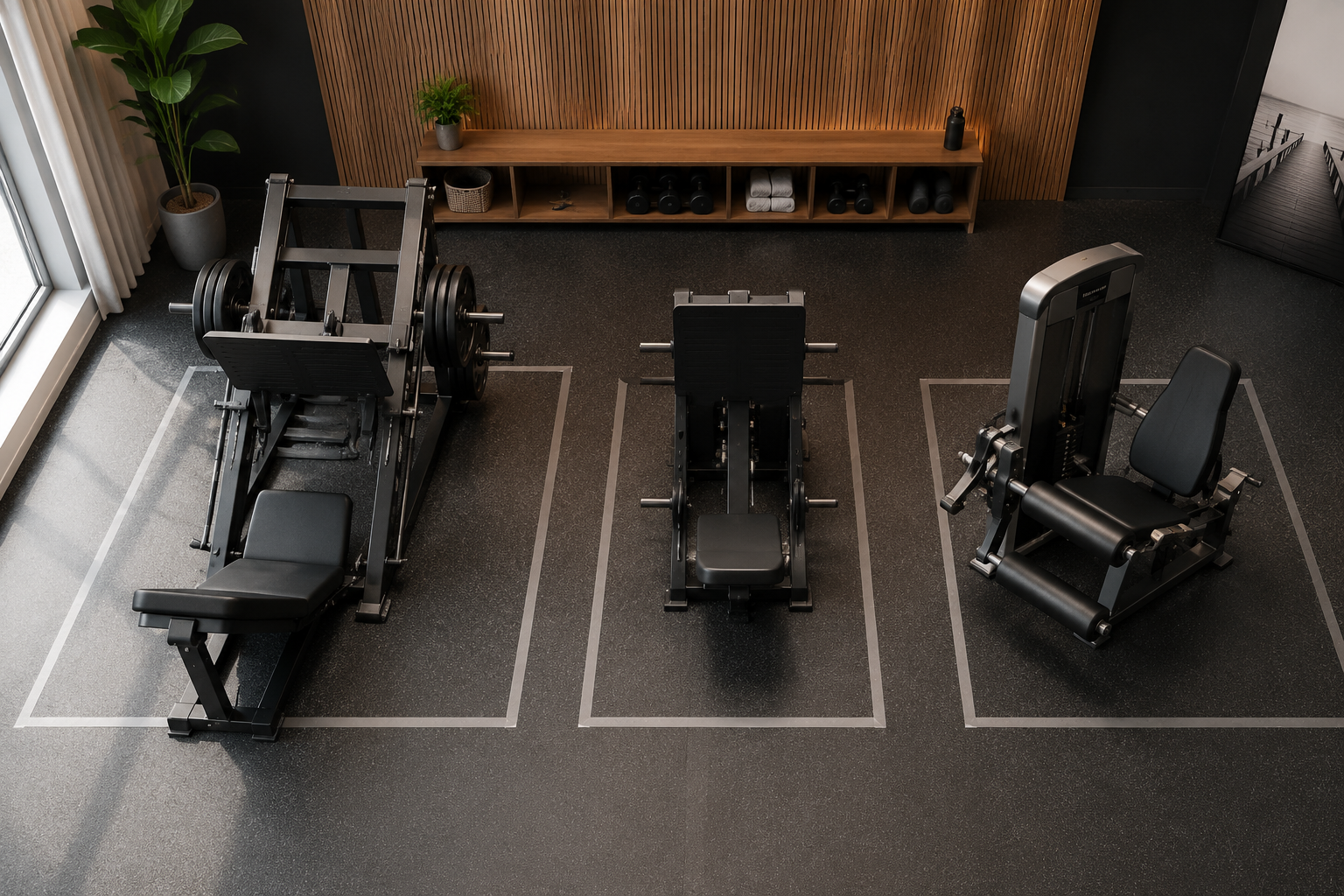
For an intermediate home gym owner, the upgrade question is narrower than most buying guides make it. You are not choosing your first leg setup. You are deciding whether a machine deserves space after the basic strength tools are already in place. That makes the useful comparison less about “best overall” and more about overlap.
A leg press/hack squat combo overlaps with squatting, but changes the fatigue cost and gives you two machine patterns in one footprint. A vertical leg press overlaps with pressing strength, but fits where a 45-degree sled will not. A leg extension/curl station does not replace squats, but it can isolate quads and hamstrings when the point is targeted work rather than another heavy compound set.
If you are still deciding how to sequence the big purchases, the broader home gym purchase guide is the better starting point. This comparison assumes the rack stage has already happened.
| Machine type | Typical home-gym value | Space reality | Best fit |
|---|---|---|---|
| Leg press/hack squat combo | Highest movement variety per footprint | Roughly 7'x4' for tested home models | Owners with enough floor space who want quad-dominant pressing and hack squats |
| Vertical leg press | Compact back-friendly loading | Examples fit about 48"x38" | Tight garages, basements, and rooms where a sled is too long |
| Leg extension/curl station | Targeted isolation only | Smaller than a combo, but single-purpose | Lifters prioritizing quad or hamstring isolation, or those avoiding more spinal loading |
| Standalone hack squat, abductor/adductor, calf raise | Usually weak value for most homes | Often consumes 10+ sq ft for narrow use | Only unusually specific goals and unusually available space |
The Leg Press/Hack Squat Combo Is the Strongest Space Argument
The combo machine earns attention because it gives you two useful lower-body patterns from one frame: a leg press and a hack squat. FitnessVolt’s 2026 testing describes home-oriented combo units from brands such as GMWD, Mikolo, and Titan as offering 1,000-plus-pound capacities in roughly a 7'x4' footprint, with GMWD examples around the $700–$900 range at the time of review.[1]
That is a large object, but at least it is a large object with a job. A leg press lets you keep pushing quad and glute volume when your low back is already tired from squats, deadlifts, rows, or life. A hack squat gives a more guided squat pattern, often with less balance and setup friction than barbell variations. For a garage gym that can actually spare the rectangle, this is the machine type most likely to keep getting loaded after the new-equipment excitement fades.
The catch is that “combo” does not automatically mean smooth, compact, or pleasant. Glide system matters. Linear bearings generally signal a smoother, more commercial-feeling carriage than basic nylon rollers, though the exact feel still depends on frame alignment, load, lubrication, and assembly quality. A machine that sticks under load changes the set; it makes you think about the sled instead of the muscle.
The other catch is the working footprint. A 7'x4' frame is not just 28 square feet on paper. You need room to load plates, step in and out, adjust the back pad or footplate, and avoid turning the rest of the gym into a sideways shuffle. If two people train together, the combo can become the thing everyone walks around.
This is where a constraint-first home gym equipment decision framework helps. The right question is not whether a combo is a good machine in general. It is whether your room can support the machine plus the behavior around it.
The Vertical Leg Press Wins When the Room Is the Limiting Factor
A vertical leg press is the more compact answer. FitnessVolt’s comparison cites the Titan Vertical Leg Press and Body-Solid PVLP156X at roughly $400–$500, with a footprint around 48"x38" for the Body-Solid model.[1] That size changes the conversation in a garage bay, spare room, or basement corner. It can fit where a 45-degree sled cannot.
The training appeal is also real. Because the load moves vertically over the lifter rather than sitting across the shoulders, the exercise can deliver hard leg pressing with very low spinal compression compared with back-loaded squatting. That does not make it magic, and it does not remove the need for careful setup, but it does explain why lifters with cranky backs keep looking at this category.
The compromise is loading headroom. The same FitnessVolt comparison notes that 400-pound capacity can become a ceiling for advanced lifters who already press over 500 pounds.[1] That does not make the machine useless. It means the buyer has to be honest. If you are already strong enough that 400 pounds is a warm-up range on a leg press pattern, the compact footprint may come with a short useful life.
Vertical presses also ask for a different kind of trust. You are lying under the load path, so stops, frame stability, plate security, and controlled reps matter. The machine may take less floor than a combo, but it should not be treated like a casual accessory you drag onto thin mats and hope for the best.
If your room is already tight, it is worth comparing vertical presses against broader compact home gym equipment categories before buying another fixed station. Sometimes the best compact solution is a vertical press. Sometimes it is a better belt squat setup, a landmine variation, or simply not adding another frame.
Combo vs. Vertical Press: The Real Split
The combo is the better buy when you can spare the floor and want the most training variety from one machine. It lets you move between a press and a guided squat pattern, and the higher capacities reported for home models leave more room for stronger lifters.[1]
The vertical press is the better buy when the main problem is space or spinal loading. It gives up movement variety and may run into capacity limits sooner, but it can turn an unusable corner into a productive leg station. That is a fair trade if the alternative is no machine at all.
Leg Extension and Curl Stations Have a Narrower Job
A standalone leg extension/curl station is not automatically a bad home-gym purchase. It is just easier to overbuy than people admit. The machine does not give you a press, a squat pattern, or a full lower-body compound. It gives you knee extension and knee flexion. That is useful when isolation is the point.
FitnessVolt ranked the Body-Solid GCEC340 at 4.7/5 and listed it at $699, highlighting its CAM resistance as a better match for the quad strength curve than a simple lever-arm mechanism.[1] That matters because resistance feel is one of the biggest differences between an isolation machine you actually use and one that feels awkward from the first warm-up set.
The RitFit PLC01 is another example of a design trying to solve the same problem at a lower price point. FitnessVolt rated it 4.5/5 at $429, and RitFit’s own guide emphasizes its cable/pulley-driven resistance where many competitors rely on simpler lever arms.[1][2] The branded material is useful for understanding the claim, but it should not carry the whole buying decision by itself.
The knee-safety question deserves a calm answer. Controlled leg extensions with correct pivot alignment are different from swinging heavy weight through a painful range. They can be a legitimate quad isolation tool. If you already have knee pathology, persistent pain, or post-surgical concerns, that is not a buying-guide problem; it belongs with a qualified clinician.
For most owners with a rack, this category should come after a hard filter: do you need isolation more than another compound loading option? If the answer is no, a standalone extension/curl station is probably not the next machine.
Some Machines Are Too Narrow for Most Home Gyms
Standalone hack squat machines, hip abductor/adductor machines, and dedicated calf raise units can all make sense in a commercial room. At home, they usually have to clear a higher bar. Garage Gym Reviews identifies these narrower machines as unlikely to justify the floor space for most home gyms, especially when bands, dumbbells, Nordic bench work, and other compact alternatives can cover similar goals without taking 10-plus square feet.[3]
The exception is a lifter with a very specific bodybuilding goal, a known weak point, and enough space that the machine will not compromise the rest of the room. That person exists. Most garage gyms are not that roomy.
This is also where single-purpose machines should be compared against multi-function options rather than judged in isolation. The same logic that separates smart home gyms from traditional all-in-one machines applies here: a machine that does one thing beautifully may still be a poor fit if that one thing is not central to your training week.
The Measurements Buyers Underestimate
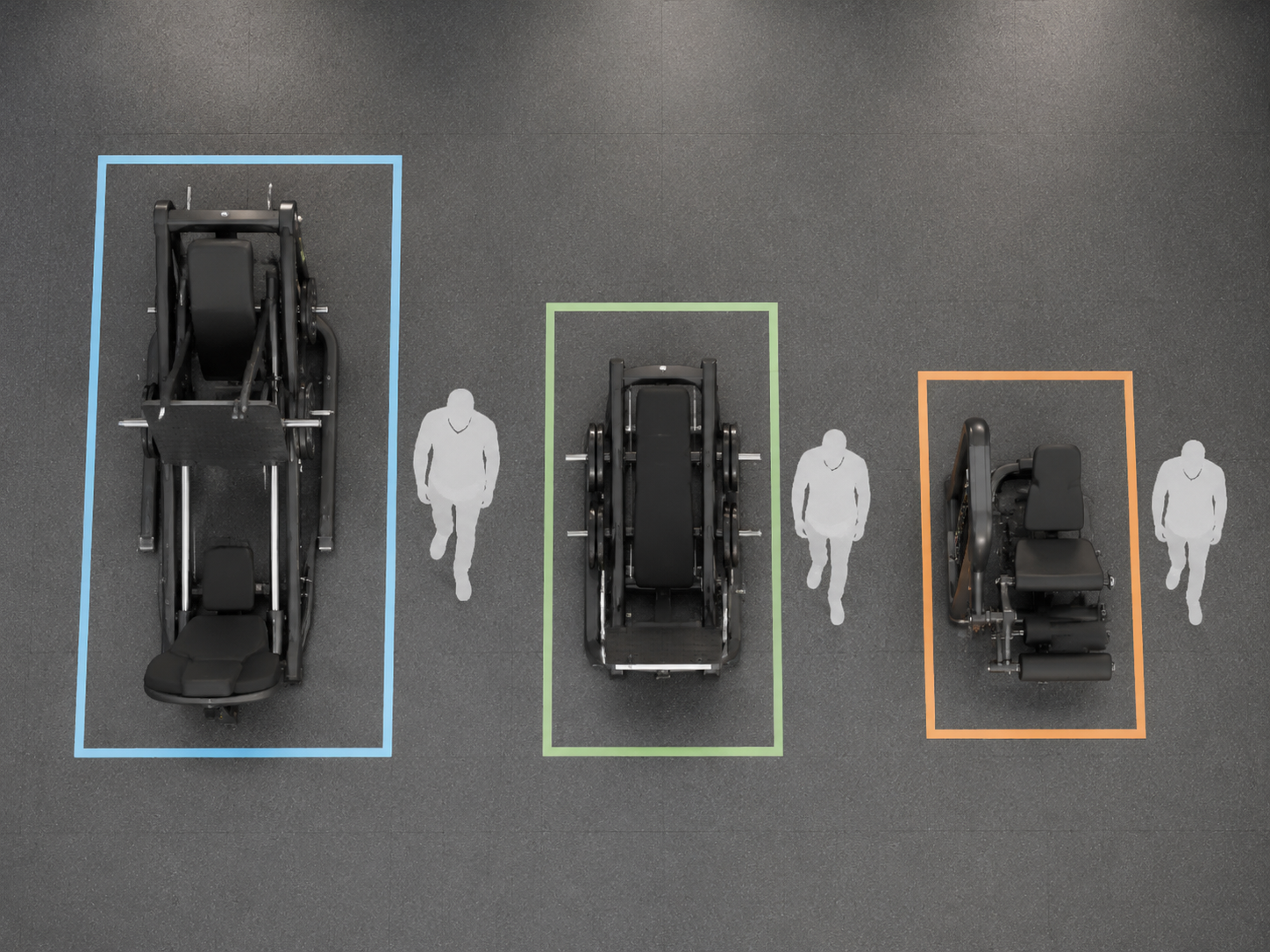
The listed footprint is only the start. Before ordering, mark the machine on the floor with tape and add the space needed to load plates, pull pins, recline or enter the unit, and walk around it. If the machine blocks plate storage, a door swing, a bike, or the path to the rack, the real footprint is larger than the spec sheet.
- Ceiling and angle: vertical presses generally need less ceiling height than 45-degree sleds or squat-rack movements, but every model still needs clearance through the full range.
- Flooring: heavy machines concentrate load through their feet, especially when plate-loaded. Upper floors, apartments, and soft flooring need more caution.
- Capacity: a 400-pound vertical press can be plenty for some lifters and limiting for others. Compare capacity with your actual working sets, not your wishful starting point.
- Resistance feel: linear bearings, nylon rollers, CAMs, cables, and lever arms do not feel the same. Smoothness affects whether you load the machine hard.
- Overlap: if the machine only duplicates a movement your rack already handles well, it needs a strong reason to stay.
For anyone placing a heavy machine outside a slab garage or basement, the flooring question is not cosmetic. The apartment home gym flooring guide is useful even if you do not live in an apartment, because it forces the right concerns: load distribution, vibration, surface grip, and what sits below the machine.
A Practical Buying Rule
Shortlist a leg press/hack squat combo if you have the floor space and want the most movement variety from one dedicated lower-body machine. Look hardest at capacity, carriage smoothness, loading access, and whether the machine still leaves the room usable.
Choose a vertical leg press if compact, back-friendly loading is the priority and the capacity ceiling fits your strength level. It is not as versatile as a combo, but it can make sense in rooms where a longer sled would never survive the tape-measure test.
Skip a standalone leg extension/curl machine unless isolation work or back limitations are the defining reason for the purchase. If you cannot say exactly which training problem it solves, the rack, dumbbells, bands, and better programming probably deserve another pass before another machine takes the floor.
References
- FitnessVolt 2026 leg machine testing, comparison, and rankings — FitnessVolt
- RitFit PLC01 leg extension and curl guide — RitFit
- Garage Gym Reviews guidance on home-gym leg machines and space value — Garage Gym Reviews
Comments
Join the discussion with an anonymous comment.