
Smart Home Gym vs. Traditional Barbell and Rack Setup: Which Is Right for You?
This article helps intermediate fitness enthusiasts and first-time home gym buyers decide between a wall-mounted digital resistance system (like Tonal or Speediance) and a traditional barbell, rack, and cable setup. It compares seven key dimensions — upfront and long-term cost, resistance ceiling, exercise variety, space, upgradability, and resale value — so you can choose the type that fits your budget, goals, and living situation.
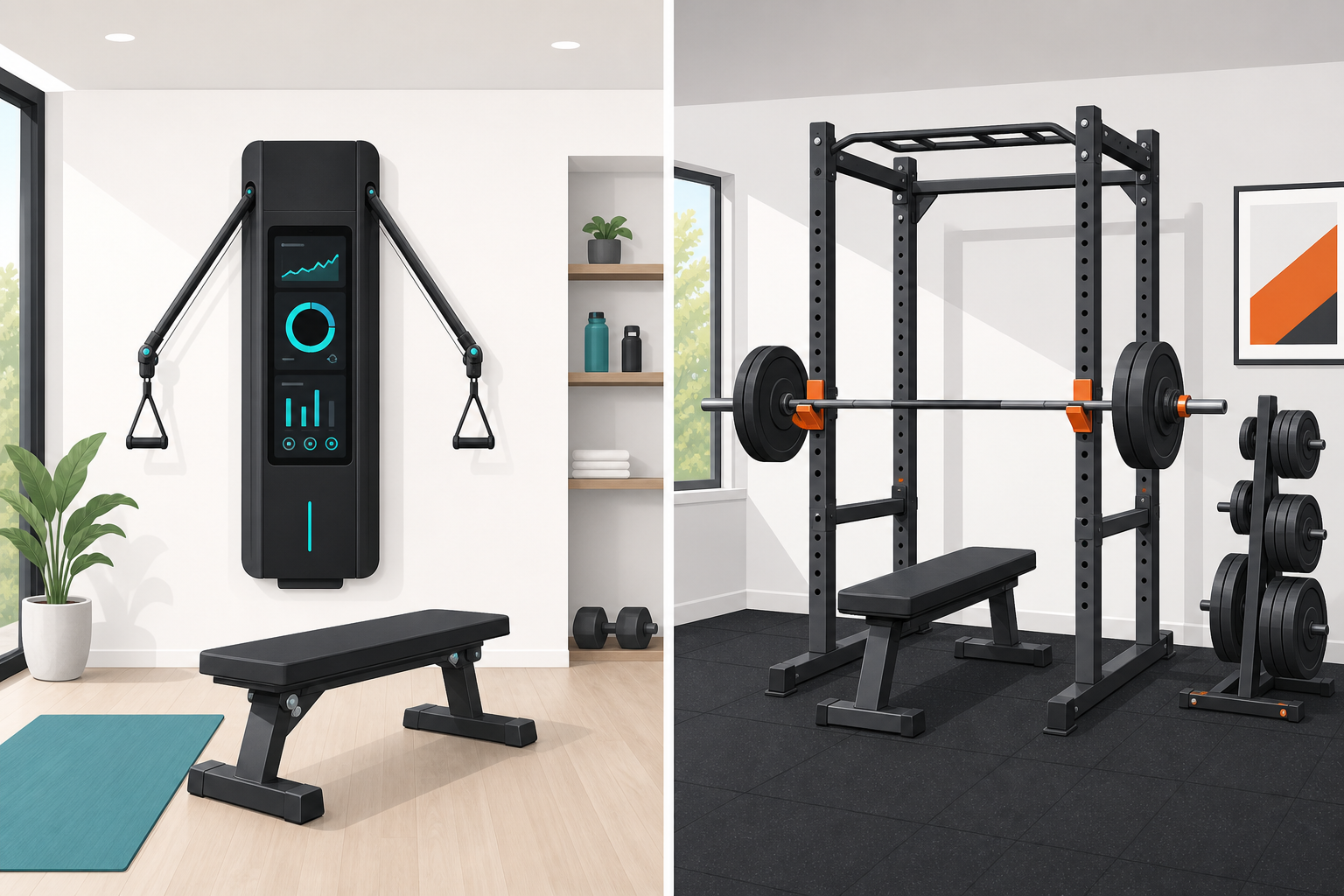
Most comparison guides stop at the sticker price. That is a mistake. The real question is: what happens after year three? Over five years, a Tonal 2 costs roughly $7,892 – more than five times a traditional barbell setup. That gap is not just about upfront cost. It is about the resistance ceiling, the upgrade path, and what you actually own at the end.
Here are the numbers that matter.
The Real Cost Over Five Years
The upfront sticker everyone sees: Tonal 2 at $4,295. Speediance Gym Monster at $3,199. A traditional barbell, rack, bench, and plates somewhere between $1,000 and $2,000. Those numbers are not wrong, but they are incomplete. Here is the same story over five years.
| Setup | Upfront cost | Monthly subscription | 5-year total |
|---|---|---|---|
| Tonal 2 | $4,295 | $59.95/mo (min 12 mo) | ~$7,892 |
| Speediance Gym Monster | $3,199 | None | $3,199 |
| Traditional barbell/rack/plates | $1,000–$2,000 | None | $1,000–$2,000 |
The Tonal subscription alone — $59.95 per month, minimum 12 months — adds up to $3,597 over five years. That is more than the cost of an entire traditional gym. Speediance avoids the subscription trap, but its $3,199 upfront is still higher than most barbell setups. The only way a smart gym becomes cheaper over time is if you would otherwise pay $65–$69 a month for a commercial gym membership for more than three years. For someone comparing equipment only, not gym vs. home, the traditional route wins on cost every time. Most guides skip this math because it is uncomfortable to say that the $4,295 machine actually costs nearly $8,000.
For a deeper breakdown of Tonal's year-by-year costs, see our total cost of ownership analysis. And if you are still weighing gym vs. home, this cost-benefit breakdown covers the full picture.
The Ceiling Nobody Warns You About
Tonal's digital resistance tops out at 250 pounds. Speediance maxes at 220. That is the combined total for both arms, not per-side. A barbell and a set of plates can load 600 pounds or more without the rack blinking.
The common defense — "It's enough for most people" — is technically true for upper-body isolation and moderate leg work. But it falls apart on compound lifts. A 150-pound person squatting their body weight for reps is already at 150 pounds. Add a few weeks of linear progression and you are knocking on 220. Deadlifts climb even faster.
I am not going to soften this: if you plan to train past the beginner stage on squats or deadlifts, digital resistance is a dead end. You will either stall, buy a separate barbell setup anyway, or abandon the movement entirely. Traditional steel has no such ceiling.
What You Actually Own
Traditional equipment retains 50–70% of its original value on the used market. Premium brands like Rogue, REP, and Titan hold 65–80%, according to resale data from ChestPressMachine. You can swap a barbell, add a cable attachment, sell a piece at a time, or pass it to a friend. After a decade, a $1,500 setup might still be worth $750.
Smart gyms have effectively zero resale after the warranty period. The hardware is proprietary, the accessories are proprietary, and the embedded software depends on a company that may change its terms, raise prices, or go out of business. You are not buying a gym; you are renting a platform.
- Traditional: Buy once, own forever, upgrade piece by piece. Compatible with any standard barbell, plate, or attachment.
- Smart gym: Buy the system, then lock into the ecosystem. No standard accessories fit. No resale market. Software support can be discontinued.
This is not a minor caveat. If you plan to keep your gym for more than five years, the smart gym is almost certainly a dead investment.
Space, Variety, and the Costs That Aren't on the Spec Sheet
Smart gyms win on footprint. Tonal 2 mounts to the wall: 21.5 inches wide, 5.25 inches deep. Speediance folds to 15 inches deep. A full power rack with plates needs 20–40 square feet of floor space and often a dedicated area.
But the space advantage comes with hidden costs. Tonal 2 requires professional installation — you cannot bolt it to drywall yourself. Speediance arrives assembled, but its unfolded footprint is 49 x 28 inches, plus enough room to move around it. Neither is truly furniture.
Exercise variety is more nuanced. A barbell and cables can produce any movement pattern you can think of. Digital resistance systems have a library of guided workouts, but the movement range is limited by the machine's geometry. You cannot do a barbell hip thrust, a landmine press, or a proper barbell row on most smart gyms. The trade-off: guidance vs. range.
Then there are the costs that do not appear on the spec sheet: proprietary accessories that cannot be replaced off the shelf, the risk of the company discontinuing support, and the software dependency that means you cannot train if the screen breaks. These are not minor caveats — they are central decision factors.
Put the Numbers Next to Your Priorities
I am not going to hand you a "best overall" pick. Instead, use the seven dimensions below. Rate each from 1 (does not matter) to 5 (dealbreaker). Score each option. The highest total that matches your priorities is your answer.
| Dimension | Smart gym score | Traditional score | Your importance (1–5) |
|---|---|---|---|
| Upfront cost | Low (high sticker) | High (low sticker) | ___ |
| 5-year total cost | Poor (subscription) | Excellent (one-time) | ___ |
| Resistance ceiling | Limited (220–250 lb) | Unlimited (600+ lb) | ___ |
| Exercise variety | Guided, limited range | Self-directed, full range | ___ |
| Footprint | Excellent (2–7 sq ft) | Large (20–40+ sq ft) | ___ |
| Upgradability | None (closed system) | Infinite (modular) | ___ |
| Resale value | Near-zero | 50–70% of original | ___ |
A few quick profiles to help you calibrate:
- Apartment dweller, wants coaching, has $3K+ budget: Smart gym makes sense. Accept the rental cost.
- Garage gym builder, plans to lift heavy, values long-term economy: Traditional. Start with a $1,500 setup and upgrade over a decade.
- Family space, shared use, no subscription budget: Traditional or Speediance (no sub). Avoid Tonal.
For a comparison of smart gyms against another category — weight-stack all-in-one machines — see our separate review.
The Bottom Line
There is no universal winner. The honest answer depends on which trade-offs you can live with.
If you want a no-compromise home gym that you can still use in 15 years, buy steel. The upfront cost is lower, the ceiling is higher, and the resale value means you are not throwing money away. If your space is tight and you value guided training, digital resistance can work — as long as you understand you are renting the experience, not owning it.
For more detail on Tonal-specific costs, read 5 Things to Know Before Buying a Tonal Home Gym. And if you are considering a weight-stack machine instead, our comparison of smart gyms vs. traditional weight-stack machines covers that fork.
This result comes from one real apartment under the stated conditions — it is a strong signal, not a guarantee your space will measure identically.
Builds this evidence supports
Cable Machine Alternatives That Save Space and Money
Compare the best cable machine alternatives for home gyms – from resistance bands and pulley systems to suspension trainers and compact digital units – and find the right option for your space and budget.
How to Choose a Compact Home Gym That Works for Your Space, Budget, and Noise Tolerance
This article provides a structured decision framework for apartment dwellers and small-space residents to match their specific floor footprint, noise sensitivity, and budget to the most suitable compact home gym strategy — whether that's an all-in-one machine, modular build, smart digital system, or band/bodyweight setup.
The Garage Gym Reality Check: What Equipment Actually Fits in a Single-Car Garage
Most garage gym guides assume a two-car space. This article uses real dimensions, real equipment footprints, and three layout templates to show what fits—and what doesn't—in a single-car garage (10x20 to 12x20 ft).
Spot something off?
If this result didn't match your own space, let us know — floor-damage and noise claims carry real deposit-risk consequences if we get them wrong.