
A Home Gym Workout Plan That Grows With Your Equipment
Most home gym workout plans assume you own every piece of equipment. This one adapts to whatever you actually have—bodyweight and bands, dumbbells and bench, or a barbell and power rack—and shows you when and how to progress to the next tier.
Before you start
- Equipment required
- None
- Assumes build tier
- No specific tier required
Most home gym workout plans lose people before the first set because they quietly assume a commercial gym: cable stack, leg press, full dumbbell rack, multiple benches, and enough floor space to make exercise selection irrelevant. A usable home gym workout plan starts somewhere less glamorous and more important: what is actually in the room today.
Use this as a 4-week framework, not a shopping list. Pick the tier that matches your current equipment, run the program as written, and progress only when the rule says the work has become repeatable. If you only need a single week to sample different equipment setups, the existing home gym workout plan by equipment tier is the faster place to browse. This one is for a 4-week progression you can repeat.
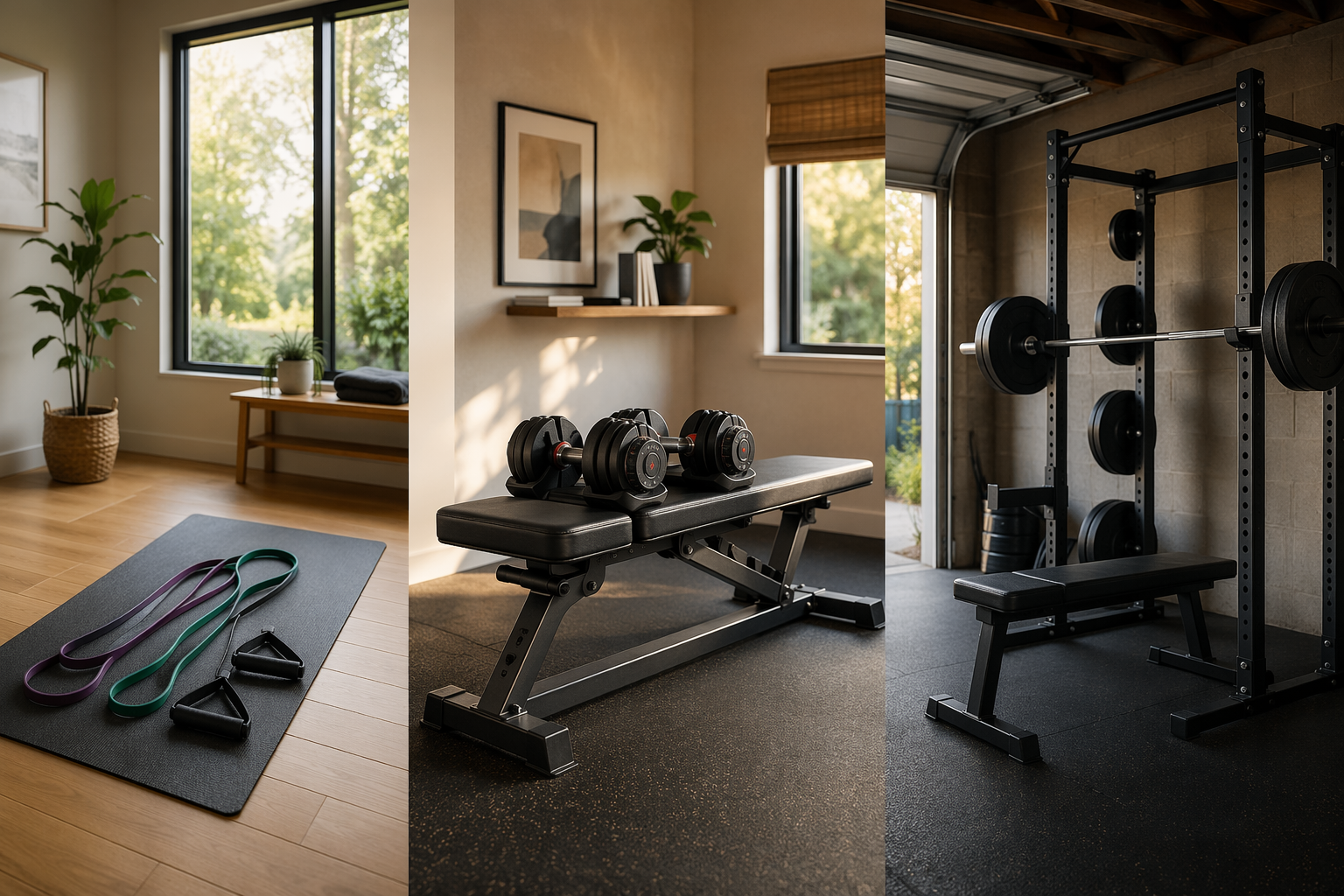
Choose Your Starting Tier
| Tier | Equipment you have | Best starting plan | Main progression method |
|---|---|---|---|
| Tier 1 | Bodyweight, resistance bands, maybe a mat | 3 full-body sessions per week | Add reps first, then band tension |
| Tier 2 | Dumbbells plus an adjustable or flat bench | 3 full-body sessions per week | Double progression: add reps, then add weight |
| Tier 3 | Barbell, plates, bench, and power rack | 4-day upper/lower split | Small linear load increases on main lifts |
If you are between tiers, start lower. A bodyweight plan you can perform cleanly beats a dumbbell plan where every pressing movement is limited by one missing bench. A dumbbell plan you can load consistently beats a barbell plan without a safe rack setup. For absolute beginners who still need help building the weekly habit around home training, start with how to start working out at home before worrying about fine progression rules.
The shared rule for all three tiers is simple: when you complete every prescribed set at the top of the rep range for the same workout across two consecutive sessions, progress the exercise. What changes is how you progress it. In Tier 1, that usually means more reps or more band tension. In Tier 2, it means earning the next dumbbell jump. In Tier 3, it usually means adding a small amount of weight to the bar.
Tier 1: Bodyweight and Bands
Tier 1 is for the person with a mat, a few bands, and maybe a door anchor. It is also the right tier if you technically own weights but cannot yet perform basic squats, hinges, push-ups, rows, and loaded carries with control. A 3-day full-body structure fits this stage well; the 4-week beginner plan from Nourish Move Love uses full-body sessions three times per week with built-in exercise modification tiers, which is the right basic shape for a home plan that has to meet people at different starting points.[1]
Bodyweight training can be productive for a practical early window, often around 8 to 12 weeks for many beginners, especially when bands or light dumbbells are added as the obvious next loading step. That is a planning range, not an expiration date. A person starting from low training history may progress longer; a stronger person may run out of useful lower-body loading sooner.
| Day | Workout | Exercises |
|---|---|---|
| Monday | Full Body A | Squat variation; incline or floor push-up; band row; glute bridge; dead bug |
| Wednesday | Full Body B | Reverse lunge; band chest press or push-up; band pulldown or row; hip hinge pattern; side plank |
| Friday | Full Body C | Split squat; pike push-up or elevated push-up; band row; single-leg glute bridge; carry or plank |
Use 2 to 3 sets per exercise. Start with 8 to 10 reps on harder movements and 10 to 15 reps on easier band or core movements. Leave a small margin on most sets. The goal is not to turn every session into a test; it is to make the same movements cleaner and more repeatable while gradually asking for more work.
- Week 1: Learn the movements and choose versions you can control.
- Week 2: Add 1 to 2 reps to exercises that stayed clean in Week 1.
- Week 3: Add a set to the main lower-body and upper-body movements if recovery is fine.
- Week 4: Keep the added work and try to reach the top of the rep range on each exercise.
For Tier 1 progression, add reps before adding resistance. Gold’s Gym describes progressive overload for beginners as increasing training demand over time through variables such as reps, weight, sets, or difficulty; at this tier, reps and band tension are the cleanest variables because the equipment is limited.[2][3]
When every set is at the top of the range for two sessions, make the movement harder. Use a stronger band, slow the lowering phase, move from incline push-ups toward floor push-ups, or change a squat into a split squat. If you need more detailed bodyweight exercise instruction, use the beginner bodyweight workout routine for exercise cues.
Tier 2: Dumbbells Plus Bench
Tier 2 is where many home gym owners live for a long time: adjustable dumbbells, a bench, maybe a pull-up bar, and enough space to train without moving furniture every set. This setup can support complete full-body training for many users for roughly 6 to 12 months, depending on starting strength, dumbbell range, and whether the lifter has enough load for legs and presses. LoadMuscle’s dumbbell-only programming emphasizes exactly the issue that matters here: dumbbell plans need a progression method that accounts for fixed jumps, not vague advice to “go heavier.”[4]
Three full-body sessions per week, with at least one rest day between them, is a strong default at this tier. Gold’s Gym, Healthline, and Planet Fitness all support beginner-to-intermediate structures that use repeated weekly sessions and progressive overload rather than daily random workouts.[2][5][6]
| Day | Workout | Exercises |
|---|---|---|
| Monday | Full Body A | Goblet squat; dumbbell bench press; one-arm dumbbell row; Romanian deadlift; plank |
| Wednesday | Full Body B | Reverse lunge; seated dumbbell overhead press; chest-supported row; hip thrust or glute bridge; side plank |
| Friday | Full Body C | Bulgarian split squat; incline dumbbell press; dumbbell row; dumbbell deadlift or RDL; loaded carry |
Use 3 sets for the main exercises. For most lifts, work in an 8 to 12 rep range. If an exercise is awkward or balance-limited, such as Bulgarian split squats, start closer to 8 reps and keep the first week conservative. For carries and planks, use time or distance instead of forcing them into the same rep scheme.
The Dumbbell Progression Rule
Dumbbells punish lazy progression rules. A 5 lb jump per hand can be reasonable for a goblet squat and enormous for a lateral raise, curl, or overhead press. LoadMuscle’s dumbbell-only framework uses double progression: first add reps inside a target range, then increase weight after the top of the range is achieved.[4]
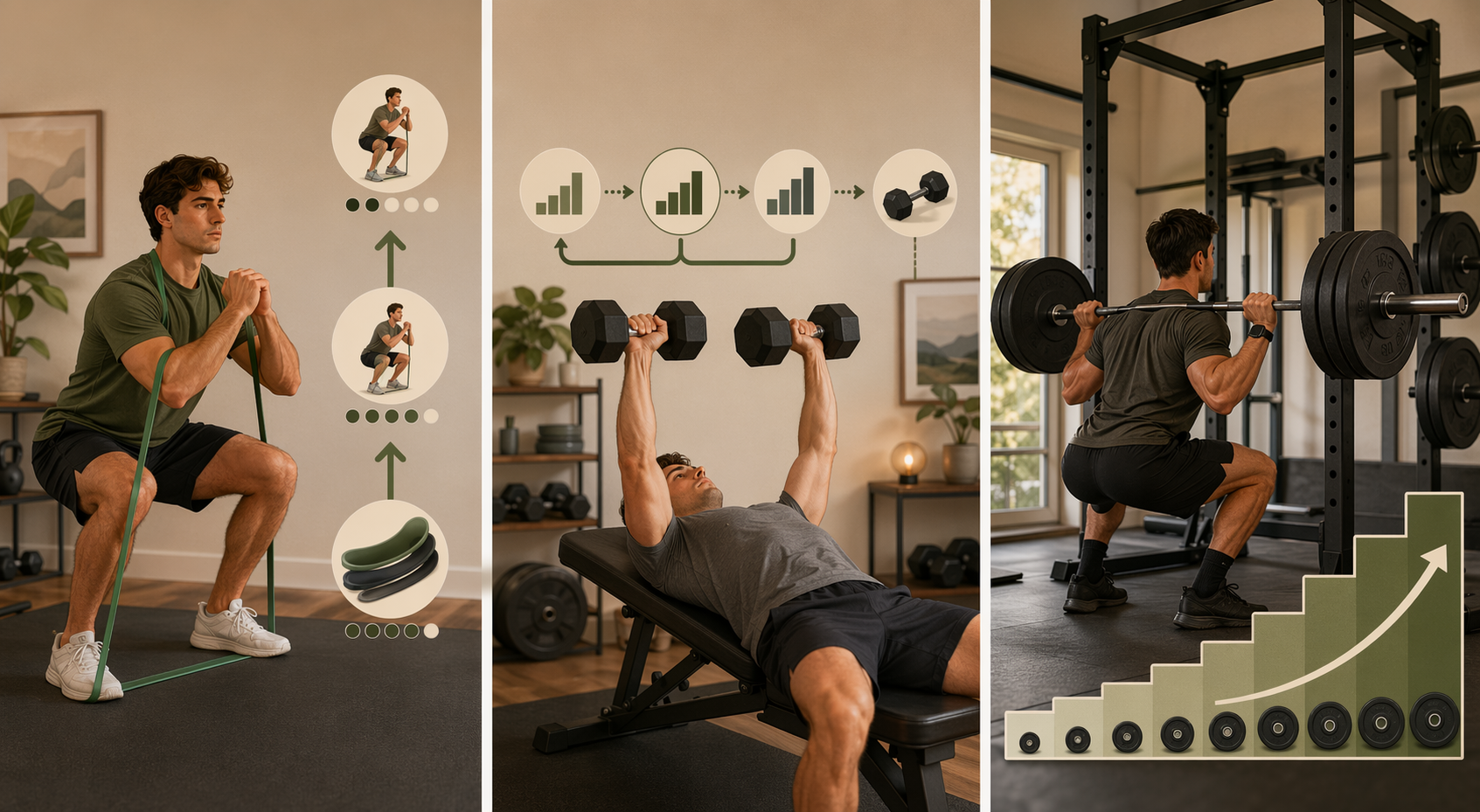
For this plan, that means an exercise stays at the same dumbbell weight until you can complete 3 sets of 12 reps in two consecutive appearances of that workout. Then you move up to the next available dumbbell and drop back toward 8 reps. If your adjustable dumbbells move in smaller increments, use them. If your dumbbells jump in 5 lb steps, expect some exercises to sit at the same weight longer.
| Session | Example dumbbell bench press result | Next move |
|---|---|---|
| Week 1 | 30 lb x 10, 9, 8 | Keep 30 lb |
| Week 2 | 30 lb x 11, 10, 9 | Keep 30 lb |
| Week 3 | 30 lb x 12, 12, 11 | Keep 30 lb |
| Week 4 | 30 lb x 12, 12, 12 | Repeat once before increasing |
| Next matching workout | 30 lb x 12, 12, 12 again | Move to the next dumbbell and restart near 8 reps |
The same rule applies unevenly across the body, and that is the point. Lower-body exercises may climb faster because the muscles are larger and the exercise options tolerate heavier loading. Shoulder raises, curls, triceps extensions, and some overhead pressing patterns may need more time at the same weight. For a deeper explanation of rep ranges, jumps, and stalled dumbbell lifts, use the full-body dumbbell workout progression framework.
How to Run the Four Weeks
- Week 1: Choose starting weights that let you land between 8 and 10 reps with clean form.
- Week 2: Add reps where possible, but keep the same exercise order and rest days.
- Week 3: Push main lifts toward the top of the range; leave isolation or smaller movements alone if the jump is not earned.
- Week 4: Confirm which lifts truly reached 3 sets of 12 across two appearances before adding weight.
If you have dumbbells but no bench, do not pretend floor pressing and supported rows are the same plan with one missing accessory. Use a no-bench variation such as the 3-day full-body dumbbell workout without a bench until a bench is actually part of the room. If you want to stay in Tier 2 longer, the 8-week full-body dumbbell workout program extends the same basic idea with more room for effort tracking.
Tier 3: Barbell, Bench, and Power Rack
Tier 3 changes the program because the equipment changes the loading problem. A rack, barbell, plates, and bench make squats, presses, deadlifts, and controlled load increases practical. Major Fitness uses barbell-based home gym programming with the traditional compound lifts at the center, which fits the shift from full-body dumbbell sessions toward a more standard split.[7]
Use a 4-day upper/lower split for this 4-week block. The point is not to copy a powerlifting template; it is to give the main barbell lifts enough attention while keeping accessory work manageable in a home rack setup.
| Day | Workout | Main work |
|---|---|---|
| Monday | Lower A | Back squat; Romanian deadlift; split squat; calf raise or loaded carry; core |
| Tuesday | Upper A | Bench press; barbell row; overhead press variation; pull-up or band pulldown; triceps or curls |
| Thursday | Lower B | Deadlift; front squat or lighter squat variation; hip thrust; lunge; core |
| Friday | Upper B | Overhead press; close-grip or incline bench press; row; pull-up or pulldown; rear delt or arm work |
Run the main barbell lifts for 3 to 5 working sets, depending on experience and recovery. Accessories can stay at 2 to 3 sets in the 8 to 12 rep range. Keep rest days between the harder lower sessions. A home rack makes heavier training possible, but it also makes setup choices matter: safeties need to be set, collars used, and failed reps planned for before the set starts.
Barbell Progression Is Smaller and More Direct
Barbells allow smaller, controlled jumps than most fixed dumbbell sets. That is why Tier 3 can use linear progression on the main lifts: when the prescribed sets and reps are completed with good form, add a small amount of weight the next time that lift appears. This works best on squats, bench press, deadlifts, and overhead press because those lifts can be loaded in repeatable increments.[7]
| Lift type | Progression target | When to hold steady |
|---|---|---|
| Squat and deadlift | Add a small plate increase after successful prescribed work | Bar speed slows sharply, depth changes, or form breaks |
| Bench press and overhead press | Use smaller jumps when available | Final reps require a major technique change |
| Rows, lunges, accessories | Use rep progression before loading aggressively | Grip, balance, or joint comfort becomes the limiter |
The common mistake after buying a rack is treating every exercise like a main lift. Do not linear-progress curls, lateral raises, and split squats with the same urgency as squats or presses. Accessories are there to support the main work and fill gaps. They still progress, but they do not need to drive the whole week.
When to Move Up a Tier
Do not upgrade because a calendar page turned. Upgrade when the current tier stops giving you a clean way to progress.
| Current tier | You are probably ready to move up when | The next tier unlocks |
|---|---|---|
| Tier 1 | You repeatedly reach the top of the rep range and stronger bands or harder bodyweight variations no longer solve the loading problem | External load, easier lower-body progression, better pressing and rowing options |
| Tier 2 | Your dumbbells are too light for legs or too large in jumps for upper-body progress, even after using double progression | Smaller loading jumps, heavier squats and presses, safer maximal strength work |
| Tier 3 | You have progressed the main barbell lifts and now need more specialization, conditioning, or accessory equipment for specific goals | More exercise variety, cables or machines if they solve a real training gap |
The cleanest upgrade signal is still the same one used inside the workouts: all prescribed sets and reps at the top of the range, across two consecutive sessions, with no meaningful form tradeoff. If that happens and the next progression option is not available inside your current equipment, the gear is now limiting the plan.
That does not mean the next purchase has to be large. A stronger band may extend Tier 1. A bench may turn an awkward dumbbell setup into a real Tier 2 plan. Microplates may make Tier 3 pressing progress less erratic. If the decision is still fuzzy, use a phased buying guide like what home gym equipment beginners should buy first, the broader beginner equipment framework, or a phased home gym equipment guide to connect the purchase to the training problem.
How the Three Plans Fit Together
The exercises change by tier, but the weekly logic stays steady: train the whole body, repeat movements often enough to improve them, and make progression observable. A home plan falls apart when every workout is novel, because the lifter never knows whether strength improved or the exercise simply changed.
| Training question | Tier 1 answer | Tier 2 answer | Tier 3 answer |
|---|---|---|---|
| How do I train legs? | Squats, split squats, bridges, lunges, bands | Goblet squats, RDLs, split squats, hip thrusts | Squats, deadlifts, front squats, barbell hinges |
| How do I train pressing? | Push-ups and band presses | Flat, incline, and overhead dumbbell pressing | Bench press and overhead press |
| How do I train pulling? | Band rows and pulldowns | One-arm rows, chest-supported rows, pull-ups if available | Barbell rows, pull-ups, pulldowns if available |
| How do I progress? | More reps, harder variations, more band tension | Add reps first, then dumbbell weight | Add small barbell loads after successful prescribed work |
If your goal changes before your equipment does, choose exercises around that goal without breaking the tier logic. A small-space lifter trying to emphasize muscle gain, strength, or conditioning can use a compact home gym by training goal to decide which equipment actually changes the program instead of just filling the room.
Start with the tier you can train today. Stay there while reps, band tension, dumbbell jumps, or barbell loads are still moving. Move up only when the next tier gives you a specific advantage the current one cannot: external load for bodyweight work, finer progression and heavier lifts beyond dumbbells, or more specialized tools after the rack has done its job. Equipment determines the exercises you can perform; those exercises determine the progression method; the progression method tells you when the next tier is useful.
References
- Free 4-Week Workout Plan for Women, Nourish Move Love
- 2026 Workout Plan: 12 Weeks to Build Strength, Habit & Consistency, Gold's Gym
- Progressive Overload Training 101, Gold's Gym
- Dumbbell Only Workout Plan (2026), LoadMuscle
- Workout Routines for Men, Healthline
- What is Progressive Overload? A Beginner's Guide, Planet Fitness
- 5 Day Home Gym Muscle Building Workout, Major Fitness
Don't have the gear this routine assumes? Find the build that covers it.
Wondering how much rest you need after this? Read our ACSM-cited recovery reference.
Questions about form, substitutions, or a correction? Leave it below.
Comments
Join the discussion with an anonymous comment.