
Most people start a home gym floor search by comparing rubber, foam, stall mats, PVC, turf, rolls, and tiles. That is backwards. Start with the heaviest thing that might hit the floor, and how it gets there.
A 20-pound dumbbell set used carefully in a spare room does not need the same surface as bumper plates dropped from overhead. A treadmill does not create the same problem as a deadlift. Yoga blocks and Pilates work do not need 3/4-inch rubber. Once you name the impact, most of the home gym floor decision stops being a product-grid problem and becomes a load-management problem.
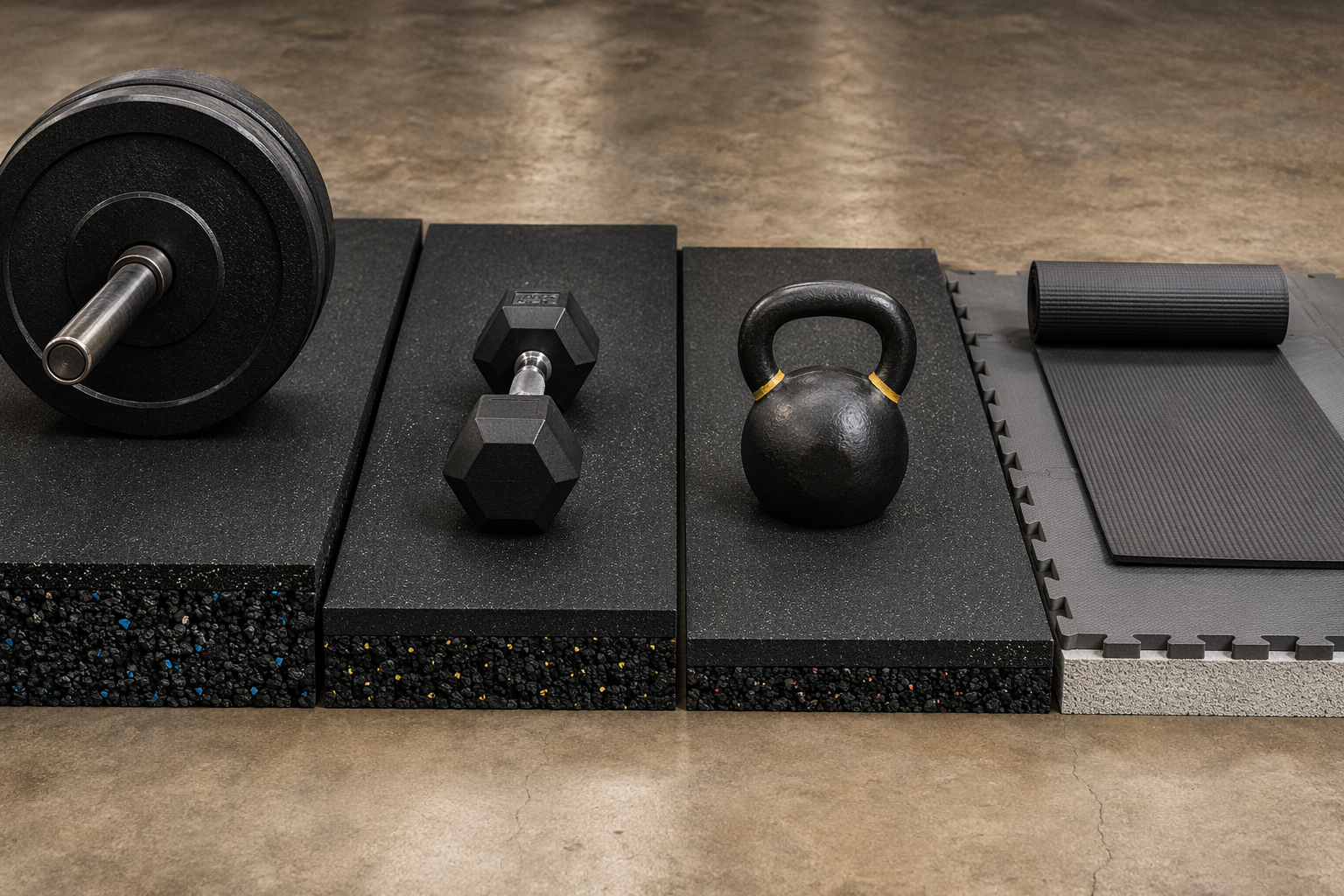
Start Here: What Actually Hits the Floor?
Use this as the first routing pass. It is not a brand recommendation, and it is not a promise that a floor can make bad lifting quiet. It is the practical minimum tier I would look at before caring about color, puzzle edges, or whether a product page says “commercial grade.”
| Primary training style | What the floor must survive | Best starting material | Minimum thickness tier | Where it starts to fail |
|---|---|---|---|---|
| Olympic lifting / CrossFit | Overhead drops, failed lifts, repeated bumper-plate impact | Dense rubber, 3/4-inch stall mats, or thick rubber rolls | 3/4 inch / about 19 mm | Apartment noise, cracked subfloors, seams opening, cheap low-density mats rebounding or shifting |
| General strength training | Deadlifts, dumbbells, controlled barbell contact | Rubber rolls, rubber tiles, or stall mats | 1/2 inch / about 12 mm minimum if anything is dropped | Routine heavy drops, thin rubber over weak subfloors, uncovered lifting zones |
| Mixed cardio + dumbbells | Burpees, HIIT, adjustable dumbbells, light kettlebells, occasional controlled drops | 8–10 mm rubber rolls or interlocking rubber tiles | 8 mm for general use; 10 mm if dumbbells get heavy | Overhead drops, storing heavy weights on foam, high-impact work in apartments |
| Bodyweight / yoga / Pilates | Knees, hands, stretching, light props | EVA foam, exercise mats, or thin rubber | 6–10 mm foam or mat-level cushioning | Kettlebell storage, dumbbell dents, dynamic lateral movement on loose tiles |
| Cardio machines only | Machine vibration, sweat, rolling feet, point loads | Equipment-specific mat or 6–8 mm rubber | Machine mat or 6 mm rubber; 8 mm for heavier equipment | Dropped weights, machines rocking on soft foam, vibration complaints below |
The uncomfortable part is that “shock absorbing” does not mean much without thickness, density, and impact type. An 8 mm rubber roll can be a good general-purpose surface and still be the wrong answer for missed snatches. Foam can feel great under knees and still take permanent dents from stored weights. The floor does not care what the product category is called. It cares about load, speed, and contact area.
If You Drop From Overhead, Build the Lifting Zone First
For Olympic lifting, CrossFit-style workouts, and any training where a loaded bar might come down from shoulder height or overhead, I would not start below 3/4 inch of rubber. That usually means horse stall mats, thick rubber rolls, or a platform design that combines rubber impact zones with a solid center surface.
Caine Wilkes, an Olympic weightlifter and former gym owner, recommends 1/2 inch as the minimum for any dropping and says he prefers 3/4 inch; his blunt explanation is, “I’ve cracked enough concrete floors to know it’s always better safe than sorry — if unsure, go thicker.”[1] That is the right instinct for this category. Overhead drops are not just heavier deadlifts. The bar has more travel, more speed, more bounce, and less forgiveness when the same spot takes repeated hits.
Noise is the second problem, especially in shared buildings. A 2025 paper by Frias et al. reported that rubber flooring significantly reduced vibration transmission from dropped weights, with 12 mm and thicker rubber showing meaningful reduction in multi-unit buildings.[2] That evidence is useful, but it should not be inflated into a guarantee that neighbors will be fine with overhead drops. The study supports the direction of the decision: thicker rubber matters. It does not turn an upstairs apartment into a weightlifting club.
Stall mats are the budget workhorse here. A common 3/4-inch horse stall mat from Tractor Supply is listed around $2.38 per square foot, which is far cheaper than many modular gym tiles at similar thicknesses.[3] The tradeoff arrives before the first workout: a 4-by-6-foot sheet can weigh about 100 pounds, the smell can be strong at first, edges may not be perfect, and unsealed floors can be vulnerable to staining.[3] None of that makes stall mats bad. It means they are a practical, heavy, imperfect solution rather than a tidy lifestyle accessory.
For overhead lifting, protect the impact zone before you spend money making the rest of the room look finished. If the budget only covers part of the room in 3/4-inch rubber, cover the lifting area first and leave the stretching corner for a mat. The worst purchase is a beautiful wall-to-wall surface that is too thin where the bar actually lands.
For Deadlifts and General Strength, 1/2 Inch Is the Real Starting Line
General strength training sits in the awkward middle. You may not be dropping loaded bars from overhead, but deadlifts, dumbbells, adjustable dumbbells, kettlebells, and benches create enough concentrated force to punish thin flooring. This is where 1/2-inch rubber, roughly 12 mm, becomes the sensible minimum if any weight is going to be dropped rather than set down.
Garage Gym Reviews reported that 73% of serious lifters in its testing preferred 12 mm or thicker flooring for routine barbell drops.[4] That is a preference sample, not a building-code rule, but it matches what shows up in real rooms: thinner flooring can survive careful lifting, while thicker rubber buys margin for fatigue, missed reps, and the person who says they “never drop weights” until the last set gets ugly.
This is also where subfloor matters. A concrete garage slab with 1/2-inch rubber is a different situation from old hardwood over a basement ceiling. Rubber spreads and damps impact; it does not erase physics. If the room below matters, or if the subfloor is questionable, step up in thickness, add a platform, or change the lifts you do there.
A good general-strength setup usually looks plain: 1/2-inch rubber tiles or rolls across the main training area, maybe 3/4-inch rubber or a deadlift platform where pulls happen. That hybrid approach is often better than overbuying thick rubber for the whole room or underbuilding the one spot that takes all the abuse.
Controlled Contact Is Not the Same as Dropping
If every rep is controlled, 8 mm rubber may be enough for a beginner strength corner. But the moment dumbbells are released from bench height, a deadlift is lowered fast, or plates hit the same seam repeatedly, the floor has moved into a different job. That is when 1/2 inch stops being overkill and starts being insurance.
Mixed Cardio and Dumbbells: 8 mm Rubber Is the Sweet Spot, With Limits
For the most common spare-room gym — some dumbbells, a bench, a kettlebell, resistance bands, burpees, maybe a rower or bike — 8–10 mm rubber is usually the cleanest answer. It is firm enough for lifting, durable enough for foot traffic, and not so thick that the whole room becomes expensive and hard to install.
The 8 mm tier is common partly because it lands in the middle of cost and performance. NHC Now lists 8 mm rubber rolls at about $2.17 per square foot from Flooring Inc, while noting that rubber rolls can require adhesive and cutting.[5] Garage Gym Reviews places 8 mm rubber around a $2.93-per-square-foot average and describes it as a common general-use thickness.[4] Prices move with shipping, region, and volume, but the pattern is stable enough: 8 mm rolls are often economical for coverage, while modular tiles cost more for easier installation.
Durability at this thickness can be better than beginners expect when the use case is right. Gray Matter Lifting reported that its 8 mm rolled rubber installation lasted more than 1.5 years with a car parked on it daily, but also noted that full glue-down was needed to prevent twisting.[6] That tells you something important: 8 mm rubber can handle sustained weight. It does not mean it is built for routine barbell drops from height.
Choose 8 mm rubber when your impacts are mostly controlled and spread across varied training. Move toward 10 mm if the dumbbells are heavy, if adjustable dumbbells might get set down hard, or if the room has a floor you really do not want to test.
Bodyweight, Yoga, and Pilates Do Not Need a Rubber Fortress
If your training is yoga, Pilates, mobility work, pushups, stretching, and light resistance bands, thick rubber is usually the wrong kind of spending. You need comfort, traction, and enough cushioning for knees, wrists, and floor work. EVA foam or a proper workout mat can make more sense than turning the room into a lifting platform.
The limit is weight. EVA foam is cheap and comfortable, often around $1–$3 per square foot, but it compresses under sustained loads.[4] Garage Gym Reviews tester Nicole Davis reported that 15 kg and 32 kg kettlebells left permanent imprints on ProsourceFit foam tiles after extended storage.[4] That is not a small cosmetic quirk if you were planning to park dumbbells, kettlebells, or a bench on foam all year.
Foam tiles also tend to separate or shift during dynamic movement more easily than rubber.[4] For slow mat work, that may not matter. For lateral hops, fast circuits, or dumbbell complexes, it starts to matter quickly.
If this is your route, go deeper on mat-level choices with Workout Mats for a Small Home Gym. The important line is simple: foam is for bodies and light gear, not for dropped or stored heavy weights.
Cardio Machines Need Stability More Than Cushion
A treadmill, bike, rower, or elliptical creates a different flooring problem. You are usually dealing with vibration, sweat, equipment feet, and the need to keep the machine stable. An equipment-specific mat or 6–8 mm rubber is normally enough unless the machine is unusually heavy or the floor below is sensitive.
Do not put a heavy cardio machine on soft foam and expect it to feel better. Too much squish can make a machine rock, dig in, or feel less stable. Rubber is boring here in the best way: it protects the finish floor, gives the machine a grippy base, and cleans up more easily than carpet.
If the machine sits in an apartment, vibration becomes a neighbor problem rather than just a floor problem. That is where a renter-specific approach matters more than chasing a generic noise-reduction percentage. The more useful next read is Home Gym Flooring for Apartments: A Renter's Guide.
After Thickness, Choose the Format You Can Actually Install
Once the thickness tier is right, the format decision gets easier. Rolls, tiles, stall mats, foam, PVC, and turf are not equal answers to the same question. They solve different installation and use problems.
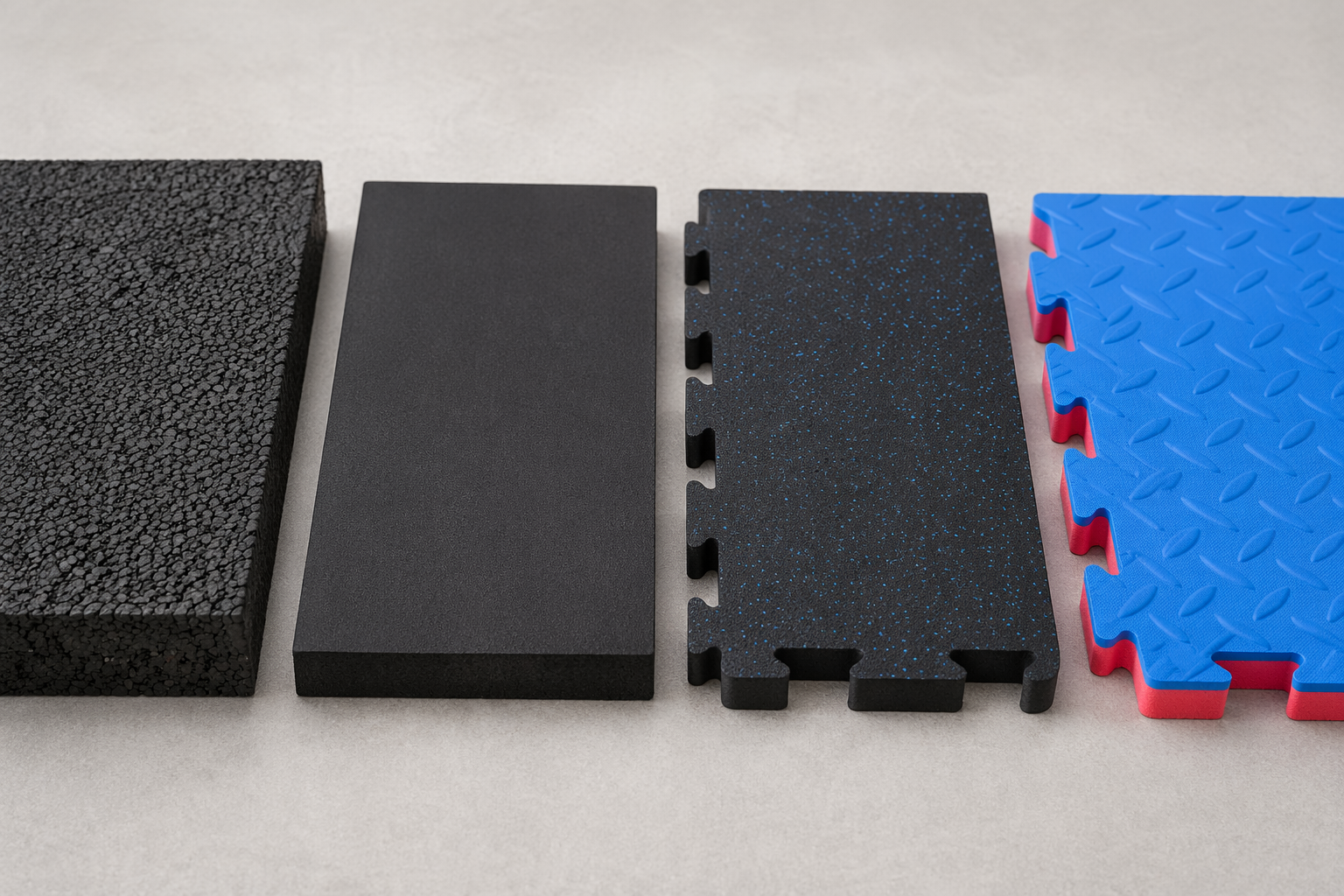
| Format | Best use | Main tradeoff |
|---|---|---|
| Rubber rolls | Wall-to-wall coverage, garages, larger rooms, mixed training | Clean look and good value per square foot, but cutting and adhesive can be annoying |
| Interlocking rubber tiles | DIY installs, small rooms, renters who may move the floor later | Easier to handle than rolls, usually higher material cost |
| Horse stall mats | Budget thick flooring for lifting zones and garages | Very cost-effective at 3/4 inch, but heavy, odorous at first, and less refined at seams |
| EVA foam | Yoga, Pilates, mobility, playroom-style bodyweight areas | Comfortable and cheap, but dents under weight and is poor for drops |
| PVC interlocking tiles | Light modular coverage where heavy lifting is not the goal | Easy to handle, but lower impact isolation than thick rubber |
| Turf | Sled work, carries, athletic drills | Useful as a training lane, not a substitute for impact flooring under weights |
Rubber rolls make sense when you want a durable surface over a larger area and you are willing to deal with layout, cutting, and sometimes adhesive. Interlocking tiles are friendlier for one-person installation and awkward rooms, but that convenience costs money. NHC Now lists Living.Fit interlocking tiles in the $5–$10-per-square-foot range, compared with lower per-square-foot benchmarks for many 8 mm rolls.[5]
Stall mats are the opposite of fussy. They are thick, cheap for the protection they provide, and miserable to carry through a tight side door. They can be the best buy for a garage lifting zone and the wrong buy for a third-floor apartment where smell, weight, and imperfect seams become daily irritations.
PVC tiles and turf belong in narrower lanes. Garage Gym Reviews notes that 6.5 mm PVC interlocking tiles are a light modular option but provide only 8–10 points of IIC improvement, compared with 20–25 for 12 mm rubber.[4] Treat that as a clue, not a universal lab promise: light modular flooring is easier to move, but thick rubber does more work when impact transmission matters.
For a deeper head-to-head after you know your route, use Which Gym Floor Mat Should You Choose? Rubber vs Foam vs Stall Mats. Material comparison is useful once it is answering a specific training problem.
Apartment, Budget, and Durability Exceptions
Apartments deserve their own warning because the person paying for the flooring is not always the person who suffers the noise. Rubber helps, and thicker rubber helps more, but impact sound can still travel through structure. Vendor noise claims should be read carefully unless they are tied to a test method and comparable assembly. The Frias et al. proceedings are more useful than a manufacturer percentage because they specifically looked at vibration transmission from dropped weights, while still carrying the limitation of a conference-proceedings format rather than a full long-term residential study.[2]
Budget can also override the neat version of the framework. If you cannot afford 3/4-inch coverage for a whole garage, do not buy thin flooring everywhere and hope. Put thicker material where weights land, use cheaper coverage elsewhere, or reduce the lifts you do at home. A partial good floor beats a full-room underbuilt floor.
Long-term durability data is thinner than product pages make it sound. Published home-gym examples often cover one or two years, not five or ten. Gray Matter Lifting’s 1.5-plus-year rolled-rubber example is useful because it describes real use, including daily car parking and the need for glue-down, but it is still one installation rather than a universal lifespan claim.[6]
If your decision also has to juggle room size, moving plans, and budget ceilings, How to Choose Home Gym Flooring Based on Your Training, Space, and Budget is the broader filter. If flooring is only one part of making a small apartment work, Compact Home Exercise Equipment: A Constraint-Based Guide for Apartment Dwellers is the better next stop.
The Practical Buying Rule
Buy for the worst impact your floor will actually see, not for the material that looks best in a product grid.
If weights drop from overhead, start at 3/4-inch rubber or a proper platform. If you deadlift or use heavy dumbbells, treat 1/2-inch rubber as the real safety line. If you train with mixed cardio and controlled dumbbell work, 8–10 mm rubber is usually the sensible middle. If you do yoga, Pilates, and bodyweight work, foam or a workout mat is fine as long as you do not ask it to store kettlebells. If you only need a treadmill or bike base, use a machine mat or thin rubber and keep the machine stable.
The right home gym floor is not the thickest floor. It is the floor that matches the thing you drop, the room underneath it, and the consequences you are not willing to repair later.
References
- How Thick Should Gym Flooring Be, Garage Gym Reviews.
- Impact noise reduction in gyms with different rubber flooring, International Congress on Noise Control Engineering, 2025.
- Tractor Supply 3/4-inch horse stall mat product listing.
- Expert-Tested: The Best Home Gym Flooring Options (2026), Garage Gym Reviews.
- Best Flooring Options for Home Gyms: Material, Cost & Installation, NHC Now.
- The BEST Home Gym Flooring In 2026, Gray Matter Lifting.
Comments
Join the discussion with an anonymous comment.