
A Chrissy Metz Weight Loss Workout Plan You Can Do at Home
A small-space weekly plan built from the verified core of Chrissy Metz's reported weight-loss approach — daily walking plus two to three full-body strength sessions — with three equipment tiers to fit your budget. It's an adaptation of the approach she described, not her actual trainer's program.
- Equipment tier required
- none
- Duration
- 20 min
- Difficulty
- beginner
- Target area
- full body
- Space footprint needed
- small-space
- Noise level
- low
If you searched for a chrissy metz weight loss workout plan, the first useful answer is also the least glamorous one: her actual trainer’s program has not been made public. What can be adapted at home is the verified pattern around her public comments — walking, consistent strength work, and the kind of day-after-day follow-through that does not require a celebrity schedule.
The source boundary matters. The one quantified exercise detail from Metz’s earlier self-reported phase is 20 minutes of daily walking, discussed alongside a self-reported 2,000-calorie diet; that is context, not a prescription for your calories or your medical situation. [1] Later coverage of her 2025 milestone pointed to consistent strength training and lifting with a supportive Nashville trainer, without publishing a full workout split, exercise list, weekly volume, or trainer name. [2]
For the fuller source audit, use What Chrissy Metz’s Diet and Workout Routine Actually Is. This article does the next job: turning the verified core into a small-space plan you can run without inventing a secret celebrity routine.
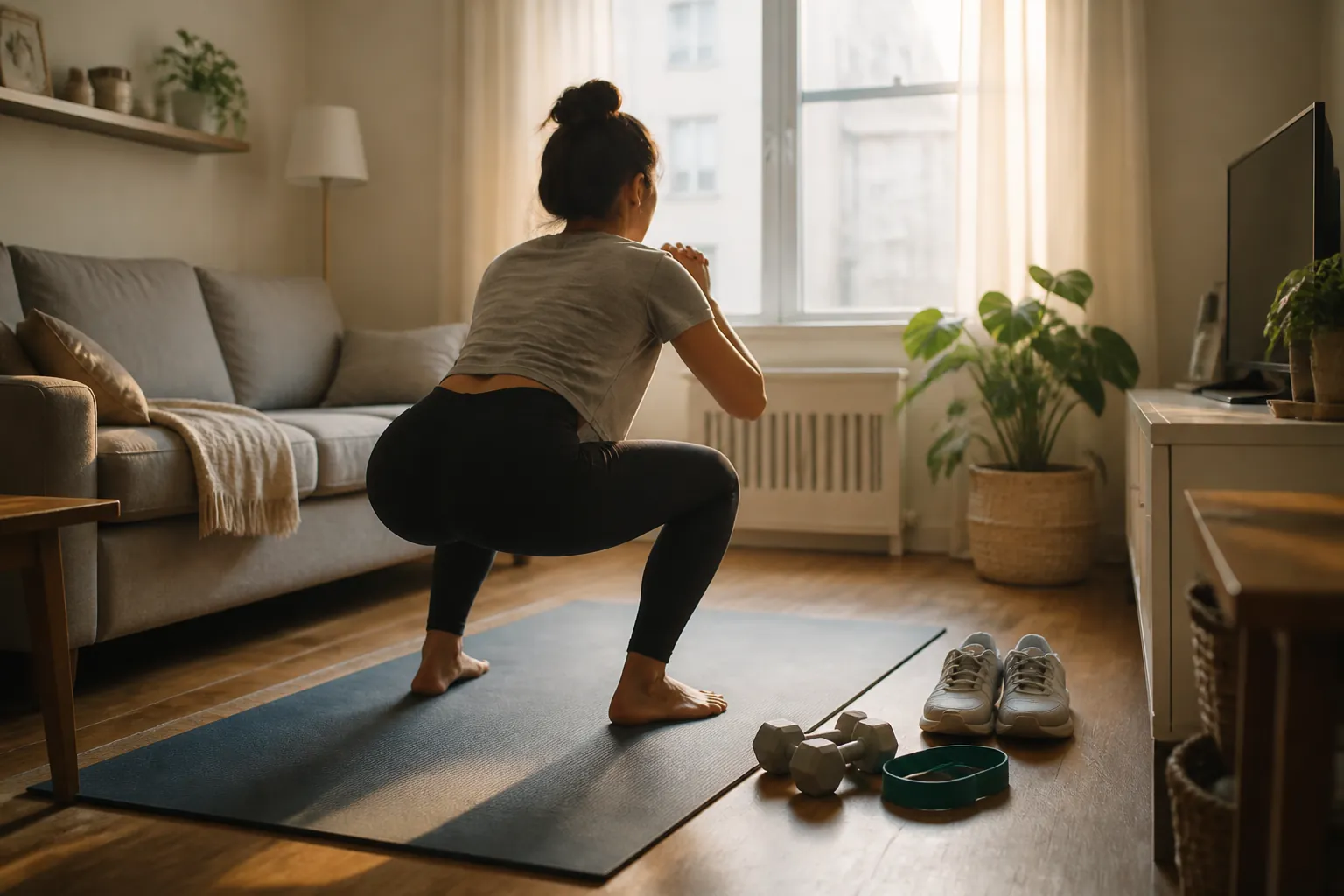
The home version: daily walking plus two or three full-body strength days
The plan below uses Metz’s public pattern as a starting point, then keeps the parts that transfer cleanly into a living room: walking most days, strength training the whole body two to three times per week, and progressing slowly enough that you can repeat it. Metz has also described the process as something you “chip away just a little bit every day,” which is more useful for a beginner than any fake five-day celebrity split. [3]
If you want to match the only public walking number exactly, make the walk 20 minutes. If your current baseline is lower, use 10 minutes and build. The important part is that walking is the low-friction daily anchor, while strength training is where you preserve and build usable muscle.
| Day | Workout | Small-space note |
|---|---|---|
| Monday | Strength A + easy walk | Use this as the first full-body day. If Monday is your hardest day to start, a short version still counts. |
| Tuesday | Walk only | Indoor loop, hallway laps, treadmill, walking pad, or outdoor route. |
| Wednesday | Strength B + easy walk | Same movement patterns as Monday, slightly different exercises or angles. |
| Thursday | Walk only + optional mobility | Keep it quiet and boring on purpose. |
| Friday | Optional Strength C + easy walk | Do this if recovery is good. Skip it if the first two strength days were enough. |
| Saturday | Longer easy walk or split walk | One longer walk, or two short walks if your schedule is chopped up. |
| Sunday | Walk + reset | No punishment workout. Prepare shoes, bands, dumbbells, or a mat for Monday. |
That third strength day is optional because beginners often need the option more than they need the extra session. Two well-done full-body workouts plus daily walking will beat a perfect-looking plan that collapses by Wednesday.
For a 20-minute Monday version that already fits bodyweight, bands, and dumbbells, use Monday Workout Motivation Starts With 20 Minutes at Home. For walking structure when the weather, neighborhood, or schedule is unhelpful, use the indoor options in Walkathon Training Plan You Can Do at Home.
Use the same workout shape at every budget
The equipment tier changes the tool, not the promise. A band row, a one-arm dumbbell row, and a heavier adjustable-dumbbell row all train a pull. The more expensive setup may make progression easier, but it does not create a different category of result by itself.
Each strength day should cover five patterns:
- Squat or sit-to-stand
- Hip hinge or glute bridge
- Push
- Pull
- Carry, march, or core stability
Start with two sets of each exercise. Most beginners do well with 8 to 12 controlled reps on strength moves and 20 to 40 seconds on core or carries. Stop each set with a couple of clean reps left; the goal is repeatable work, not proving something to the floorboards.
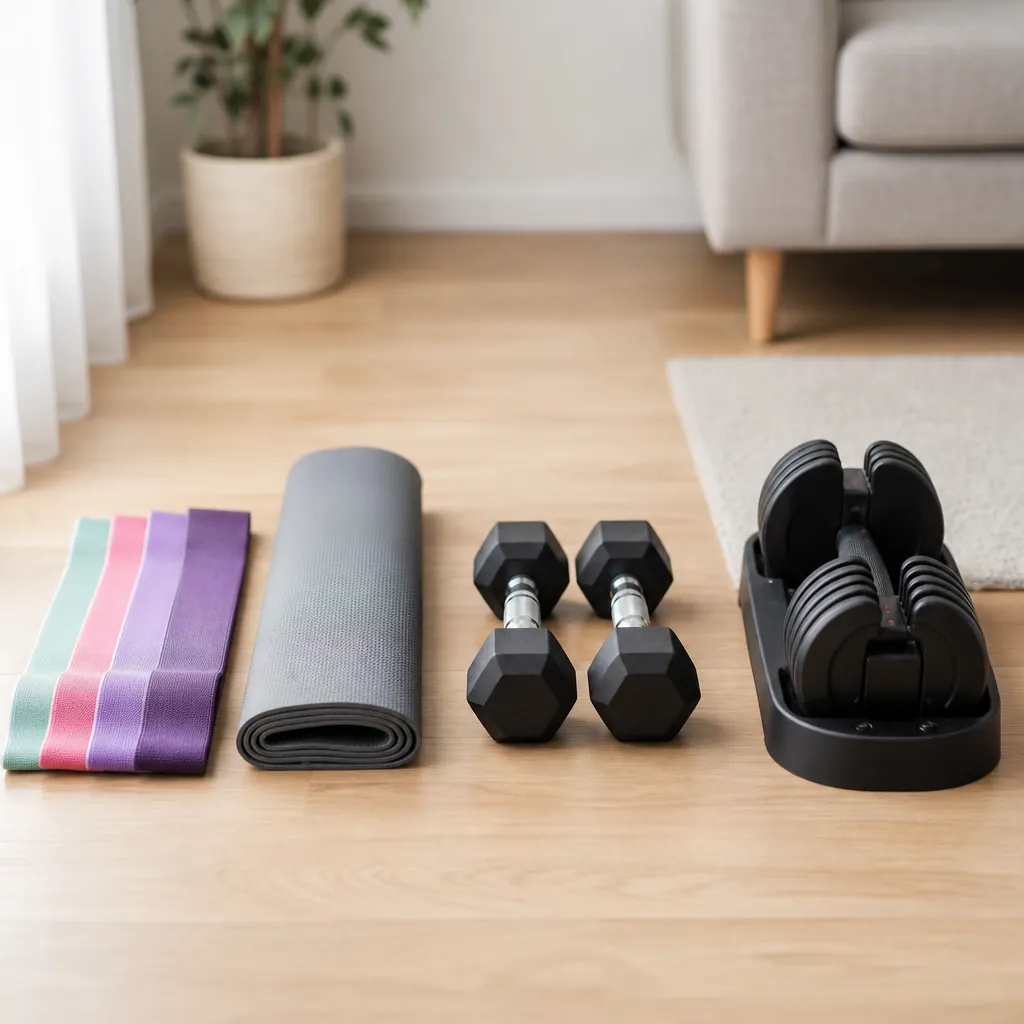
$0–100 tier: bodyweight, bands, and furniture that does not wobble
This is the most honest starting tier for a small apartment. You need a mat if your floor is hard, a long resistance band if you have one, and a chair, couch edge, or countertop that can safely support light balance work. Do not use a rolling office chair for anything that asks you to brace.
| Pattern | Exercise | How to make it apartment-safe |
|---|---|---|
| Squat | Chair sit-to-stand or slow bodyweight squat | Tap the chair lightly instead of dropping onto it. |
| Hinge | Glute bridge or band good morning | Use bridges if hinge form feels confusing. |
| Push | Incline push-up on counter or sturdy table | Higher hands make it easier and quieter. |
| Pull | Band row | Anchor only to something stable; if you cannot anchor safely, loop the band around your feet while seated. |
| Core | Dead bug or standing band press-out | Choose dead bugs if your neighbors hear every footstep. |
A sample Strength A at this tier is simple: chair sit-to-stand, glute bridge, incline push-up, band row, dead bug. Strength B can be bodyweight split squat to a short range, band good morning, wall push-up or incline push-up, seated band row, and slow marching in place.
The mistake at this tier is turning every move into cardio because there is no heavy weight. Slow the lowering phase, pause briefly at the hardest safe point, and use clean reps. If the exercise becomes bouncy, loud, or sloppy, it is no longer the better version.
$100–300 tier: a pair or small set of dumbbells
Dumbbells make the full-body days easier to progress without taking over the room. They also remove some of the awkwardness of band anchoring, which is where many apartment workouts quietly become doorframe experiments.
| Pattern | Exercise | Small-room setup |
|---|---|---|
| Squat | Goblet squat to chair or box | The chair gives a depth target without needing a rack. |
| Hinge | Dumbbell Romanian deadlift | Keep the weights close to your legs and move slowly. |
| Push | Dumbbell floor press | No bench needed; the floor limits shoulder range. |
| Pull | One-arm dumbbell row supported on chair or couch | Keep the support stable and avoid twisting. |
| Carry/core | Farmer hold, suitcase hold, or slow suitcase march | March in place instead of pacing if space is tight. |
A good dumbbell Strength A is goblet squat, dumbbell Romanian deadlift, floor press, one-arm row, and suitcase hold. Strength B can be supported split squat, glute bridge with a dumbbell on the hips, standing dumbbell press if your shoulders tolerate it, supported row, and slow farmer march.
If you already own dumbbells and want a more muscle-focused home template, The Rock-Inspired Home Workout for Muscle Growth uses the same practical dumbbells-and-bands world without pretending that a home setup is a commercial gym.
$300–800 tier: compact adjustable dumbbells
Adjustable dumbbells are useful when the lighter tier stops giving you enough room to progress. They are not mandatory. Their main advantage is boring and valuable: you can add load in small jumps without storing a rack of separate weights.
| Pattern | Exercise | Why the adjustable tier helps |
|---|---|---|
| Squat | Goblet squat, front-loaded squat, or supported split squat | You can choose a load that is challenging without changing the movement. |
| Hinge | Heavier dumbbell Romanian deadlift | The hinge often outgrows very light dumbbells quickly. |
| Push | Dumbbell floor press or low-incline press if you own a bench | Load can rise while the setup stays compact. |
| Pull | One-arm row or chest-supported row if you have a bench | Rows usually benefit from more load options. |
| Carry/core | Suitcase carry, suitcase deadlift, or farmer hold | Heavy holds train grip and trunk stability without jumping. |
At this tier, the temptation is to make the plan more complicated because the equipment looks more serious. Resist that. Keep the same weekly rhythm and increase load only when your form and recovery justify it.
Quiet-floor substitutions that actually change the workout
A small-space plan fails fastest when it asks for movements that belong in a garage, studio, or very forgiving downstairs-neighbor situation. You do not need jump squats, burpees, high knees, or fast mountain climbers to make this approach work.
| If the plan says | Use this instead | What you keep |
|---|---|---|
| Jump squat | Slow squat to chair with a pause | Leg strength without impact |
| Reverse lunge | Supported split squat in a short range | Single-leg work without stepping into furniture |
| Burpee | Incline plank step-back | Upper-body bracing without the floor slam |
| Mountain climber | Dead bug or slow plank shoulder tap | Core control without foot noise |
| High knees | Low marching with deliberate arm swing | Warm-up rhythm without pounding |
| Box jump | Step-up to a low, stable step | Leg drive without landing noise |
For more strength swaps that respect leases, floors, and limited square footage, use Can You Powerlift at Home in a Small Apartment?. The lifts are different, but the apartment problem is the same: the best exercise is the one you can repeat without turning your home into a conflict zone.
How to progress without turning this into a fake celebrity challenge
Run the plan in four-week blocks. The first block is for learning the movements and proving the schedule is survivable. The second block is where you ask for a little more work.
| Weeks | Strength work | Walking |
|---|---|---|
| Weeks 1–2 | Two full-body days, two sets per exercise | Daily easy walk at a duration you can repeat |
| Weeks 3–4 | Add a third set to one or two exercises, or add the optional third strength day | Add a few minutes to one or two walks if recovery is good |
| Weeks 5–6 | Increase band tension, dumbbell load, or reps on the easiest moves | Keep most walks easy; avoid making every walk a test |
| Weeks 7–8 | Keep two hard-enough strength days and one optional lighter day | Use one longer walk or split walk on the weekend |
A simple rule works better than a motivational overhaul: when you can complete all sets at the top of the rep range with clean form and normal recovery, make the exercise slightly harder next time. That can mean a heavier dumbbell, a stronger band, a slower lowering phase, or a harder variation. Change one thing at a time.
If a week goes badly, do not restart the whole plan. Do the next scheduled walk. Then do the next scheduled strength day at one set less. The calendar does not need drama; it needs the next ordinary session.
If you prefer a more general eight-week bodyweight ramp before buying equipment, Build a Heart-Healthy Home Workout Routine in 8 Weeks is the cleaner place to start.
What this plan does not borrow from Metz’s public story
It does not borrow her calories. The 2,000-calorie detail was self-reported in a specific earlier phase and should not be converted into a universal target. [1] It also does not merge the two separate public “100 lb” references into one neat timeline: the earlier account and the 2025 milestone coverage are separate pieces of reporting, and treating them as one continuous program would make the story cleaner than the record. [1][2]
It does not claim she trained five days a week. That detail circulates online, but it is not supported by the reliable reporting used for this home translation. It does not name her trainer or her medication, either, because those details have not been publicly disclosed in the sources used here.
It also does not treat Pilates as the hidden engine of the plan. Metz publicly discussed taking her first-ever Pilates class on July 3, 2025, which is interesting as a confidence and movement update, not enough to rebuild this routine around Pilates. [4]
GLP-1 context belongs in the medical lane
Metz has more recent public updates, including August 2026 reporting that she has used a GLP-1 medication and continued trainer-guided strength work. [5][6] That does not turn this article into medication advice. If your weight loss involves a GLP-1 drug, perimenopause symptoms, diabetes care, blood pressure medication, a history of disordered eating, or any other medical concern, your doctor or registered dietitian belongs in the conversation.
The training principle still travels: strength work is commonly emphasized in GLP-1 fitness guidance because preserving muscle matters during weight loss, and accessible medical coverage has highlighted strength training recommendations in that context. [7] For more specific home programming around that situation, use The Full Home Workout Week for GLP-1 Weight Loss, Home Workout Tips to Protect Muscle on GLP-1 Weight Loss, or GLP-1 Diet and Exercise Plan for Fat Loss, Not Muscle Loss.
The version worth doing
The most defensible Chrissy Metz-inspired home plan is not a reconstruction of a workout no one has published. It is daily walking, two to three full-body strength sessions, quiet substitutions where your apartment demands them, and a budget tier that fits your actual floor, storage, and attention span.
If you like celebrity-to-home translations when they stay honest about the source material, How to Do Mick Jagger’s Longevity Workout at Home follows a similar idea: keep the verified pattern, discard the fantasy, and make the routine livable.
References
- Chrissy Metz opens up about weight loss — TODAY, February 2017
- Chrissy Metz Shows Off Her 100-Lb. Weight Loss — People
- Chrissy Metz's Weight Loss: What to Know About Her Health Journey — People
- Chrissy Metz on Pilates and Facing Her Fears — Woman's World
- Chrissy Metz reveals GLP-1 use for weight loss — TODAY, August 2026
- Chrissy Metz Says She Is Taking a GLP-1 — People
- Strength Training for People Taking GLP-1 Drugs — JAMA
What a small equipment investment adds
We don't have a build tagged to this exact tier yet. Browse all builds.
How often should you repeat this?
See our recovery and rest reference for citation-anchored rest-interval guidance.
Spot something off?
Tell us if a movement, tier assumption, or duration didn't match your experience.