
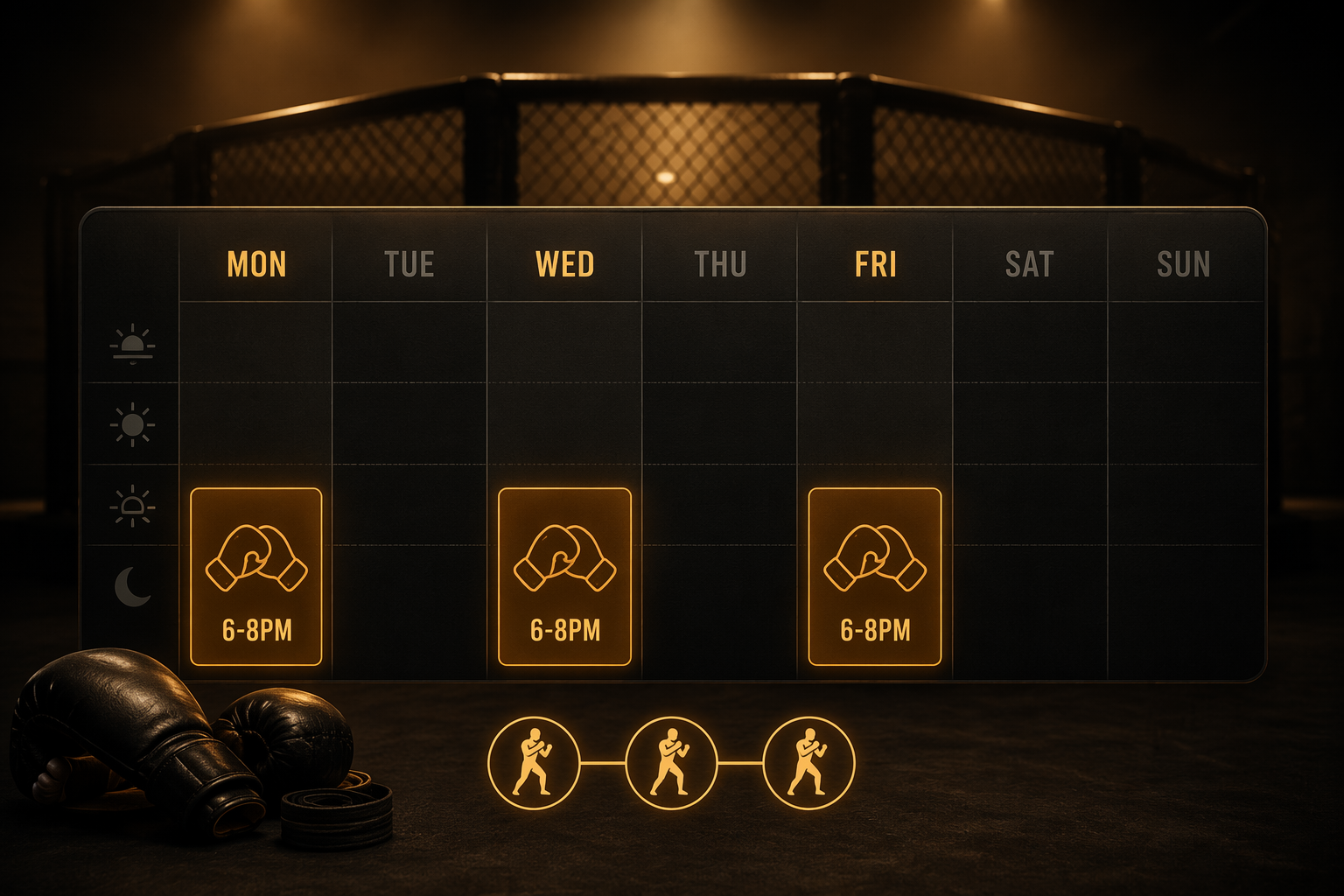
The first thing worth noticing about the RJ Harris workout routine is not a secret exercise, a brutal finisher, or some six-day fighter camp fantasy. It is the calendar: Harris reportedly trains Monday, Wednesday, and Friday from 6 to 8 p.m., while also working full-time as a power lineman in Ohio.[1][2]
That is the part that makes the story useful. A UFC heavyweight winning a debut is impressive. A UFC heavyweight protecting three after-work training blocks while spending his workdays climbing poles, hauling equipment, and doing physical labor is a different kind of impressive. It sounds less like a lifestyle brand and more like the kind of schedule an adult might actually have to negotiate.
This is RJ Harris the UFC heavyweight, nicknamed “The Hammer,” not the radio personality with the same name. The fighter’s public profile is still thin compared with long-established UFC names, so the honest version of his training story has to stay at the level the sources support: his schedule, his MMA gym setting, his job load, his weight-class shift, and the fight skills that show up in his record and scouting notes.
The Confirmed RJ Harris Training Model
The confirmed model is simple, but not easy: three formal MMA sessions per week, each about two hours, layered on top of a full-time lineman job. Harris has trained at Sprawlin & Brawlin MMA in Zanesville, Ohio, while working for Thayer Power & Communications.[2]
| Part of the week | What is publicly supported | What it likely means for training |
|---|---|---|
| Monday, Wednesday, Friday evenings | Reported 6–8 p.m. MMA training blocks | The main structured work: skill practice, wrestling, striking, grappling, conditioning, and coached fight preparation |
| Workdays | Full-time power lineman job | A large physical baseline: climbing, carrying, bracing, gripping, and moving under fatigue |
| Off days from MMA | No public detailed plan | Recovery has to matter because the job is not passive rest |
| Strength programming | Specific sets, reps, lifts, and periodization are not public | Any exact “RJ Harris workout plan” would be guesswork |
That last line matters. There is no verified public spreadsheet showing Harris’s exact lifts, rounds, intervals, sparring volume, or progression scheme. If someone claims to know his precise bench sets, assault bike intervals, or weekly periodization without sourcing it, they are filling in gaps.
What is clear is that three days does not mean three casual gym visits. A two-hour MMA practice can include warmups, drilling, live wrestling, clinch work, striking rounds, grappling exchanges, conditioning, coaching corrections, and partner resistance. That is a full-body demand before you even count the job.
Why Three Days Can Work When the Other Days Are Not Sedentary
For a desk worker, three workouts a week may be the whole training dose. For Harris, the three MMA sessions sit on top of work that already asks something from his legs, back, grip, trunk, and shoulders. A lineman’s day is not the same as programmed strength training, but it can function as general physical preparedness: repeated exposure to awkward carrying, climbing, stabilizing, and moving while tired.
That does not make the job a magical fourth, fifth, and sixth workout. Physical labor builds capacity in some ways and drains it in others. A hard workday can arrive at practice as conditioning, but it can also arrive as fatigue, sore hands, a tight low back, or one more recovery bill that still has to be paid.
This is where the three-day rhythm starts to make sense. Monday, Wednesday, and Friday give him repeated exposure to fight training without pretending the rest of the week is empty. The blank days on the gym calendar are not wasted; they are where the body either absorbs the work or starts falling behind.
For home fitness readers, the lesson is not “train less.” It is to count the stress you already carry. A nurse walking a hospital floor, a delivery driver loading packages, a parent doing manual house projects after work, and a lineman climbing poles do not all start from the same recovery budget. The useful routine is the one that survives your real week.
Harris Had a Fight Base Before He Had a UFC Schedule
Harris’s rise moved quickly: Toughman boxing tournaments, Rough N’ Rowdy, amateur MMA at super heavyweight, professional heavyweight fights, and then a UFC signing after roughly a three-year arc from informal fighting to the sport’s biggest promotion.[2]
He was not starting from nothing athletically. Harris was a two-time sectional wrestling champion at Zanesville High School, and his known fight tendencies include blast double legs, clinch work, and guillotine threats.[2][3] That background changes how a three-day MMA schedule reads. A former wrestler can make better use of limited mat time than someone who is still learning how to sprawl, pummel, shoot, and stand up safely.
His official UFC debut made the story louder. Harris beat Alvin Hines by TKO via uppercut to punches at 1:40 of Round 1 on July 18, 2026.[4]
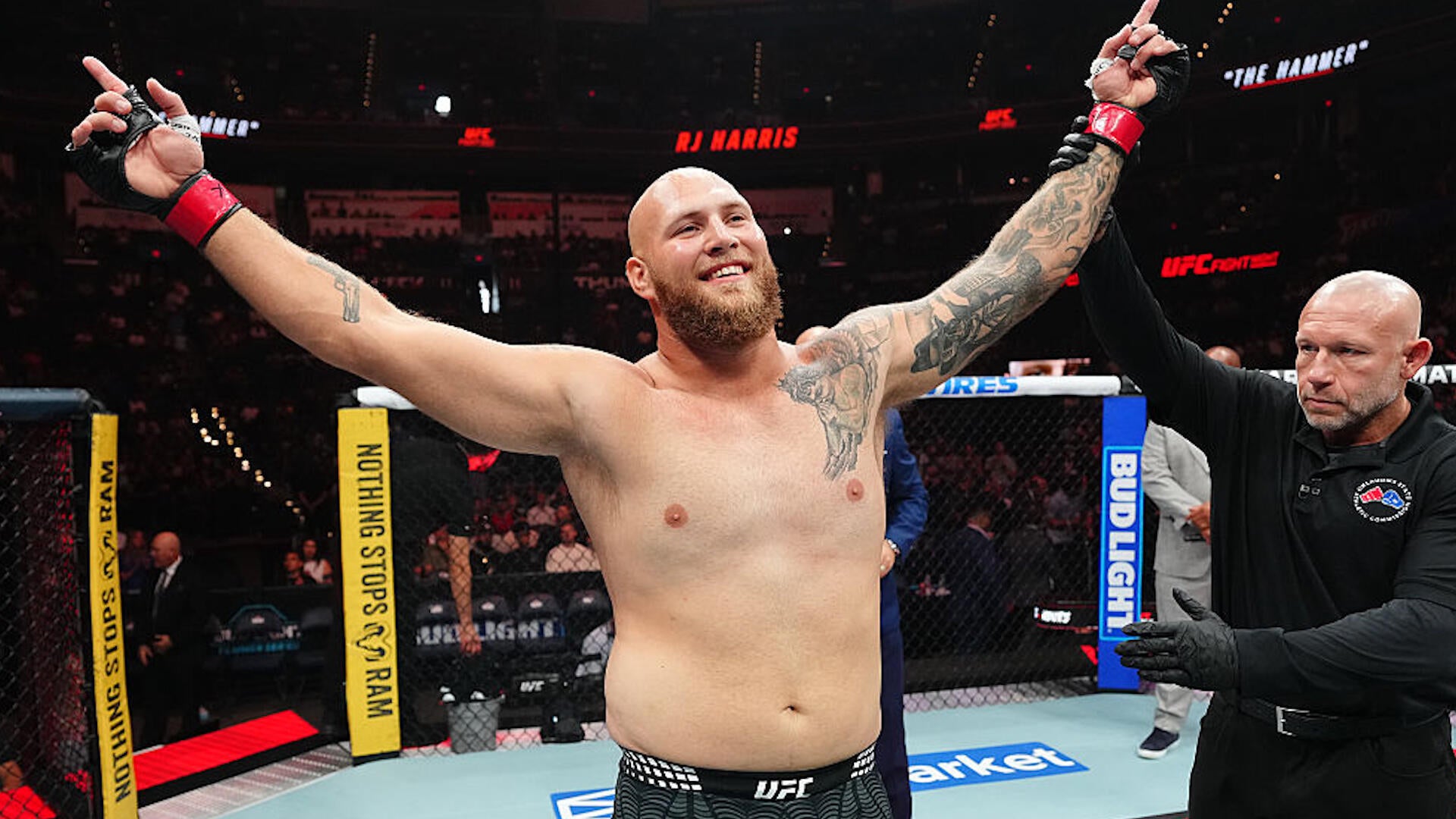
The danger is turning that result into a lazy promise: three workouts a week and you, too, can be UFC-ready. That is not what the evidence says. Harris brought wrestling experience, toughness, a physical job, coached MMA sessions, and enough heavyweight power to end a fight fast. The transferable part is the structure, not the fantasy that the structure erases the years behind it.
The Weight Drop Shows Discipline, Not a Public Diet Plan
Harris’s bodyweight change is one of the more striking parts of the record. Tapology lists his amateur super heavyweight range around 289 pounds and his pro heavyweight listing around 258 pounds, and his profile notes a drop from 315 pounds to roughly 258 pounds, a 57-pound change.[3]
He also reportedly had only 10 days’ notice to make the UFC heavyweight limit of 265 pounds for his debut.[2] That is a serious cut window, especially for someone not living inside the full-time athlete bubble.
Still, the public material does not give enough detail to reverse-engineer his nutrition. We do not have verified daily calories, macros, sodium manipulation, water-loading procedures, or the exact support he used. The responsible takeaway is narrower: Harris changed his body enough to move from super heavyweight territory into the UFC heavyweight limit, while maintaining enough performance to win. That points to consistency and buy-in, not to a copyable diet template.
How to Borrow the Three-Day Idea Without Pretending to Be Harris
A home version of the Harris model should keep the rhythm and change the contents. Most readers do not have his wrestling base, his coaches, his sparring partners, or his work capacity. They also do not need to get punched in the face to make the structure useful.
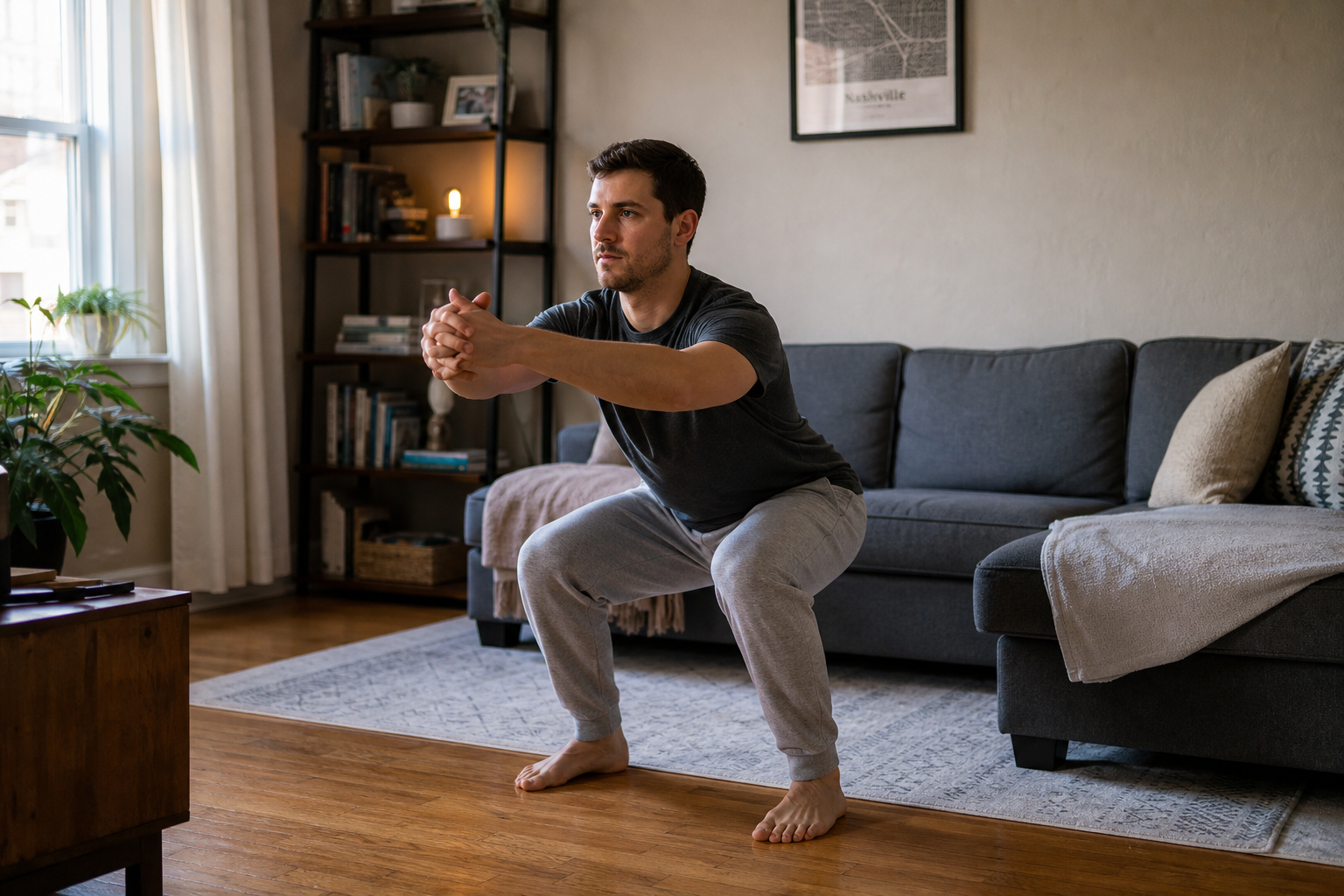
The basic translation is three demanding full-body sessions per week, with enough recovery between them to keep quality high. If you have an MMA gym, those can be coached classes. If you train at home, they can combine strength, conditioning, and fighter-style movement without pretending shadowboxing in the garage is the same as live rounds with trained partners.
| Day | Home-fitness emphasis | What to avoid |
|---|---|---|
| Monday | Full-body strength plus short conditioning | Turning the first session into a max-effort test every week |
| Wednesday | Skill, movement, carries, core work, moderate intervals | Stacking so much fatigue that Friday becomes sloppy |
| Friday | Harder conditioning or mixed full-body circuit | Adding junk volume just because the weekend is near |
| Tuesday, Thursday, weekend | Walking, mobility, easy cycling, stretching, or true rest | Calling every off day “recovery” while secretly training hard |
If your goal is a more conventional strength structure, a comparable three-day framework is the EXOS UFC strength routine. It is not Harris’s personal plan, but it fits the same practical constraint: three serious training days instead of a daily gym requirement.
For readers who want the MMA flavor laid out more directly, a 4-week MMA home training routine is the safer path than inventing sparring work alone. A boxing-inspired option like this 30-minute home fighter workout can also work when time is tighter and equipment is limited.
What each session should probably include
Because the exact Harris programming is not public, the best home adaptation is principle-based. Each training day should touch more than one quality instead of isolating a single muscle group and calling it enough.
- A full-body strength pattern: squat, hinge, push, pull, carry, or loaded core work.
- A conditioning block: intervals, circuits, hill walks, bike sprints, jump rope, or heavy bag rounds if you have the skill and setup.
- A movement or skill block: footwork, shadowboxing, sprawls, technical stand-ups, mobility, or grappling-specific solo drills.
- A recovery exit: breathing, cooldown walking, stretching, or easy mobility so the next workday is not wrecked.
A busy lifter may get more from three full-body sessions than from a body-part split that leaves half the week unfinished. If fat loss and recovery are part of the goal, full-body dumbbell workouts are a useful way to keep the training effect high without needing a commercial gym.
Recovery Is the Part People Skip When They Copy Fighter Schedules
The appealing part of Harris’s routine is that the formal training week has space in it. The easy mistake is filling all that space with extra work because three days feels too modest on paper.
If you have a physical job, off days should probably look different from the off days of someone who sits for eight hours. Walking, light mobility, easy cycling, and low-intensity movement can help, but hard intervals, heavy lifting, and “bonus” circuits quickly stop being recovery. A practical active recovery plan matters more when your job is already part of the load.
The signs are not mysterious. If Wednesday’s session is worse every week, your grip is always cooked, your sleep is sliding, or your joints feel older by Friday, the answer is not usually more toughness. It is better load management.
A Sensible Home Version of the RJ Harris Routine
If building your own plan, start with the same constraint Harris appears to use: three protected training appointments. Then decide what each one must accomplish before adding accessories.
- Pick three nonconsecutive days you can protect for at least eight weeks.
- Make each session full-body instead of saving major movement patterns for days that may never happen.
- Put the hardest conditioning after skill or strength work, not before it.
- Use off days for recovery, easy movement, or life obligations instead of guilt-driven extra workouts.
- Progress one or two variables at a time: load, rounds, density, or technical difficulty.
Equipment can stay modest. Dumbbells, a pull-up bar, bands, a jump rope, a heavy bag, a sled, or a loaded backpack can all support the idea. If you are deciding what belongs in your space, a home gym workout plan should start with movement patterns and time constraints, not with buying the most fighter-looking gear.
Someone with no MMA background should also be careful with the fight-skill pieces. Shadowboxing, footwork, bag work, sprawls, and conditioning circuits are reasonable. Hard sparring, live takedowns, and improvised submissions are not home experiments. For another lower-risk adaptation, fighter-style conditioning tips can bridge the gap between general fitness and combat-sport demands.
Small Source Notes Worth Keeping Straight
A few details around Harris are still uneven because he is a new UFC name rather than a long-documented contender. The Monday, Wednesday, Friday schedule comes from a local Times Recorder snippet with limited full-article context available.[1] The job, gym, and career arc are better supported by the MMA Junkie/Yahoo feature.[2]
His height also varies across public profiles, with listings such as 6-foot-3 and 6-foot-6 appearing in different databases and coverage.[4][5] That is worth noting, but it does not change the training lesson. Fighter measurements are often self-reported, updated at different times, or handled differently across outlets.
Record pages can also differ depending on whether they emphasize amateur bouts, pro bouts, exhibition-style events, or database verification standards. That is why the cleanest claim is not that every number around Harris is perfectly settled; it is that the supported pattern is consistent: a fast combat-sports rise, heavyweight competition, a major weight drop, a physical job, and a three-evening MMA routine.
What Harris Actually Proves
RJ Harris does not prove that minimal training is enough. He proves something more useful for people with demanding lives: three consistent, hard, full-body training sessions can be a serious plan when the rest of the week is built honestly around work, recovery, and real physical demands.
The UFC label makes the story bigger, but the calendar is what makes it worth borrowing. Monday, Wednesday, Friday. Show up after work. Train the whole body. Respect the off days. Do not invent precision where none exists. That is a better model than pretending the only serious routine is the one your actual life will never let you keep.
References
- Zanesville Times Recorder search snippet on RJ Harris training schedule — Zanesville Times Recorder.
- How RJ Harris went from sh*ts and gigs fighting to UFC signing — MMA Junkie / Yahoo Sports.
- RJ Harris “The Hammer” — Tapology.
- RJ Harris — UFC.com.
- CBS Sports / Fightomic profiles on RJ Harris — CBS Sports / Fightomic.

Comments
Join the discussion with an anonymous comment.