
You can make either cart look reasonable in 2026. One cart has an all in one gym around $1,300 to $2,000, delivered as a single training station with cables, a Smith machine, and enough exercise variety to start tomorrow. The other starts with a power rack, barbell, plates, and bench, then gets expensive as soon as you add cables, more weight, or a premium integrated functional trainer.
Here is the uncomfortable part: the cheaper first purchase is not always the cheaper five-year setup. The real question is which setup becomes incomplete first for the way you train.
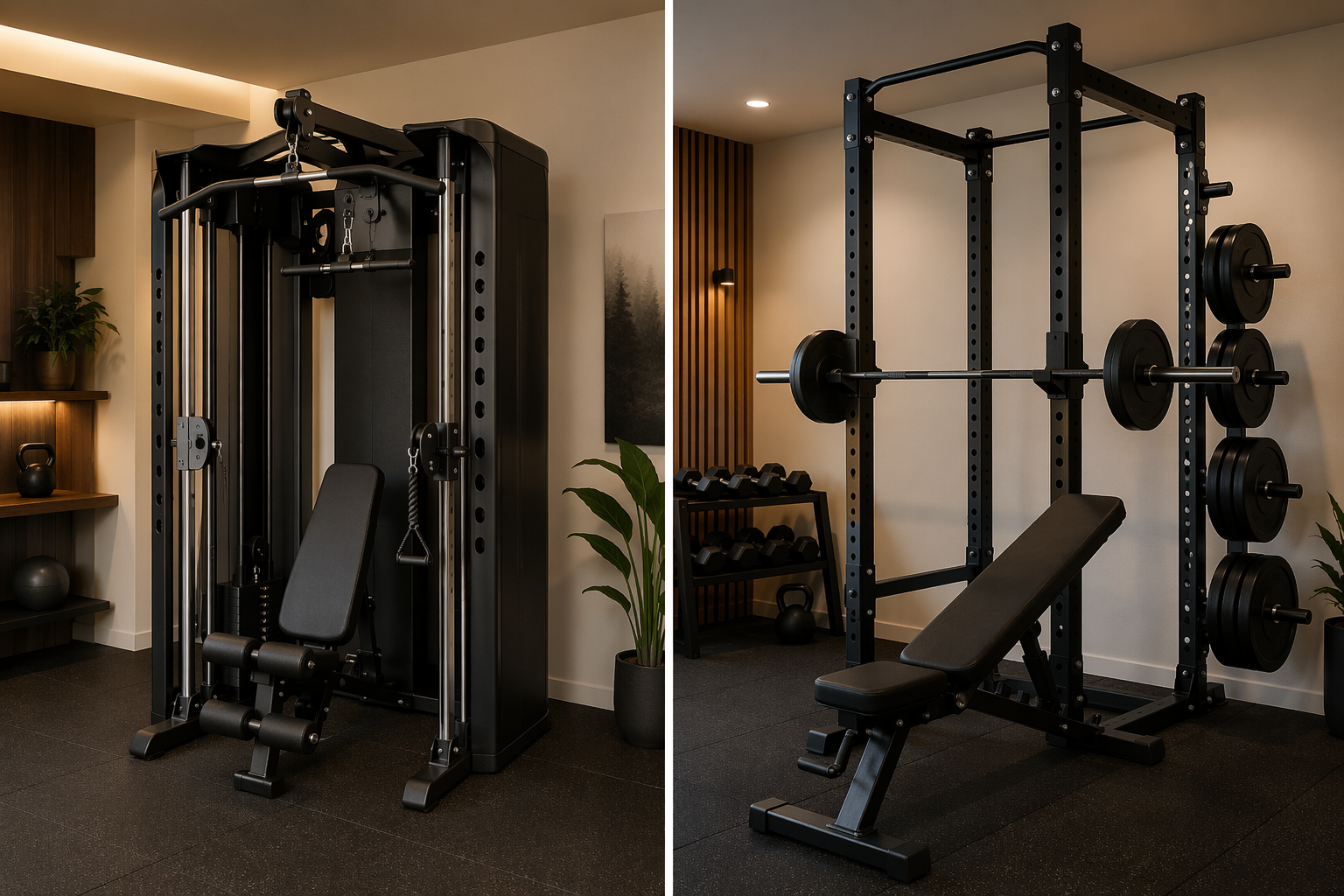
5-Year Cost Snapshot
Prices here reflect manufacturer and review-site data available in June–July 2026. They can move with sales, shipping, bundles, taxes, and financing. The totals also exclude flooring, extra handles, storage, collars, specialty bars, and the small accessories that somehow always appear after the first month.
| Path | Representative 2026 setup | Likely upfront cost | Likely 5-year equipment cost | What usually drives the second purchase |
|---|---|---|---|---|
| Entry all-in-one | RitFit M1 Pro-style single-stack system with Smith machine and lat pulldown | About $1,299 | About $1,299–$1,800 if the included resistance and exercise menu remain enough | More plates, better bench, or a separate rack/barbell if free-weight training becomes the priority |
| Midrange all-in-one | Force USA G3-style all-in-one with Smith machine, landmine, and cable trainer | About $1,999 | About $1,999–$2,600 if minor accessories are added | Resistance ceiling, Smith-machine dependence, or wanting a heavier-duty rack feel |
| Budget all-in-one range | Bells of Steel All-in-One-style budget machine | $1,299–$1,900 | $1,299–$2,400 depending on attachments and plate needs | Plate loading, cable limitations, and whether the rack portion feels rigid enough under heavier work |
| Modular rack build | Power rack, Olympic bar, plates, adjustable bench, and cable tower or functional trainer | About $1,450–$3,600 | About $1,800–$3,600 if bought in stages | Cable system, more plates, attachments, storage, and upgrading the first budget component |
| Premium rack-plus-cable setup | REP PR-4000-style rack with REP Ares 2.0-style integrated cable system | Around $3,700 | Around $3,700+ before accessories and additional plates | Mostly accessories rather than replacing the core structure |
Garage Gym Reviews reports an average home gym cost of $1,855 across more than 50 tested machines, which puts the common all-in-one price band right in the middle of the market rather than in bargain-bin territory.[1] RitFit lists the M1 Pro around $1,299 and frames a $1,000–$1,500 all-in-one as breaking even against a $50–$60 monthly gym membership in roughly 2–3 years; that is useful context, but it is also vendor math, so it should not be treated as a neutral guarantee.[2]
The cleanest five-year answer is not “all-in-one costs less” or “separate setup costs less.” An all-in-one gym usually asks for less cash on day one. A modular rack setup usually buys more ways to adapt after year two, especially if barbell strength work keeps moving up.
What Each Cart Actually Includes
The all-in-one cart is not just one product category. A single-stack machine suits one person doing guided cable and Smith-machine work. A dual-stack or functional-trainer-centered unit is better when two users train differently or when cable work matters more than heavy barbell work. For a fuller breakdown of those machine architectures, see the all-in-one home gym types guide.
The representative all-in-one examples in this comparison are the RitFit M1 Pro at about $1,299, the Force USA G3 at about $1,999, and the Bells of Steel All-in-One in the $1,299–$1,900 range. BarBend rates the Force USA G3 4.3 out of 5 as its “Best All-in-One,” while Garage Gym Reviews names the Bells of Steel All-in-One a top budget pick with a 4.2 out of 5 rating.[3][1]
The modular cart is more honest if it is priced as a full training station, not as a lonely rack in an empty garage. A practical version includes a power rack at about $400–$800, an Olympic bar at about $150–$300, plates at about $300–$600, an adjustable bench at about $200–$400, and a cable tower or functional trainer at about $400–$1,500. That puts the realistic range around $1,450–$3,600 before flooring and accessories.
The premium version is the setup many people really mean when they say they want the best of both worlds: a rack such as the REP PR-4000 paired with an integrated cable system such as the Ares 2.0, landing near $3,700 with dual 260-pound weight stacks and a rack rated for more than 1,000 pounds. That is not a budget workaround. It is a long-term garage gym core.
Where the Five-Year Cost Actually Moves
Sticker price favors the all-in-one machine because the first invoice includes more training stations. You get a guided bar path, cable pulleys, a lat pulldown station, and often a landmine or low-row option without having to learn rack compatibility charts. For a beginner who wants chest presses, rows, pulldowns, curls, triceps work, assisted squats, and machine-supported lower-body work, that matters.
The modular setup starts to catch up when each component remains useful after the training plan changes. A good rack still works when you switch benches. A barbell still works when you add bumper plates. Plates move from squats to deadlifts to plate-loaded cables. The cable tower is the expensive add-on, but it is not replacing the rack; it is expanding it.
| Cost driver | All-in-one effect | Modular rack effect | Five-year consequence |
|---|---|---|---|
| Cable training | Often included upfront, especially on Smith/cable hybrids | Often the biggest later add-on at about $400–$1,500 | All-in-one looks better early if cable work is central |
| Weight plates | May still need plates if the machine is plate-loaded | Required from the beginning | Both paths can underprice the first purchase if plates are omitted |
| Resistance ceiling | Limited by stack size, plate horns, guide rails, and frame rigidity | Limited mainly by rack rating, bar, plates, and user strength | Modular setup ages better for heavy barbell progression |
| Bench quality | Included benches may be good enough, fixed, or not included depending on system | Chosen separately | Separate bench is annoying to price but easier to replace |
| Resale and replacement | One large machine can be harder to split up or move | Components can be sold or upgraded individually | Modular setups usually have cleaner partial-upgrade paths |
That cable line in the table is the one many buyers miss. If you compare a $1,299 all-in-one gym against a $699 rack, the rack looks cheaper. If you compare the all-in-one against a rack, bar, bench, plates, and a cable tower, the comparison changes quickly.
The Smith Machine Question Is Not a Footnote
A Smith machine can be the reason an all-in-one gym gets used. The bar is already there. The path is guided. Solo lifters can train without the same setup friction. For someone who is nervous under a free bar or mostly wants controlled hypertrophy work, that can be a feature rather than a compromise.
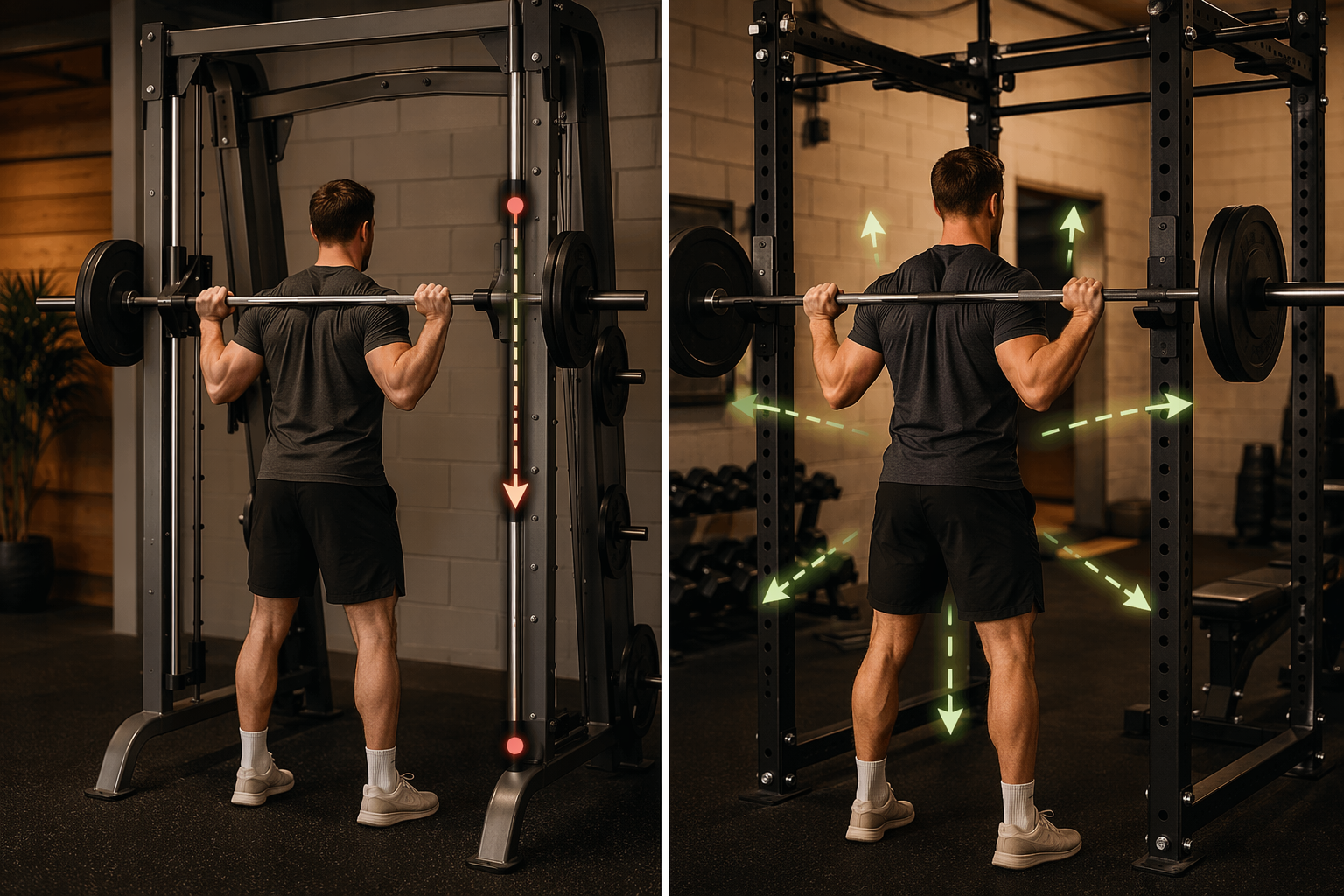
It becomes a cost issue when the Smith machine is treated as a full substitute for free-weight barbell training. Smith machine bars are typically listed around 25–33 pounds, and the guided track does not replicate the stabilizer demands of a free bar moving through space.[2] That does not make Smith squats useless. It means they are not the same training exposure as free-weight squats.
This is where a good beginner purchase can become incomplete. If the buyer later wants conventional barbell squats, bench press off J-hooks, deadlifts, overhead press, and heavier progressive loading, the all-in-one may need to be supplemented with a separate rack and bar. At that point, the original “one machine” savings start looking like the first stage of a two-stage build.
On the other hand, if the user never intended to chase heavy free-weight lifts, buying a modular rack first can be the slower mistake. A rack without a cable system is not very satisfying for someone who mainly wants pulldowns, rows, flyes, lateral raises, curls, pressdowns, and guided pressing. They may end up buying the cable tower anyway, just later and with more assembly.
Rigidity, Steel Gauge, and Why “Capacity” Costs Money
Capacity is not only the maximum number printed on a product page. It is how the frame feels under repeated loading, how much movement appears during cable work, whether the uprights inspire confidence, and whether the machine still feels stable after the first enthusiastic month.
The broad pattern in the 2026 market is that all-in-one machines under $1,500 often use 14-gauge steel, while premium units above $2,000 move toward 11–12 gauge. Modular racks in the $400–$800 range often start with 11–12 gauge steel. That difference does not automatically make every rack better than every machine, but it explains why a separate rack can feel overbuilt for the money while an all-in-one machine has to divide its budget among pulleys, guide rods, attachments, and the frame.
Selectorized stacks and plate-loaded systems also change the ownership experience. REP’s guide to selectorized versus plate-loaded strength equipment describes the tradeoff clearly: selectorized stacks are faster and cleaner to adjust, while plate-loaded equipment can be less expensive and lets existing plates serve more than one station.[4] Over five years, convenience can keep a machine in use, but shared plates can keep upgrade costs down.
Which Setup Becomes Incomplete First?
For a small-space beginner, the all-in-one gym often has the better first three years. It consolidates the decisions. It gives the buyer a defined place to train. It reduces the chance that the garage becomes a half-built project with a rack, one pair of plates, and no cable work. If the machine covers the exercises that person actually repeats, the five-year value can be excellent.
For an intermediate lifter who already knows barbell training will stay central, the modular setup usually ages better. The rack does not become obsolete because a cable attachment improves. The plates do not become obsolete because the bench changes. The barbell remains useful even if the training split moves from powerlifting to general strength.
For bodybuilding-style training, the decision is closer. Cable access, controlled pressing, rows, pulldowns, and isolation work matter a lot. A Force USA G3-style machine or Bells of Steel-style all-in-one may deliver more usable variety per square foot than a bare rack build. The modular path pulls ahead only if the buyer is willing to pay for a real cable solution, not just a rack with a pulley attachment they dislike using.
For a garage buyer with enough space and a clear strength progression goal, the premium rack-plus-cable setup is expensive but coherent. Around $3,700 is a painful starting point compared with a $1,299 machine, but it reduces the chance of replacing the core structure. Most future spending is likely to be on attachments, specialty bars, storage, or more plates rather than buying a second main gym.
A Practical Five-Year Read
| Buyer profile | Better starting point | Why |
|---|---|---|
| Beginner who wants one delivery and guided training | All-in-one gym | Lower barrier to entry, consolidated footprint, and enough built-in variety to start immediately |
| Small-space user focused on cables and machine-guided work | All-in-one gym | The included pulleys and Smith station may matter more than free-weight expansion |
| Lifter expecting heavier squats, bench, deadlifts, and overhead press | Modular rack setup | Free-weight progression and rack capacity are less likely to become the limiting factor |
| Buyer who wants to upgrade one piece at a time | Modular rack setup | Bar, plates, bench, rack, and cables can be improved separately |
| Buyer who wants rack strength and serious cable training from day one | Premium rack-plus-cable setup | Highest upfront cost, but the least pressure to replace the core system |
The decision gets easier if you stop asking which setup is cheaper in the abstract and ask what you would have to buy next. If the answer is “probably nothing except a few handles and plates,” the all-in-one machine can be the better value. If the answer is “a real rack, a real barbell, more plates, and a better way to bench,” the modular route should probably start now.
For broader budget tiers, see the 2026 home gym cost breakdown. If you are comparing traditional equipment with connected machines, the smart vs. traditional all-in-one gym TCO guide handles the subscription question separately. Small-space buyers may also want the compact home gym equipment categories guide, while anyone still sorting out priorities should start with how to choose home gym equipment for your space, budget, and goals.
Disclosure: this comparison may include affiliate-linked products or related buying guides. That does not change the pricing caveats: street prices, shipping, bundles, and financing can shift the real total, and any five-year estimate is only as good as the training path it assumes.
References
- Best Home Gyms, Garage Gym Reviews
- Are All-in-One Home Gyms Worth It? RitFit M1 Pro Buyer Guide, RitFit
- Best Home Gyms, BarBend
- Selectorized vs Plate Loaded Strength Equipment: Pros and Cons, REP Fitness

Comments
Join the discussion with an anonymous comment.