
If you searched fitness equipment stores near me and now have a showroom visit on your calendar, the visit has three jobs: test the equipment, test the staff, and test the support behind the sale. A treadmill that feels fine for 90 seconds at walking speed has not really been tested. A salesperson who starts with a model number before asking about your room, your body, and your budget has not really helped. A warranty described only as “limited lifetime” has not really been explained.
Walk in with permission to slow the process down. Adjust things. Change speeds. Ask who installs the machine. Ask who repairs it. If the store earns your trust, good. If it only performs confidence, keep looking.
Before You Leave Home
Do a little measuring before you do any shopping. You do not need a design binder, but you do need the numbers that decide whether a machine can live in your house.
- Measure the floor area where the machine will sit, including walking space around it.
- Measure ceiling height, especially for treadmills, ellipticals, climbers, and racks.
- Measure doorway width, hallway turns, stair landings, and any tight delivery path.
- Write down your realistic budget, not just the number you hope to spend.
- Write down your goals, experience level, injury concerns, and who else will use the equipment.
Prepared buyers tend to get better recommendations because staff can match equipment to real constraints instead of guessing from a vague “I want a home gym” conversation.[1] If you are not sure what belongs in your space or budget yet, sort that out before the visit with a planning guide such as How to Choose Home Gym Equipment That Actually Fits Your Space, Budget, and Goals. If the visit is really about choosing a store type first, start with Which Local Store Should You Buy Fitness Equipment From? and then come back to this checklist.
Do just enough brand and warranty research that you are not walking in blank. You are not trying to memorize every model. You are trying to recognize when a warranty is being described too loosely, when a brand is unfamiliar for a good reason, or when the store cannot explain why it carries what it carries.
Use the Showroom Visit as a Testing Session, Not a Tour
The first machine you try should not be treated like a demo ride. Treat it like equipment you may have to live with for years: you are testing fit, sound, feel, and stability under conditions closer to real use.
Start by adjusting every contact point before you judge the machine. On a bike, move the seat height and fore-aft position, then adjust the handlebars. On an elliptical, check whether the stride feels natural instead of forcing your hips into a path that only feels acceptable because you are standing still. On strength equipment, move the seat, pads, arms, and starting positions. Testing across multiple settings is recommended by fitness equipment shopping guides because noise, smoothness, and stability can change once speed, incline, or resistance increases.[2][3]
Do not be shy about taking a few minutes. A good showroom should expect this. If you feel awkward, use a simple script: “I’m going to test this at a few settings so I can hear it and feel the adjustment range.” That is not being difficult. That is doing the only thing a store visit can do better than a product page.
For Treadmills
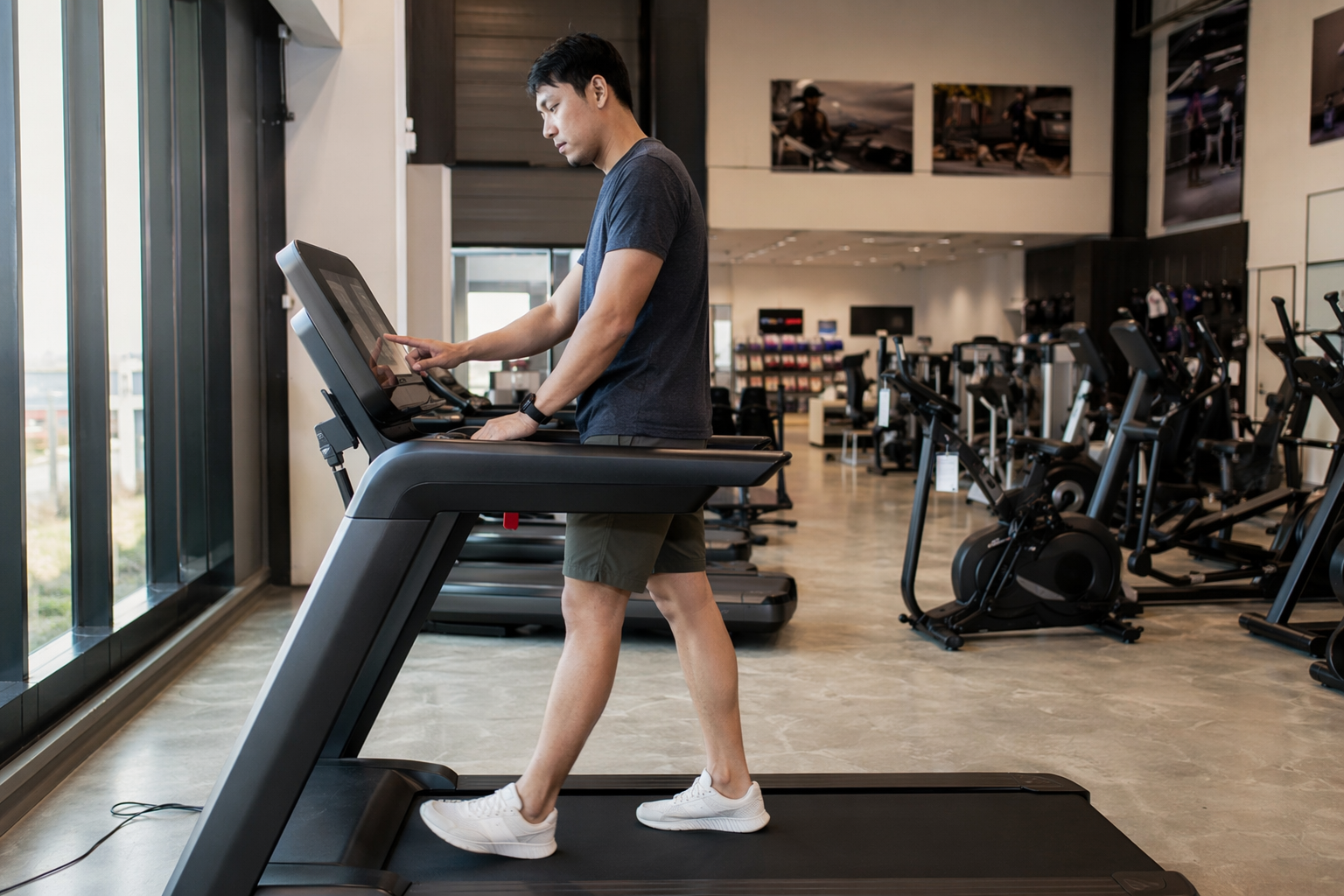
Walk first, then jog or run if that is how you plan to use it. Change speed. Change incline. Listen when the belt is moving slowly and again when it is working harder. A treadmill can sound polite at display speed and very different once your foot strike, motor load, and belt movement combine.
- Check whether the deck length and width let you move naturally without watching your feet.
- Listen for belt slapping, grinding, rattling, or console vibration as speed changes.
- Hold the side rails briefly, then let go and see whether your stride still feels centered.
- Use the controls while moving; tiny buttons and laggy response matter more at speed.
- Ask whether the displayed model is on the same deck, motor, and console platform as the one you would receive.
For Bikes, Rowers, and Ellipticals
Cardio machines should feel smooth through the full motion, not only at the easy setting a salesperson chooses for you. Increase resistance gradually. Pay attention to the hand positions you would actually use, not just the one that looks good for a minute.
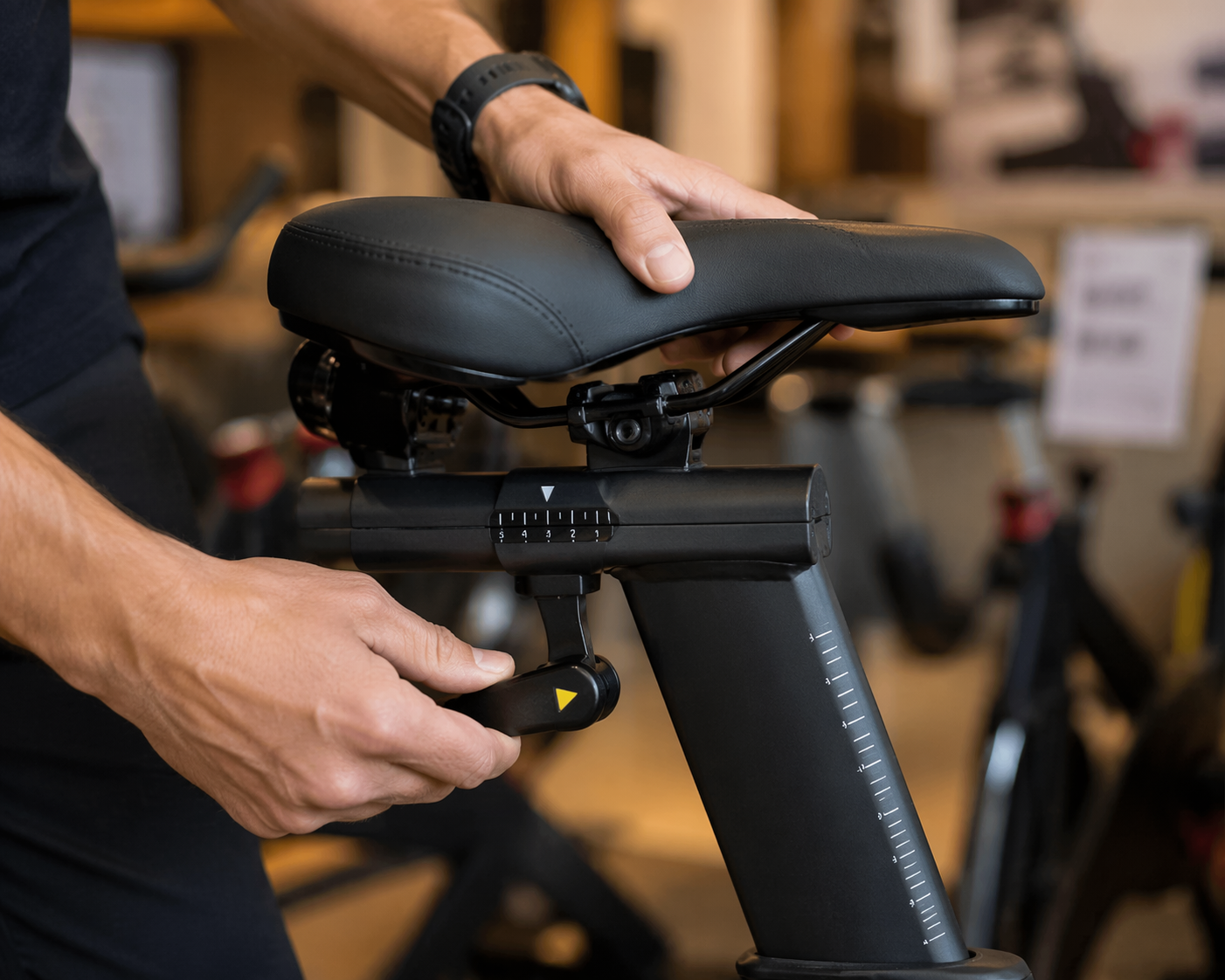
- On bikes, check knee tracking, seat comfort, handlebar reach, and whether adjustments are easy for every likely user.
- On rowers, check the catch position, foot strap adjustment, handle feel, rail smoothness, and noise at harder pulls.
- On ellipticals, check stride path, pedal spacing, handle movement, and whether your knees or hips feel guided into an awkward line.
- On all of them, test low, middle, and higher resistance so you hear and feel more than the showroom default.
For Strength Equipment
Strength equipment tells on itself when you adjust it, load it, and change direction. A bench that feels solid when empty may shift when you set up for a press. A selectorized machine may feel fine until the weight stack moves quickly. A rack can look heavy but still wobble if the frame, floor contact, or assembly is poor.
- Move every adjustment point and confirm it locks securely without guessing whether the pin seated.
- Check for wobble under normal use, not by abusing the display model.
- Watch cable travel on functional trainers and home gyms; it should feel smooth through the range you will use.
- Test bench angles, pad firmness, rack height, safety arms, and plate storage with your own proportions in mind.
- Ask what regular maintenance looks like: cable inspection, lubrication, bolt checks, or belt tension where relevant.
It is also fair to try a machine above your budget. The point is not to talk yourself into spending more. The point is to identify what feature actually matters. If the expensive model feels better because of a smoother adjustment, a better stride path, or a quieter drive system, you can ask whether that feature appears in a lower-priced model in the same line.[4]
The Staff Test Starts Before the Recommendation
The best showroom staff do not open with “This is our most popular model.” They ask what the machine has to do for you. A useful conversation usually covers goals, experience level, physical limitations, space, budget, delivery path, and who else will use the equipment. Dealer-written comparisons argue that specialty-store staff are more likely to have home-fitness product expertise than big-box associates, though those sources are naturally favorable to specialty retail.[1] Use the standard anywhere: specialty showroom, sporting goods store, warehouse club, or used-equipment dealer.
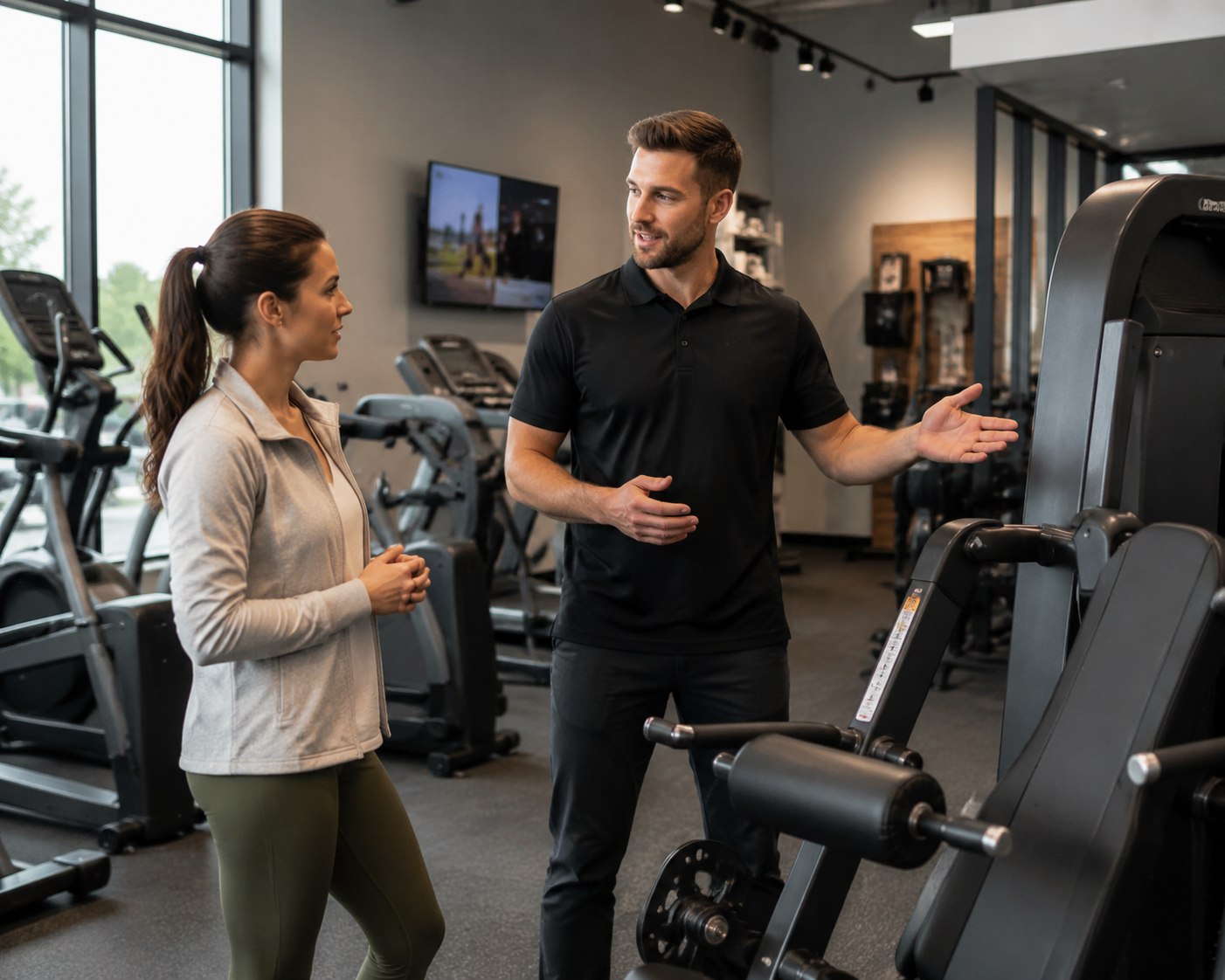
One of the most revealing questions is simple: “What brands do you carry, and why?” A competent provider should be able to explain brand selection in terms of parts access, service history, build quality, warranty support, intended user, or price tier, not just say that a model is available or on sale.[5]
| Ask this | Listen for this | Be careful if you hear this |
|---|---|---|
| What would make this model wrong for me? | A real discussion of space, body fit, use level, noise, or service limits. | Nothing. If every model is somehow perfect, the advice is not being filtered. |
| Why this brand instead of the one next to it? | Differences in frame, drive system, adjustment range, warranty, service access, or parts availability. | A vague answer about popularity, “commercial-grade” feel, or a temporary discount. |
| Who installs it? | A clear answer: store team, manufacturer-authorized crew, or named third-party carrier. | “Delivery handles that” without explaining placement, assembly, leveling, or testing. |
| Do you service what you sell? | Local service scheduling, parts process, labor coverage, and who handles warranty claims. | A phone number, a manufacturer handoff, or a promise that “these never need service.” |
| Can you break down the warranty? | Separate terms for frame, motor or electronics, parts, labor, wear items, and exclusions. | Only the phrase “limited lifetime” with no written detail. |
Pushy closing tactics are not a personality quirk you have to tolerate. If a salesperson discourages testing, dodges warranty specifics, or keeps steering back to monthly payment instead of fit and support, the store is making the decision easier than it thinks.
Warranty Language Needs to Be Split Apart
Fitness equipment warranties are not one promise. They are several promises stacked together. A frame may have one term, a motor another, electronics another, parts another, and labor another. Some dealer materials cite specialty brands with long coverage windows, including TRUE Fitness examples with lifetime frame coverage and 30-year motor coverage on some models, but those terms come from manufacturer and dealer materials and must be verified at purchase.[6]
Ask for the current warranty document for the exact model and SKU you are buying. Then separate it into plain language:
- Frame: what structural parts are covered, and for how long?
- Motor or resistance system: what is covered, and what counts as misuse?
- Electronics and console: what happens if the screen, buttons, sensors, or connectivity fail?
- Parts: which replacement parts are covered, and for how long?
- Labor: who pays for the technician, travel, diagnosis, and installation of parts?
- Wear items: belts, pads, cables, upholstery, grips, batteries, and cosmetic parts may be treated differently.
Some specialty-retail sources frame longer warranty coverage as a proxy for stronger construction and argue that big-box equipment is often built to lower price points with shorter warranties.[7] Treat that as a useful claim to investigate, not a rule that decides the purchase by itself. A modest machine with clear support may be a better buy than an impressive machine attached to vague coverage.
Delivery and Service Are Part of the Product
The sale is not finished when the receipt prints. Heavy equipment still has to reach the room, fit through the path, be assembled correctly, be leveled, be tested, and be supported if something goes wrong. ConnectFit, a specialty dealer source, says it regularly fixes incorrectly installed equipment bought through online-only or big-box channels.[5] That is one dealer’s stated experience, not a universal rate, but the underlying question is the right one: who owns the setup if the setup is wrong?
Before payment, get a written answer to what delivery includes. “Delivery” can mean curbside drop-off, threshold delivery, room-of-choice placement, full assembly, leveling, packaging removal, and post-installation testing. Those are different services. If the machine is going upstairs, into a basement, through a narrow hallway, or over delicate flooring, say so before the store quotes the job.
- Who performs delivery: in-house team, manufacturer-authorized installer, freight carrier, or third-party contractor?
- Will they place the machine in the final room?
- Will they assemble, level, calibrate, and test it before leaving?
- Will they remove packaging?
- What happens if the machine does not fit through the delivery path?
- Who do you call for service: the store, the manufacturer, or a third-party warranty administrator?
If a store has an in-house service team, ask what that actually means. Local technicians? Stocked parts? A service radius? A typical scheduling process? Preventive maintenance? A store can sell reputable brands and still leave you chasing support through a call center if the service path is not clear.
If You Are Looking at Used Equipment
Used equipment deserves the same testing, with less patience for mystery. The local used market varies too much by region to make broad price claims, so inspect the exact unit in front of you. Run it. Adjust it. Look for missing covers, frayed cables, cracked plastic, rust, uneven wear, console errors, belt tracking problems, and improvised repairs.
Ask whether the warranty transfers, whether the dealer refurbished the unit, and what “refurbished” means in writing. If used or secondhand stores are part of your search, use Where to Find Used Fitness Equipment Near You and What to Inspect before you make the trip.
The Final Questions Before You Pay
Once a machine feels good and the staff seems useful, slow down again. The final questions are not dramatic, but they are where many expensive misunderstandings hide.
- Is this the exact model, year, console, and configuration I tested?
- What is the out-the-door price, including delivery, installation, accessories, mats, haul-away, and taxes?
- What is the return or exchange policy, and are delivery or restocking fees involved?
- What warranty document applies to this exact item today?
- Who handles the first service call if something is wrong after installation?
- What maintenance should I perform, and what work should be left to a technician?
If the price is still unsettled, do not let the showroom decide your budget for you. A phased approach may make more sense than buying the wrong machine because it is available today. For tighter budgets, compare the tradeoffs in How to Build a Budget Home Gym Under $500 or a longer purchase sequence like Best Home Exercise Equipment: A Phased Purchase-Sequence Guide.
The visit has done its job when three things are true: the equipment feels right after real testing, the staff can explain why it fits you, and the warranty, delivery, installation, return policy, and service path are clear in writing. If any one of those fails, you have not wasted the visit. You have found the reason not to buy there.
References
- Choosing a Local Fitness Equipment Retailer vs A Big-Box Store, Total Fitness Equipment
- What to Ask When Shopping for Fitness Equipment, LiveFit
- 5 Tips On Buying Fitness Equipment, SportsArt
- Why Shopping for Fitness Equipment in Person is Worth It, Better Body Montana
- The Ultimate Guide to Choosing a Gym Equipment Provider, ConnectFit
- Specialty Fitness Brands vs. Big-Box Giants, Fitness Specialist
- Why Fitness Equipment Costs More at a Specialty Fitness Store vs. Big Box Stores, Fitness Specialist

Comments
Join the discussion with an anonymous comment.