Searching fitness equipment near me is usually not just a request for the closest treadmill. It is a way of reducing the number of things that can go wrong after the receipt prints: delivery, assembly, warranty coverage, returns, repairs, and whether the machine actually fits the way you train.
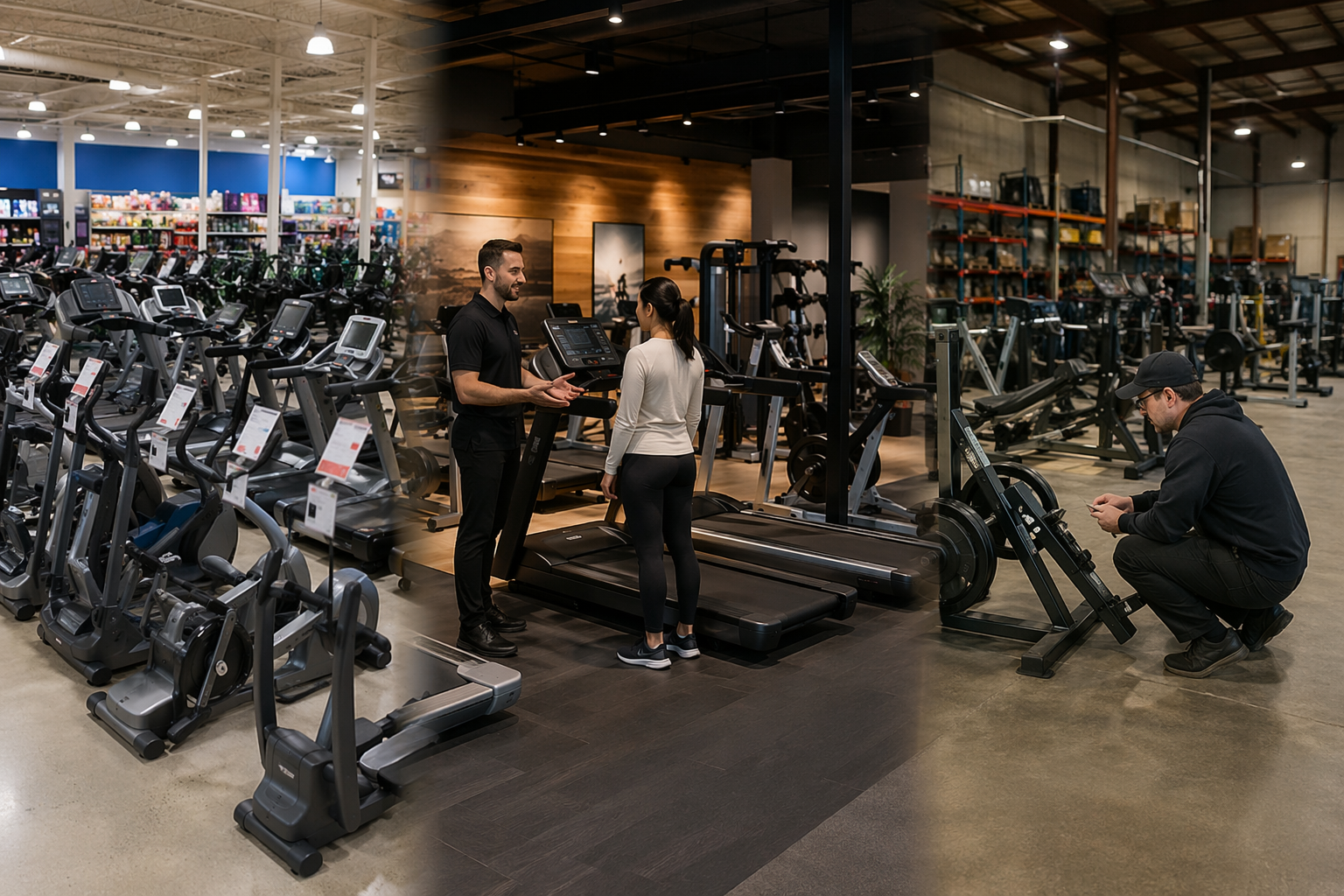
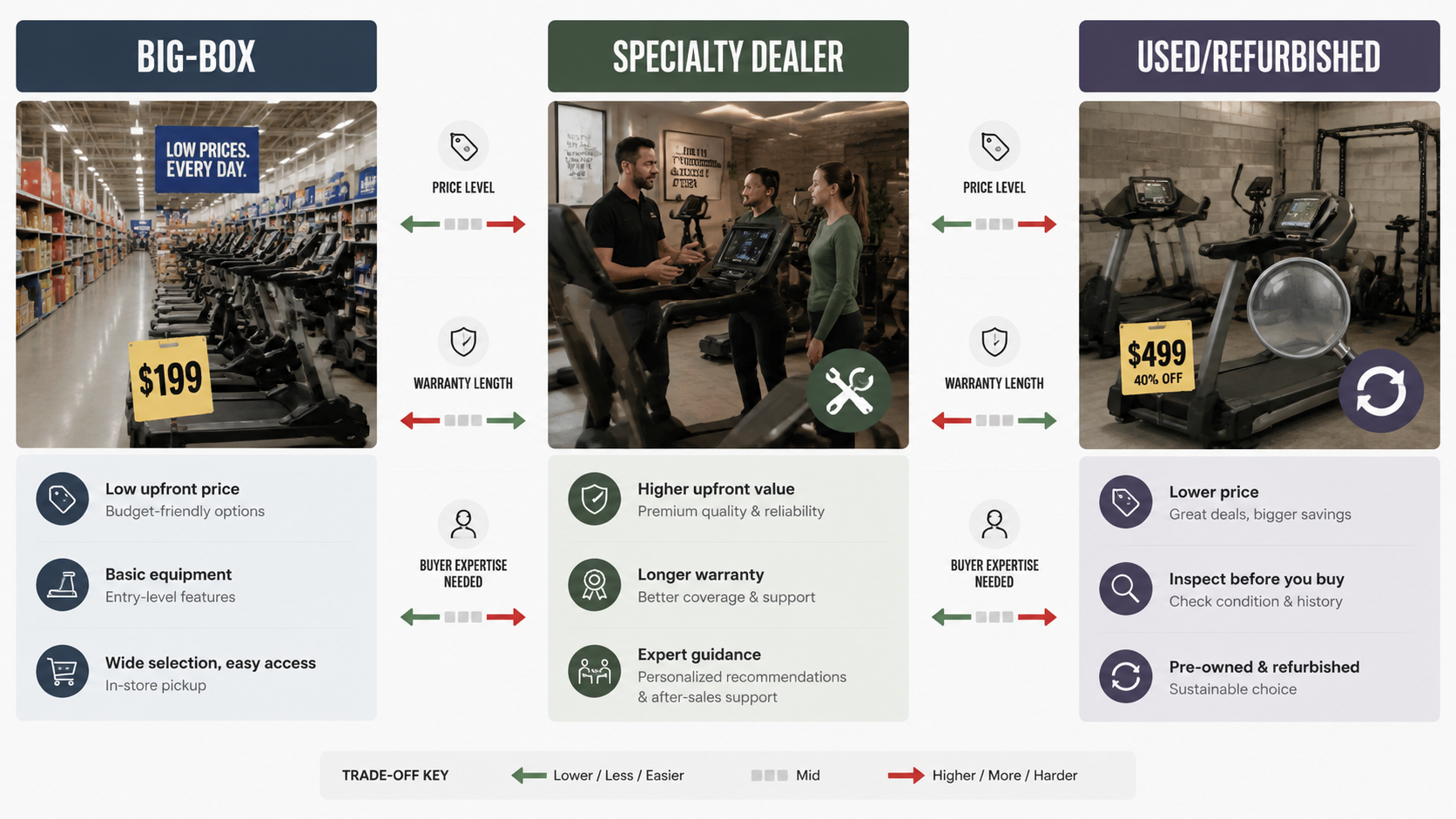
The useful first split is simple. Big-box stores are usually the best local stop when you want the lowest entry price and a straightforward purchase. Specialty fitness dealers make more sense when guidance, delivery, assembly, warranty, and service are worth paying extra for. Used and refurbished sellers offer the biggest discount, but they also hand more inspection risk to the buyer.
A recent channel snapshot helps explain why this decision is messier than “go local” or “buy online.” OpenBrand/TraQline data for the rolling four quarters ending Q3 2023 put the average paid price for fitness equipment at $536, with in-store purchases averaging $483 and online purchases averaging $567. Only 26% of purchases happened in retail stores, while 66% happened online, even though 85% of buyers researched online first. Price was the leading purchase driver at 59%, followed by selection at 33% and convenience at 14%.[1]
Those numbers are not a live Q3 2026 price sheet for your neighborhood. They are still useful because they show the shape of the problem: most buyers shop with online information, many still care deeply about price, and the local store visit has to earn its place by reducing uncertainty.
| Local source | Best fit | Main advantage | Main risk |
|---|---|---|---|
| Big-box store | Budget-first buyer choosing common equipment | Low entry price and broad availability | Limited expert guidance, service path, and warranty depth |
| Specialty dealer | Buyer who wants guidance, delivery, assembly, and repair support | Stronger warranty/service structure and showroom testing | Higher upfront price and local-policy variation |
| Used or refurbished seller | Confident buyer chasing maximum discount | Steep savings versus retail | Inspection burden and weaker warranty certainty |
Start With The Store Type, Not The Store Name
Local availability changes by region, so naming one universal “best” store is less helpful than matching the store type to your tolerance for hassle. A buyer who can carry home a pair of adjustable dumbbells has a different problem from a buyer who needs a 300-pound treadmill delivered downstairs, leveled, assembled, and serviced later.
If you are not sure what category of equipment you should buy yet, pause the store search and use a decision framework first. A budget rack, compact cardio machine, adjustable bench, rowing machine, and all-in-one trainer solve different problems. The right store cannot fix the wrong equipment category. For that earlier decision, start with a home gym equipment decision framework by budget, space, and goals or a broader home exercise equipment buying guide.
Big-Box Stores: Lowest Friction, Least Hand-Holding
Big-box retailers are attractive for the obvious reason: you can compare familiar brands, catch a sale, use normal retail payment options, and often leave with the item the same day. In the OpenBrand/TraQline dataset, Walmart’s average paid price was $296 and Amazon’s was $364, both below the overall industry average of $536.[1]
That makes big-box shopping a reasonable path for simple items: dumbbells, mats, jump ropes, basic benches, entry-level bikes, and other equipment where the downside of a wrong choice is manageable. It is also useful for a beginner building in phases rather than trying to solve the whole home gym in one haul. If that is you, a phased beginner equipment guide under $1,000 can keep the first purchase from eating the whole budget.
The trade-off is that the store is not usually built around fitness-equipment ownership. Staff may be able to tell you what is in stock, but not whether a treadmill deck is appropriate for your usage, whether the console parts are easy to get, or who services the machine after the return window closes. For small items, that may not matter. For powered cardio equipment, cable gyms, or anything that takes two people and a dolly to move, it matters quickly.
Big-box also looks less cheap if the purchase requires separate delivery, assembly, haul-away, or later service calls. Before treating a low tag price as the full price, ask who assembles it, whether old equipment removal is included, how long parts coverage lasts, and what happens if the unit arrives damaged or develops a problem after a few months.
Specialty Dealers: Pay More To Reduce The After-Purchase Guesswork
Specialty fitness stores are easiest to justify when the machine is expensive, heavy, technical, or likely to be used hard. This is where the showroom matters. You can test stride length, belt feel, noise, console controls, seat fit, resistance changes, and how the machine feels at the speed or load you will actually use.
The stronger argument, though, is not that specialty stores are morally better than big-box stores. It is that some of them attach concrete protections to the purchase. ConnectFit cites dealer-based brands such as True Fitness offering 10-year parts warranties backed by dealer networks, while contrasting them with online-only budget machines described as having 2-year parts coverage on products with an estimated 3-year lifespan.[2]
Retailer-published claims need to be checked store by store, but the policies worth asking about are specific: price matching, trade-in programs, in-house delivery and assembly, and certified service technicians. Fitness Specialist describes those as specialty-store advantages over big-box and online channels.[3][4]
The part to verify is not the sales language. It is the paper trail. A useful specialty dealer should be able to show the current warranty terms, explain which parts and labor are covered, name who performs service in your area, quote delivery and assembly before checkout, and explain what happens if the machine has to be exchanged.
- Ask whether the warranty covers parts only, labor only, or both.
- Ask who services the equipment locally and whether they are certified for that brand.
- Ask whether delivery includes room-of-choice placement, stairs, assembly, leveling, and packaging removal.
- Ask whether the store offers trade-ins or trade-ups if your first choice is too small, too light, or wrong for your training.
- Ask for the price-match policy in writing, including exclusions for closeouts, marketplace sellers, and online-only bundles.
This is the store type that makes the most sense for buyers who already learned the hard lesson once: the cheaper machine was loud, wobbly, underpowered, hard to repair, or impossible to return without a fight. OpenBrand/TraQline reported that 46% of buyers were first-time buyers and 13% were replacement buyers, a mix that fits a market where many people are still learning what matters after the first purchase.[1]
Used And Refurbished: The Biggest Discount Comes With Homework
Used equipment can be the best deal in the room. Discounts of 50% or more off retail are common enough to take seriously, especially through used retailers, certified remanufacturers, and private local listings. That discount is real, but it is not free money. It is payment for accepting more uncertainty.
The first distinction is private seller versus used-equipment business. A private seller may offer the lowest price, but usually offers little recourse once the machine is in your garage. A certified remanufacturer or used-equipment retailer may cost more, but can offer inspection, refurbishment, and warranty coverage that private sellers cannot. Global Fitness and UsedGymEquipment.com both emphasize inspection of frame condition, electronics, moving parts, noise, and upholstery before buying used equipment.[5][6]
What To Inspect Before Buying Used
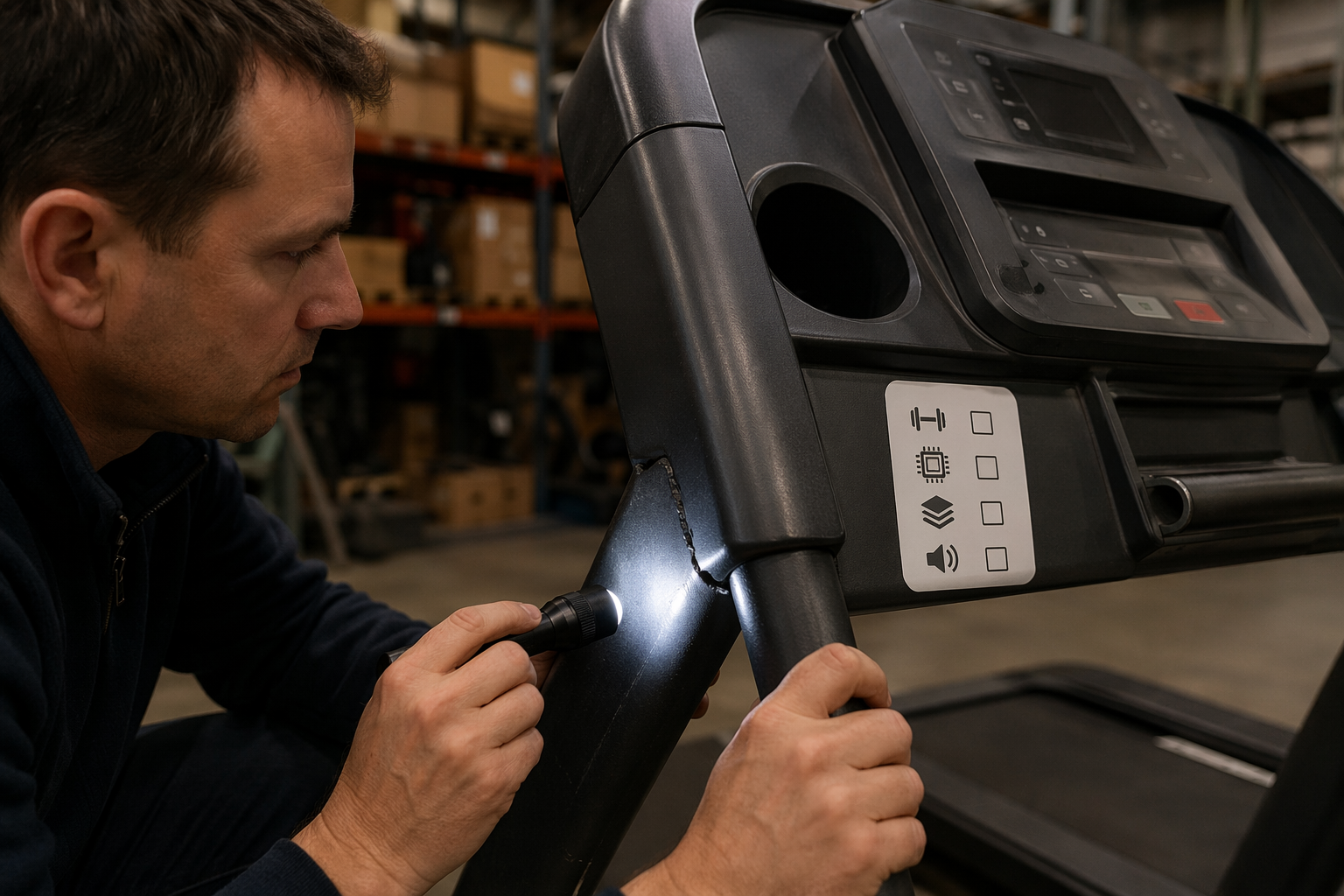
- Frame: look for cracks, bent sections, rust in load-bearing areas, and welds that appear separated or repaired.
- Electronics: test the display, buttons, incline or resistance controls, heart-rate contacts, ports, and error messages.
- Moving parts: run belts, pulleys, rollers, rails, pedals, arms, and cables through normal use instead of only turning the machine on.
- Noise: listen for grinding, knocking, scraping, belt slippage, fan irregularity, or motor strain under load.
- Upholstery and touch points: check tears, loose stitching, collapsed foam, sticky grips, worn pedals, and cracked plastic.
- Parts path: search for the model number before buying and confirm that belts, decks, cables, pads, batteries, or console parts are still available.
For treadmills, do not judge only by whether the belt moves. Walk and jog on it if the seller allows it, change speed, test incline, and listen after several minutes rather than after five seconds. For strength machines, inspect the cable path, weight-stack guide rods, selector pin, pulleys, bushings, and any place metal rubs against metal. For bikes and ellipticals, check resistance changes under load and watch for wobble at the crank, pedals, or handles.
A used purchase is a better fit if you are comfortable saying no in person. If you feel pressure to decide before testing, cannot confirm the model, cannot see it powered on, or cannot move it safely, the discount may be hiding the job you are about to inherit.
Online Returns Explain Why Local Still Matters
Online shopping can be convenient for research and price checks, but returns are where large equipment stops behaving like ordinary retail. Fitness Specialist notes that returning large fitness equipment bought online may require original packaging, disassembly, and return shipping that creates damage risk, with the buyer carrying much of the logistics burden.[7]
That is the hidden value in a good local source. If a machine arrives damaged, does not fit through the turn, or needs a service visit, the question is no longer “Who had the lowest checkout price?” It is “Who is responsible for solving this?” A nearby store is not automatically better, but a nearby store with clear delivery, assembly, exchange, and service policies can remove a lot of expensive ambiguity.
Match The Store To The Kind Of Buyer You Are
A budget-first beginner should usually start with big-box stores, local used listings, or basic specialty-store closeouts, depending on the equipment category. Keep the first purchase modest, then add pieces as habits become clearer. If you need a staged plan, use a budget home gym guide or a home gym budget allocation guide before committing most of the budget to one machine.
A space-constrained buyer should be more cautious than the price tag suggests. Compact equipment is not just smaller; it has to fold, roll, store, and clear doors without becoming a daily obstacle. Compare dimensions, folded footprint, ceiling clearance, and transport wheels before choosing the store. A small-space exercise equipment guide can help narrow the category before the local visit.
A buyer who needs assembly and service should lean specialty, especially for treadmills, ellipticals, cable gyms, functional trainers, and premium bikes. The store does not need to be fancy; it needs to be accountable. Delivery terms, service territory, technician access, and warranty handling matter more than showroom lighting.
A confident used-market shopper can do very well with refurbished dealers, used sporting-goods stores, and private listings. The right buyer brings a flashlight, model-number search, tape measure, moving plan, and willingness to walk away. The wrong buyer brings only optimism and a borrowed truck.
A replacement buyer should be the least impressed by a familiar discount. If the last machine failed because it was underbuilt, unsupported, too large, too loud, or hard to repair, the next purchase should solve that specific failure. Use a home gym system cost breakdown to decide whether the premium belongs in the machine itself, the warranty, the delivery, or a different equipment category.
The Decision Rule
Choose a big-box store when price, convenience, and a simple equipment category matter most. Choose a specialty dealer when warranty, expert guidance, delivery, assembly, and repair access justify the premium. Choose used or refurbished when the discount matters more than warranty certainty and you can inspect carefully or buy from a certified source.
The closest store is only the starting point. The better local purchase is the one where the post-purchase problem already has an owner.
References
- OpenBrand/TraQline rolling 4Q ending Q3 2023 fitness equipment purchase data, OpenBrand/TraQline, rolling 4Q ending Q3 2023.
- Online vs Dealer-Based...The Truth About Fitness Equipment, ConnectFit, 2023.
- Specialty Fitness Brands vs. Big Box Giants: Key Differences, Fitness Specialist, 2024.
- Why Fitness Equipment Costs More at a Specialty Fitness Store vs. Big Box Stores and Why It's Worth It, Fitness Specialist, 2024.
- Worth the Weight: Tips for Buying Used Gym Equipment, Global Fitness.
- The Smart Gym Owner's Checklist: 7 Things to Inspect Before Buying Used Gym Equipment, UsedGymEquipment.com, July 29, 2025.
- The Disadvantages of Buying Fitness Equipment Online: The Challenges of Returns and Shipping, Fitness Specialist, 2024.
Comments
Join the discussion with an anonymous comment.