
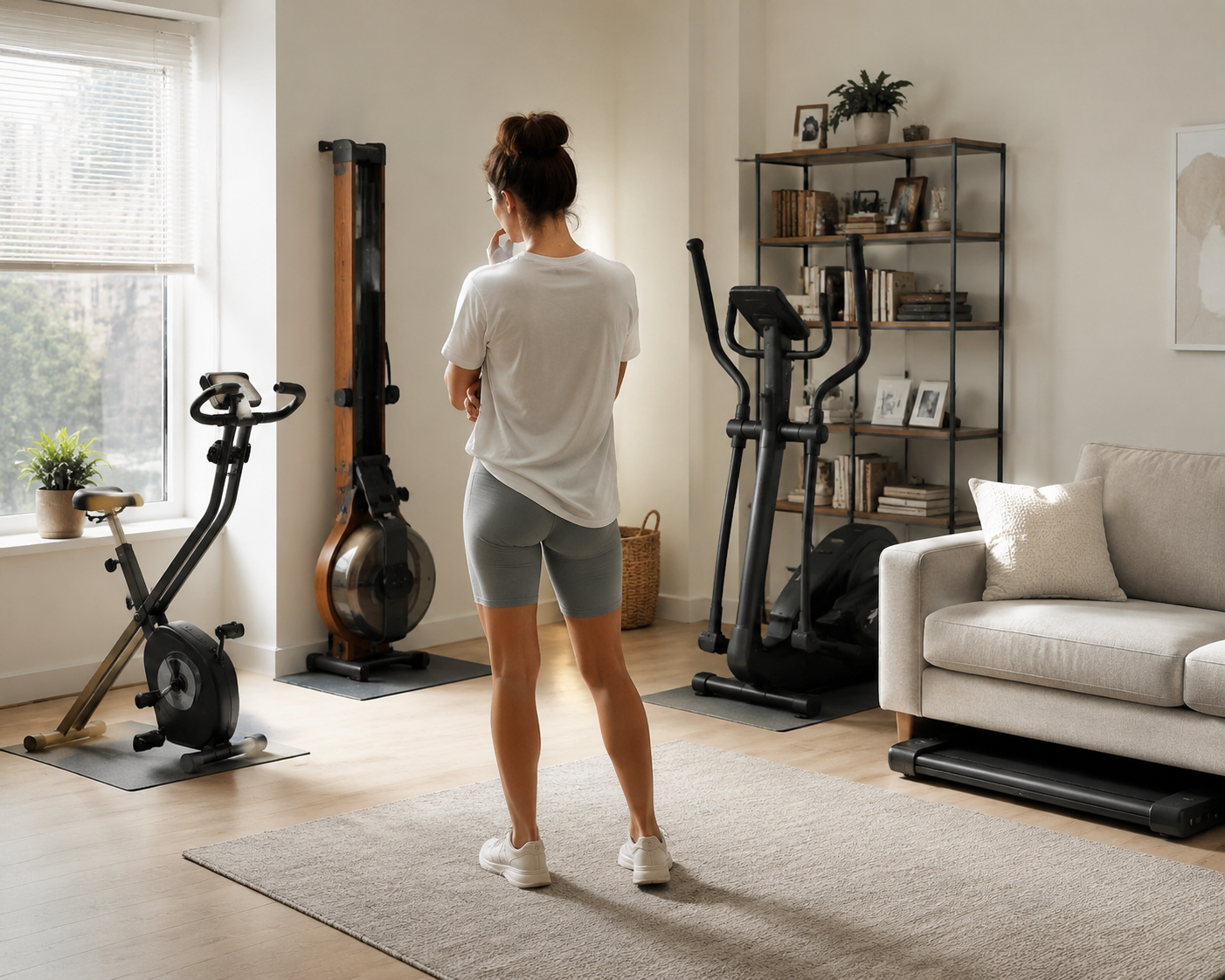
A small apartment does not care that a cardio machine is technically “compact.” It cares whether the machine blocks the couch, whether it has to be dragged across hard flooring, whether the person downstairs hears every interval, and whether the room becomes usable again before dinner. That is the real filter for home gym cardio equipment in a rented space.
That constraint affects a lot of buyers: roughly 39 million Americans live in apartments, according to National Apartment Association data cited by Garage Gym Reviews.[1] For them, the right machine is rarely the one with the biggest screen or the most dramatic calorie estimate. It is the one that clears four apartment tests before the workout even starts.
- Footprint: ideally under 10 square feet while in use, not just when folded.
- Noise: below or near 50 dB when possible, especially for upstairs units.
- Movability: under 150 pounds unless it will live in one place.
- Storage: no permanent wall mounting, no drilling, and no “just lean it somewhere dangerous” solution.
The apartment test comes before the product category
Most small-space cardio mistakes happen because the buyer starts with the workout they want, then tries to make the room comply. In an apartment, the order has to flip. The room gets the first vote.
Noise is the most unforgiving constraint. TODAY fitness contributors put magnetic resistance in the 40–50 dB range, roughly library-quiet, which is why exercise bikes tend to make more sense above another person’s ceiling than fan-based or motorized machines.[2] Garage Gym Reviews’ lab testing places magnetic resistance in that same 40–50 dB range, air resistance around 55–65 dB, and motorized treadmills around 60–75 dB.[3] Those ranges are not moral judgments; they are warnings about who else is involuntarily participating in the workout.
Footprint is more slippery. A machine can fold beautifully and still be annoying if the unfolded workout position takes over the only walking path in the room. Storage footprint matters after the session; active footprint matters during it. If both are awkward, the machine usually stops being equipment and becomes furniture with guilt attached.
For broader equipment planning beyond cardio, the same constraint-first approach applies to strength gear, benches, and storage in compact home gym equipment categories. Here, the narrower question is which cardio category gives up the least painful thing.
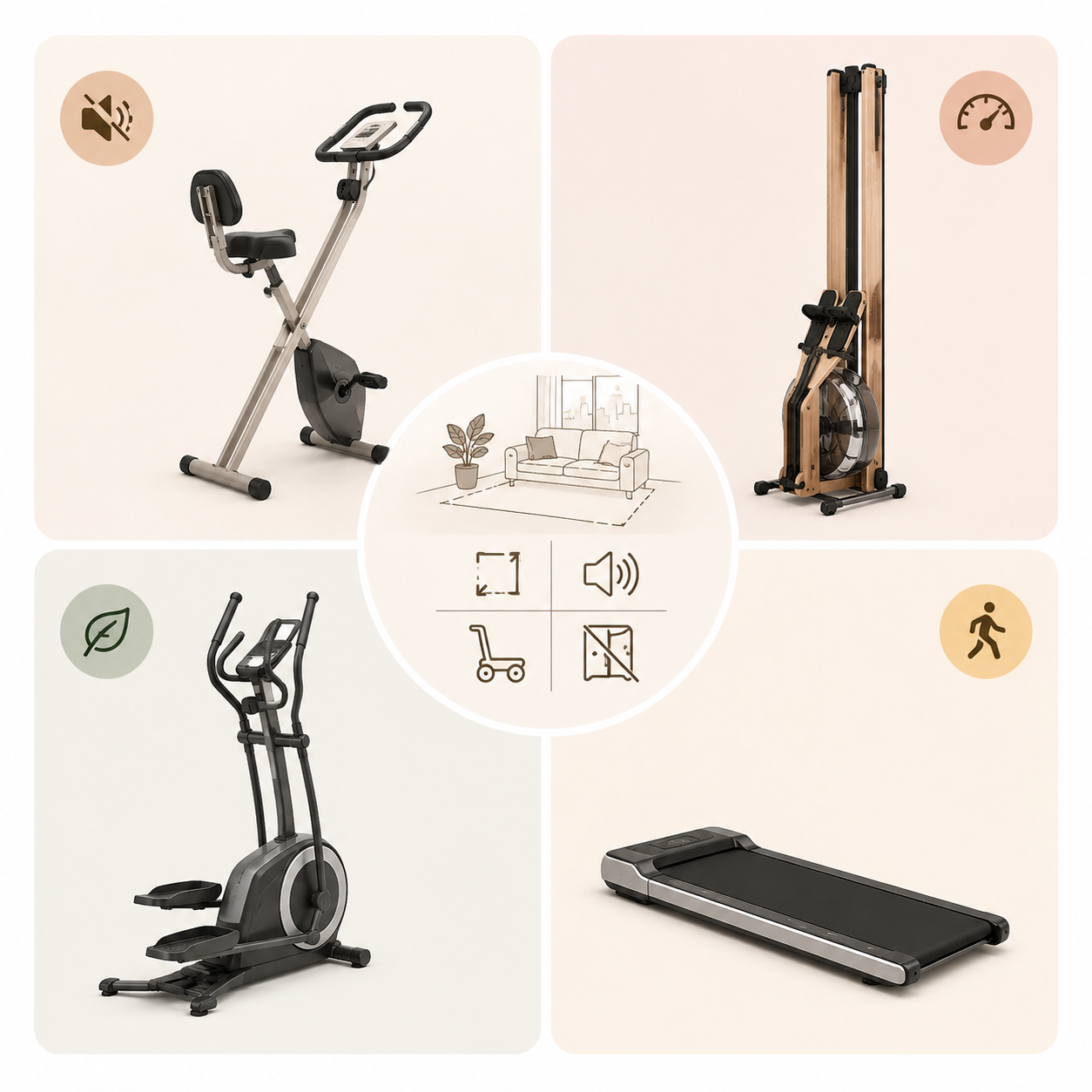
The four viable categories, side by side
| Category | Apartment strength | Main compromise | Example data point |
|---|---|---|---|
| Folding magnetic exercise bike | Quietest and easiest to move | Lower intensity ceiling than rowers or running | LEIKE X Bike: 38.5 lb, tested at 47.4 dB, under $200 in GGR’s apartment guide[1] |
| Compact vertical-stride elliptical | Low-impact motion without an outlet | Locked stride path may feel unnatural | Niceday elliptical: battery-powered, 400-lb listed capacity, 16 resistance levels, under $600[4] |
| Upright-storage rower | Strong training value with excellent storage | Air resistance is louder than magnetic equipment | Concept2 RowErg: stores vertically in 24 in × 14 in, weighs 57 lb, 500-lb listed capacity[3] |
| Under-desk treadmill | Best for walking volume and flat storage | Walking-only speed and lower capacity | WalkingPad P1: folds to 56 in × 21.5 in × 5 in, 62 lb, 3.75 mph max, 220-lb capacity[4] |
This comparison is not a ranking in disguise. A quiet bike and a vertical rower solve different problems. The useful question is not “Which is best?” but “Which compromise will I still tolerate in week eight?”
Folding magnetic bikes are the safest apartment bet
If the apartment has thin floors, shared walls, or a roommate trying to work nearby, a folding magnetic bike is usually the first category to check. The mechanical reason is simple: magnetic resistance avoids the fan roar of air resistance and the belt-and-motor sound of treadmills. The practical result is better odds that a morning ride does not become a building-wide announcement.
The LEIKE X Bike is a useful example because its numbers match the apartment problem instead of just sounding compact. Garage Gym Reviews listed it under $200, measured it at 38.5 pounds, and tested it at 47.4 dB.[1] That is light enough for most people to reposition without turning setup into a second workout, and quiet enough to sit inside the magnetic-resistance range that makes bikes attractive for upstairs units.
The trade-off is intensity. A folding X-frame bike is not pretending to be a commercial spin bike, and that matters if the goal is hard interval training or long-term progression. It can handle steady cardio, beginner sessions, and low-friction consistency. It may not satisfy someone who wants out-of-saddle riding, heavy resistance sprints, or the planted feel of a studio bike.
That is not a flaw so much as the price of the design. The frame folds because it is lighter and simpler. The ride feels less substantial for the same reason. If the machine’s job is to come out, stay quiet, and disappear, the compromise is reasonable. If the machine’s job is to replace aggressive cycling classes, a folding bike may start to feel like a polite appliance.
Compact ellipticals solve impact, not natural movement
A compact elliptical makes sense for the person who wants upright, low-impact cardio but does not want the seat position of a bike. It also works better than a treadmill for someone who needs to avoid repeated foot strikes on a hard floor. The catch is that compact ellipticals often save space by narrowing or steepening the stride path. The machine fits partly because your movement is more constrained.
The Niceday elliptical is the cleanest example in the current small-space set. Garage Gym Reviews describes it as battery-powered, so it does not need to live near an outlet, and lists a 400-pound weight capacity, 16 resistance levels, and a price under $600.[4] Testers also called it “shockingly quiet,” which matters for a category that can otherwise squeak or rock when the frame is underbuilt.[4]
Two cautions belong next to those numbers. First, a manufacturer-listed weight capacity is not the same thing as a long-term durability guarantee. It tells you what the company claims the frame can support, not how the machine will feel after months of frequent use. Second, the battery-powered design removes the outlet problem, but the available material does not establish how often the batteries need replacement for console brightness or resistance control.
The elliptical buyer should care less about whether the machine is “full body” and more about whether the stride feels tolerable. A locked stride path is fine when it matches your body. When it does not, the machine can be quiet, compact, and still wrong.
The Concept2 RowErg is the best machine here that may still be wrong for your apartment
The Concept2 RowErg creates the sharpest small-space contradiction. On paper, it does several apartment things beautifully. Garage Gym Reviews reports that it stores vertically in a 24-inch by 14-inch footprint, weighs 57 pounds, carries a 500-pound listed capacity, costs $990, requires no subscription, and includes a 5-year frame warranty.[3] TODAY also cites an expert estimate that rowing engages about 85% of the body’s muscles.[2]
That is a serious training profile for a machine that can stand in a corner. It is also why rowers keep showing up in small-space conversations: the stored footprint is almost suspiciously good compared with the workout quality. If your room has a clear strip of floor during use and a safe vertical storage spot afterward, the rower gives back the living area better than many machines with smaller marketing claims.
The problem is the fan. The RowErg uses air resistance, and Garage Gym Reviews’ noise comparison places air resistance around 55–65 dB, louder than magnetic resistance and below the loudest motorized treadmill range.[3] That does not make it unusable in every apartment. It does mean the rower’s excellent storage footprint should not distract from the sound profile.
A ground-floor apartment, a building with good insulation, or a workout schedule that avoids quiet hours changes the calculation. A thin-walled upstairs unit changes it back. The Concept2 can be the best training machine in the group and still be the wrong neighbor decision.
Under-desk treadmills are for walking volume, not running ambition
Under-desk treadmills are often sold with the most seductive small-space promise: walk while working, then slide the machine away. That promise is real for the right user. It is also easy to overbuy in your imagination and underuse in the room.
The WalkingPad P1 shows both sides. Garage Gym Reviews rates it 4.1 out of 5 and reports that it folds to 56 inches by 21.5 inches by 5 inches, weighs 62 pounds, and can store under a bed.[4] Those are genuinely apartment-friendly storage numbers. A five-inch folded height is the kind of spec that can turn “where does it go?” into a solvable question.
The performance ceiling is just as clear: the WalkingPad P1 maxes out at 3.75 mph and has a 220-pound capacity.[4] That is walking equipment. It is not a runner’s workaround, and it is not the right choice for someone who needs jogging-intensity cardio from a single machine.
The other issue is vibration. Motorized treadmills sit in the 60–75 dB range in Garage Gym Reviews’ comparison, but a decibel number does not capture every thud transferred through a floor.[3] Placement matters. Carpet helps more than bare hard flooring, and a mat can reduce some vibration. For apartment-specific options, home gym flooring for apartments covers basic mat choices, including interlocking foam setups.
What the saved space becomes matters
A machine that folds is not automatically a machine that works in a small apartment. Folding helps only if the folded object has somewhere realistic to go and if putting it away is easy enough to repeat. A rower standing vertically in a corner, a treadmill sliding under a bed, and a bike folding beside a closet all solve different versions of the same problem: restoring the room.
This is where weight becomes more than a spec. A 38.5-pound bike can be moved casually by many users.[1] A 57-pound rower is still manageable for many people because the storage motion is built into the design.[3] A 62-pound under-desk treadmill may be fine if it rolls cleanly and stores near where it is used.[4] Once a machine approaches the point where moving it feels like furniture handling, “I’ll put it away every time” becomes less believable.
The best small-space setup is not always the smallest object. It is the one with the shortest path from stored to usable to stored again. If that path requires moving the coffee table, unplugging a lamp, warning a roommate, and dragging 100-plus pounds across the floor, the room will eventually win.
For a full-room approach that includes where cardio fits alongside strength training, storage, and open floor space, see the apartment dweller’s compact home gym setup. If you are still deciding between cardio and other compact equipment first, home exercise equipment for small spaces gives the broader comparison.
Match the machine to the compromise you can live with
Start with the constraint that would actually make you stop using the machine. If it is noise, choose the folding magnetic bike first. It gives up some intensity, but it is the least likely category here to create a neighbor problem, and the LEIKE X Bike’s 47.4 dB test result is the kind of number that matters in an apartment.[1]
If training quality matters more than maximum quiet, the upright-storage rower is the stronger pick. The Concept2 RowErg is hard to dismiss: strong capacity, no subscription requirement, serious conditioning value, and a storage footprint that beats many weaker machines.[3] The cost is fan noise. In a building where 55–65 dB air resistance would carry, that cost may be too high.[3]
If low-impact upright movement matters most, the compact elliptical earns a look. The Niceday removes the outlet issue and offers a high listed capacity, but the locked stride path has to feel good to your body.[4] Do not buy that category just because it seems like the middle ground between a bike and a treadmill. Buy it because you want that particular motion.
If the goal is more daily walking, not harder cardio, the under-desk treadmill is the cleanest match. The WalkingPad P1 folds impressively flat and stores in places most cardio machines cannot, but its 3.75 mph ceiling and 220-pound capacity define the lane clearly.[4] It is for steps, not running.
Prices in this category can move with sales, and the figures cited here come from published retail data available in June 2026. Capacity claims also deserve caution, especially on budget equipment, because listed limits do not prove long-term durability under frequent use. For a broader buying framework that includes space, storage, noise, budget, and progression, use how to choose compact home gym equipment based on your real constraints before committing to a machine.
For most upstairs apartments, the bike is the safest choice. For stronger conditioning with better storage than expected, the rower is tempting. For low-impact stability, the elliptical has a specific case. For walking volume, the under-desk treadmill is the honest match. None of them removes the compromise; the useful one makes the compromise obvious before the box arrives.
References
- Best Workout Equipment for Apartments (2026), Garage Gym Reviews.
- What is the Best Cardio Machine?, TODAY Show.
- Tested and Reviewed: The 10 Best Cardio Machines for 2026, Garage Gym Reviews.
- The Best Compact Exercise Equipment (2026), Garage Gym Reviews.
Comments
Join the discussion with an anonymous comment.