Strength training for women over 40 at home does not have to mean turning the living room into a gym or learning a dozen barbell lifts before dinner. The starting question is smaller and more useful: if you have 20 to 35 minutes, a bit of floor space, and maybe one pair of dumbbells, can you do enough to matter?
The answer is yes. In a 2024 analysis reported in JACC and covered by NPR, women who did strength training 2 to 3 days per week had a 30% lower risk of cardiovascular mortality and a 24% lower risk of all-cause mortality; the association was independent of aerobic exercise.[1] That does not prove that lifting weights alone caused the lower risk. It does, however, put a hard edge on something many women sense after 40: muscle is not cosmetic padding. It is working tissue tied to how you move, age, recover, and remain independent.
The public-health baseline is also modest. The World Health Organization and the American College of Sports Medicine recommend muscle-strengthening activities at moderate or greater intensity at least 2 days per week, yet only about 1 in 5 U.S. women meet that guideline.[2] So if you are not lifting yet, you are not unusually behind. You are standing at the same starting line as many women who were never taught what to do with a dumbbell in the first place.
Why Strength Training Starts To Matter More After 40
After 40, the body becomes less forgiving of long gaps in strength work. Muscle mass declines with age, and estimates commonly cited in clinical and health sources put the loss at 3% to 8% per decade after age 30, accelerating to 5% to 10% per decade after age 50.[3] Menopause adds another layer because estrogen decline affects muscle, bone, fat distribution, and recovery. This is not a warning that your body is falling apart. It is a reason to stop treating strength work as optional.
Muscle helps you get off the floor, carry groceries, climb stairs, protect joints, and tolerate everyday stress without everything feeling like a maximal effort. Bone also responds to load. A body that regularly pushes, pulls, squats, hinges, braces, and carries is receiving a different message than one that only walks or stretches.
It is also not too late. Mayo Clinic Press notes that resistance training can slow and, in many cases, reverse age-related changes in muscle fibers, even among people who begin after age 70.[4] That matters because shame is a terrible training plan. Starting at 43, 52, or 68 is still starting.
What Counts As Enough For A Beginner?
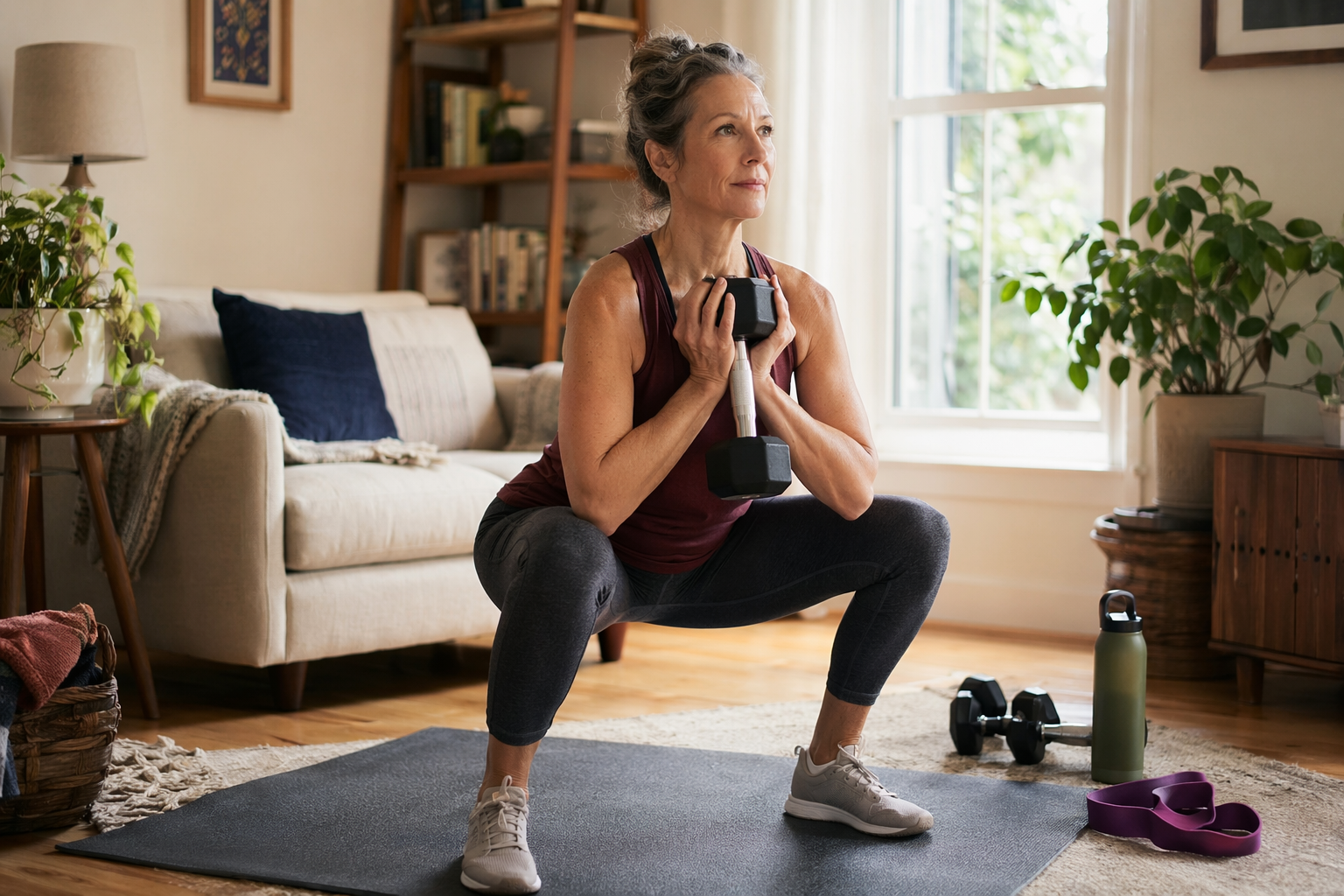
For a beginner at home, “enough” is not the most complicated program you can tolerate. It is a repeatable routine that trains the major movement patterns 2 to 3 times per week and becomes gradually harder as your body adapts.
Reviews and trials give some guardrails. A systematic review of 26 studies in post-menopausal women ages 50 to 80 found that programs averaging 3 workouts per week, 7.5 exercises, and 9 to 16 repetitions per set consistently produced muscle-mass gains.[5] A separate review on time-efficient training concluded that protocols using as few as 3 sets per exercise, 2 to 3 days per week can produce meaningful strength and hypertrophy gains in older adults.[6]
That gives a beginner permission to begin with a simple full-body plan. You do not need a split routine, a garage full of machines, or a spreadsheet of percentages. You need enough resistance that the last few reps feel challenging while your form stays steady.
| If you are starting from... | Begin with... | A good first goal |
|---|---|---|
| No strength training experience | 2 full-body sessions per week | Learn the movements and finish without joint pain |
| Some exercise background | 2 to 3 full-body sessions per week | Add reps or load every 1 to 2 weeks when form is solid |
| Post-menopause and focused on muscle gain | 3 sessions per week, eventually more total sets | Build toward higher weekly volume over time |
There is one caveat worth naming without making it the center of the room. In a 20-week controlled trial of middle-aged pre- and post-menopausal women doing free-weight strength training, post-menopausal participants did not show significant muscle-mass gain at 6 to 8 sets per muscle group per week, although strength gains were still achievable at any intensity.[7] The trial was small, with 31 completers, so it should not be treated as the final word. It does suggest that if your long-term goal is visible hypertrophy after menopause, a token routine may eventually need to become a more substantial one.
The Equipment You Actually Need
Start with what reduces friction. If the equipment has to be dragged out of a closet, assembled, and apologized for because it blocks the hallway, it will lose to an ordinary Tuesday.
- Best first purchase: one medium pair of dumbbells you can press overhead for 8 controlled reps.
- Most flexible setup: 2 to 3 dumbbell pairs, usually light, medium, and heavy.
- Small-space option: a set of resistance bands with handles or loop bands.
- No-equipment option: bodyweight squats, wall push-ups, glute bridges, planks, step-ups, and carries using household items.
- Household substitutions: water jugs, a backpack loaded with books, or a sturdy tote bag for rows and carries.
Bodyweight is a legitimate starting point, especially if you are learning positions and managing joint sensitivity. If you want more detail on why no-equipment work can still create a training stimulus, see Bodyweight Training Actually Works. If space is your biggest problem, How to Build a Home Gym in Under 50 Square Feet is more useful than buying one more thing you have nowhere to put.
The Five-Move Home Strength Routine
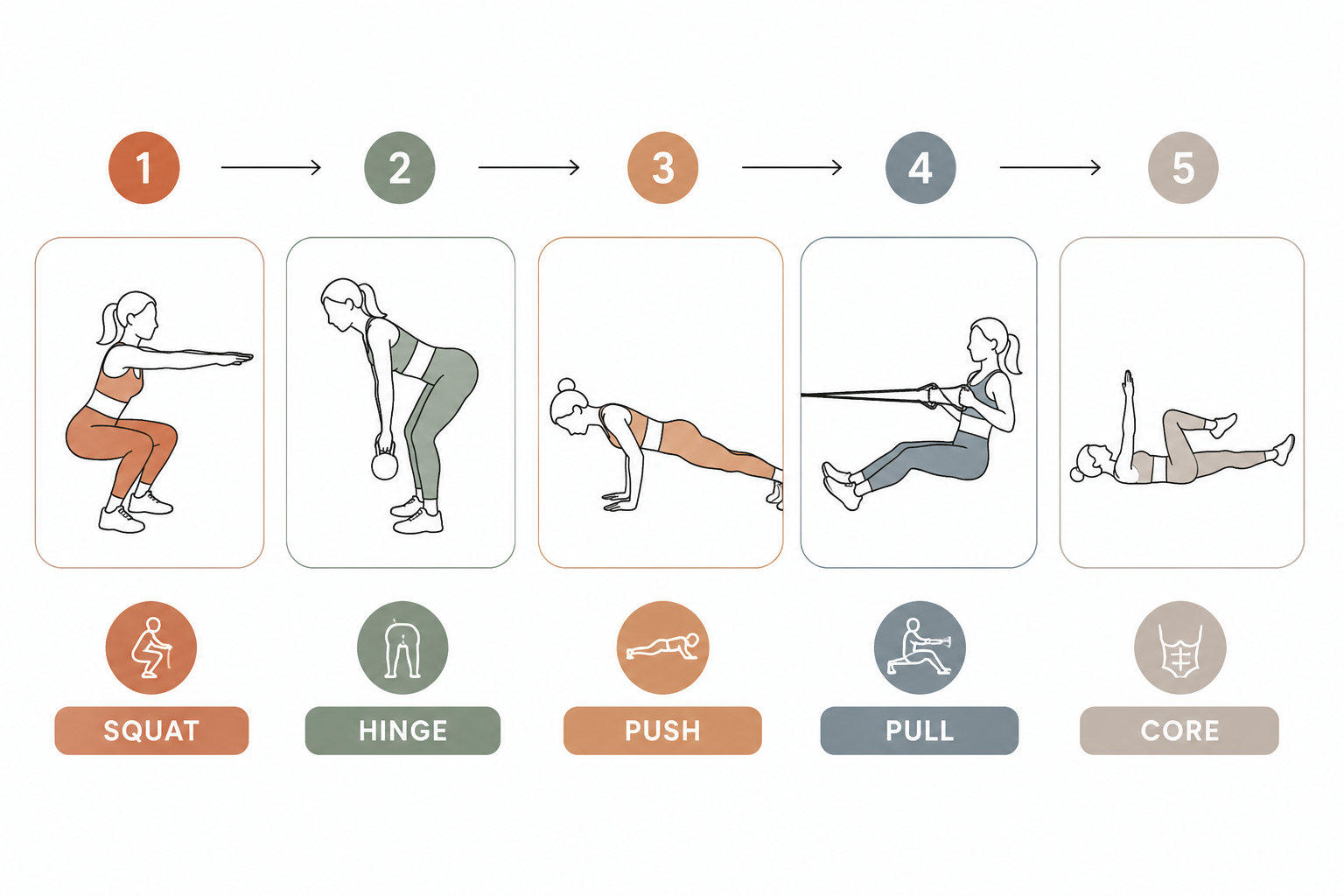
This routine trains five foundational patterns: squat, hinge, push, pull, and core or anti-rotation. Do it 2 days per week for the first 2 to 4 weeks. If you are recovering well and want more, add a third day.
| Pattern | Beginner exercise | Sets and reps | Rest |
|---|---|---|---|
| Squat | Chair squat or goblet squat | 2 to 3 sets of 8 to 12 reps | 60 to 90 seconds |
| Hinge | Glute bridge or dumbbell Romanian deadlift | 2 to 3 sets of 8 to 12 reps | 60 to 90 seconds |
| Push | Wall push-up, incline push-up, or dumbbell floor press | 2 to 3 sets of 8 to 12 reps | 60 to 90 seconds |
| Pull | Resistance band row or one-arm dumbbell row | 2 to 3 sets of 8 to 12 reps per side | 60 to 90 seconds |
| Core / anti-rotation | Dead bug, plank, or farmer carry | 2 to 3 sets of 20 to 40 seconds | 45 to 75 seconds |
Use a resistance level that leaves about 2 good reps in reserve. If you finish a set and know you could have done 10 more, it is too easy for a working set. If your form changes before you reach the target range, it is too heavy or too advanced for today.
Warm Up In Five Minutes
The warm-up is not a performance. It is a short ramp from sitting, driving, or computer posture into loaded movement.
- March in place or step side to side for 60 seconds.
- Do 8 slow bodyweight squats to a chair.
- Do 8 hip hinges with hands on hips, pushing your hips back toward the wall.
- Do 8 wall push-ups.
- Do 6 dead bugs per side or 20 seconds of easy planking.
1. Squat: Chair Squat Or Goblet Squat
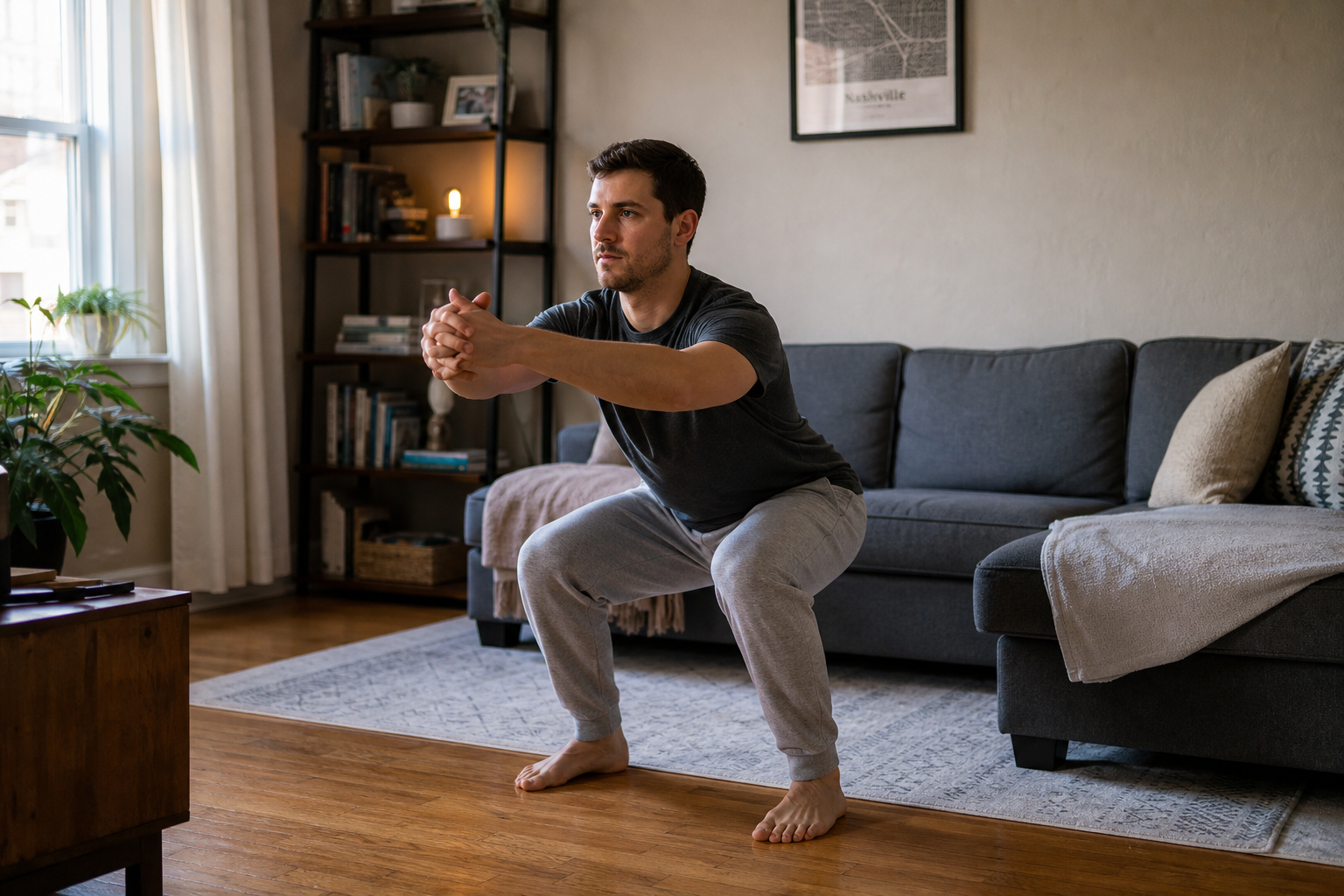
Stand in front of a sturdy chair with feet about hip- to shoulder-width apart. Sit your hips back, lightly tap the chair, then stand. Keep your ribs stacked over your hips and your knees tracking in the same direction as your toes. If this is easy, hold one dumbbell at your chest for a goblet squat.
- Make it easier: use a higher chair or hold a countertop lightly for balance.
- Make it harder: slow the lowering phase to 3 seconds or add a dumbbell.
- Watch for: knees collapsing inward, heels lifting, or dropping onto the chair instead of controlling the descent.
2. Hinge: Glute Bridge Or Dumbbell Romanian Deadlift
If the hinge pattern is new, start on the floor with glute bridges. Lie on your back, knees bent, feet flat. Press through your feet and lift your hips until your body forms a line from shoulders to knees. Pause, then lower with control.
When that feels comfortable, move to a dumbbell Romanian deadlift. Hold dumbbells in front of your thighs, soften your knees, and push your hips back as the weights slide down your legs. Stop when you feel a stretch in the back of your thighs or when your back wants to round, then stand by driving your hips forward.
- Make it easier: stay with glute bridges and pause for 1 second at the top.
- Make it harder: use heavier dumbbells or add a slow lowering phase.
- Watch for: turning the hinge into a squat, rounding your lower back, or reaching the weights toward the floor just to go lower.
3. Push: Wall Push-Up, Incline Push-Up, Or Dumbbell Floor Press
For push-ups, the wall is not a failure setting. It is an angle. Start with hands on a wall or countertop, body in a straight line, and elbows moving about 30 to 45 degrees from your sides. Lower your chest toward the surface, then press away.
If wrists or shoulders prefer dumbbells, lie on the floor with one dumbbell in each hand. Press the weights above your chest, lower until your upper arms touch the floor, then press again. The floor gives you a clear stopping point, which is one reason this variation works well at home.
4. Pull: Band Row Or One-Arm Dumbbell Row
Pulling is the pattern most home routines accidentally skip. Anchor a resistance band securely at chest height, hold the handles, and pull your elbows back as if you are moving them toward your back pockets. If you are using a dumbbell, place one hand on a chair or bench, hinge slightly, and row the weight toward your ribs.
- Make it easier: use a lighter band or row from a more upright position.
- Make it harder: pause for 1 second at the top of each row.
- Watch for: shrugging the shoulders toward the ears or twisting the torso to move the weight.
5. Core: Dead Bug, Plank, Or Farmer Carry
Core training after 40 does not need to be a long series of crunches. The useful skill is bracing while your arms or legs move. For dead bugs, lie on your back with arms up and knees bent over hips. Slowly lower one heel and the opposite arm while keeping your lower back from arching hard off the floor. Return and switch sides.
For a farmer carry, hold a weight in each hand and walk slowly for 20 to 40 seconds. If space is limited, march in place. The point is to stay tall while the weights try to pull you out of position.
A Simple Weekly Schedule
Two sessions per week is the minimum worth protecting. Three is a strong next step. More is not automatically better if it turns the plan into something you avoid.
| Week setup | Monday | Tuesday | Wednesday | Thursday | Friday | Weekend |
|---|---|---|---|---|---|---|
| 2-day beginner | Strength | Walk or rest | Rest | Strength | Walk or mobility | Rest or easy activity |
| 3-day beginner | Strength | Walk or rest | Strength | Rest | Strength | Easy activity |
| Busy-week fallback | Strength | Rest | 10 to 20 minute walk | Strength | Rest | Optional short session |
If 35 minutes sounds unrealistic right now, do one warm-up round and 2 sets of each exercise. That is still a real session. For a shorter format, Why 20-Minute Home Workouts Work for Beginners pairs well with this routine.
How To Progress Without Turning It Into A Second Job
For the first 2 weeks, progress means showing up and learning the shapes. After that, use one lever at a time.
- Add reps first: move from 8 reps toward 12 reps with the same weight.
- Then add load: once all sets hit 12 clean reps, use a heavier dumbbell or stronger band.
- Then add sets: move from 2 sets to 3 sets for the main exercises.
- Then add a day: go from 2 weekly sessions to 3 if recovery is good.
This is where many beginners get impatient. A workout that felt awkward in week 1 can feel almost too easy in week 4, and that is not a sign it stopped working. It is a sign your body learned it. Add a little resistance or another set, not an entirely new routine every Monday.
If your goal shifts from general strength to more visible muscle gain, you may eventually need more weekly volume. That is when a plan like Build Muscle with This 3-Day Dumbbell-Only Full-Body Plan makes sense. It is a next step, not a prerequisite for beginning.
What If Your Knees, Wrists, Or Back Complain?
Some muscle effort is expected. Sharp joint pain is not the price of admission. If a movement hurts, change the range, angle, load, or exercise.
| If this bothers you | Try this instead |
|---|---|
| Knees during squats | Use a higher chair, reduce depth, slow down, or try sit-to-stand reps |
| Wrists during push-ups | Use wall push-ups, dumbbell handles, or dumbbell floor presses |
| Lower back during hinges | Return to glute bridges and practice the hip-hinge pattern unloaded |
| Shoulders during overhead work | Use floor presses or incline push-ups before overhead pressing |
| Balance during carries or squats | Stand near a wall or countertop and reduce the load |
For persistent knee sensitivity, use a lower-impact plan such as Low-Impact Workout for Knee Pain You Can Do at Home. For form help, a beginner-friendly app can be useful if it shows clear demonstrations and lets you repeat the basics instead of constantly chasing novelty; The Best Strength Training Apps for Absolute Beginners Learning Proper Form is a practical place to compare options.
Protein, Recovery, And The Part Between Workouts
Strength training sends the signal. Food and recovery help you adapt to it. Protein recommendations vary, but a practical range for active women is roughly 0.54 grams per pound of body weight on the conservative end, based on Mayo Clinic guidance, up to about 0.7 to 1 gram per pound used in many fitness-oriented recommendations.[8] You do not need to turn meals into math every day, but you do need enough protein distributed across the day to support repair.
Recovery is similar. Sleep, rest days, easy walking, and not stacking hard sessions on top of poor sleep all matter. If soreness keeps derailing the next workout, the solution is usually less drama: reduce a set, use a lighter weight, and build back. For a more complete recovery setup, see Your Complete Post-Workout Recovery Routine at Home.
Where Heavy Lifting And Gym Training Fit
There are good reasons some women eventually move into heavier gym training: more load options, barbells, machines, and easier progression. There are also advanced approaches that use very heavy weights for low reps, especially in perimenopause-focused strength discussions. Those can be useful later for the right person with the right coaching, but they are not the first problem to solve in a living room.
For now, the job is to make the baseline unavoidable in the best way: 2 or 3 weekly sessions, the same five patterns, enough resistance to make the final reps honest, and a progression you can repeat without needing a new identity.
Next week, that might look like chair squats, glute bridges, wall push-ups, band rows, and farmer carries on Monday and Thursday. It might take less than the time between starting dinner and hearing the oven timer. That is not a consolation prize compared with the gym. For a woman over 40, it is a credible starting intervention with real upside for strength, longevity, and independence.
References
- Strength training boosts longevity, mood and metabolism as it builds muscle, NPR, March 11, 2024, https://www.npr.org/sections/health-shots/2024/03/11/1236791784/strength-resistance-weight-training-longevity-aging-heart-disease
- Physical activity, World Health Organization, https://www.who.int/news-room/fact-sheets/detail/physical-activity
- The best way to work out after menopause, UCLA Health, https://www.uclahealth.org/news/article/best-way-work-out-after-menopause
- The many benefits of resistance training as you age, Mayo Clinic Press, https://mcpress.mayoclinic.org/healthy-aging/the-many-benefits-of-resistance-training-as-you-age/
- Resistance training interventions in postmenopausal women: a systematic review, Aging Clinical and Experimental Research, 2021
- No Time to Lift? Designing Time-Efficient Training Programs for Strength and Hypertrophy: A Narrative Review, Sports Medicine, 2021
- Resistance training alters body composition in middle-aged women depending on menopause - A 20-week controlled trial, BMC Women's Health, 2023, https://pmc.ncbi.nlm.nih.gov/articles/PMC10559623/
- Are you getting too much protein?, Mayo Clinic Health System, https://www.mayoclinichealthsystem.org/hometown-health/speaking-of-health/are-you-getting-too-much-protein
Comments
Join the discussion with an anonymous comment.