
Most advice about low impact exercise equipment splits the problem in half. One list tells you what is gentle on knees and hips. Another tells you what fits in an apartment. The useful answer is the overlap: equipment you can actually keep in the room, use often enough to approach the CDC’s adult guideline of 150 minutes of moderate-intensity aerobic activity per week, and put away before it becomes part of the dining furniture. [1]
That is why the first decision is not rower versus bike versus elliptical. It is where the thing lives when nobody is exercising.
Start with the space tier, then choose the equipment
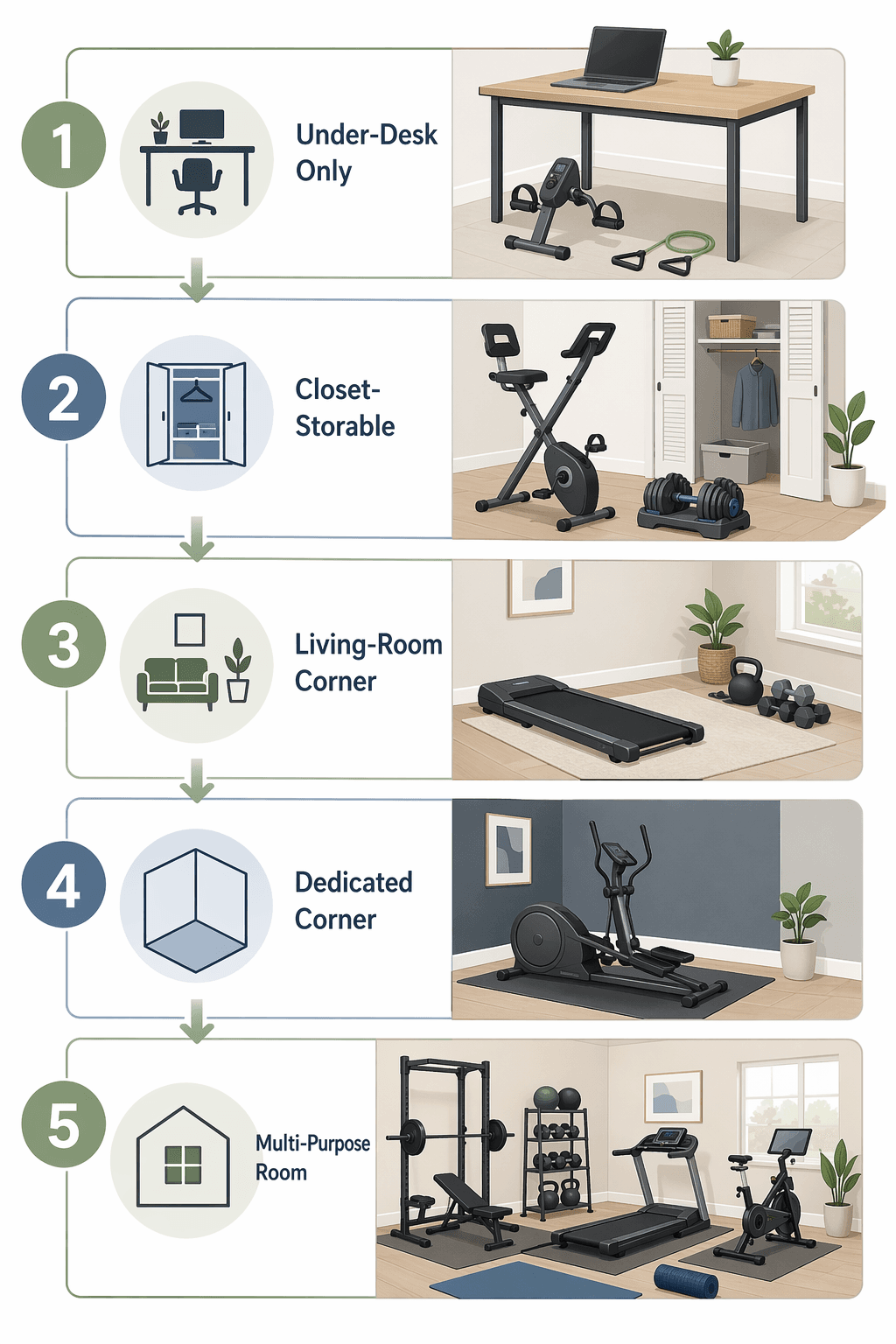
The five tiers below are not rankings. A dedicated-corner rower may deliver more output per session, but an under-desk pedaller may win in a real apartment because it gets used during calls, disappears under the desk, and never asks anyone to rearrange the living room. Hypervibe’s equipment analysis rates under-desk pedallers, recumbent bikes, and rowing machines around 1 out of 5 for joint load, with walking pads and ellipticals around 2 out of 5; treat that as a product-analysis framework, not a clinical standard. [2]
| Space tier | Best low-impact combination | Typical budget | Likely noise profile | Best use case |
|---|---|---|---|---|
| Under-desk only | Pedal exerciser or under-desk elliptical + resistance bands | $100–$200 | Generally quiet if magnetic resistance; minimal floor vibration | Remote workers, zero open floor space, very small studios |
| Closet-storable | Folding exercise bike + adjustable dumbbells | $300–$500 | Usually apartment-friendly; depends on bike resistance and floor contact | Beginners who need cardio and strength without a permanent setup |
| Living-room corner | Walking pad + resistance band system | $400–$700 | Low impact, but motor hum and footfall transfer still matter | People who will walk during TV, calls, or short work breaks |
| Dedicated corner | Compact elliptical or compact rower | $500–$1,500 | Magnetic machines tend to be quieter; air rowers can be louder | Higher-output cardio when one corner can stay assigned to fitness |
| Multi-purpose room | Folding treadmill + adjustable kettlebells | $800–$2,000 | Most noise-sensitive tier; matting and placement matter more | A spare room, office, or flex room that can handle setup time |
The right tier should feel slightly boring. If a machine requires moving a coffee table, opening a closet, finding shoes, waking a tablet, and apologizing to the downstairs neighbor, it has to be an unusually good workout to survive regular life. For small spaces, the best equipment is usually the setup with the fewest excuses built into it.
Tier 1: Under-desk only
This is the tier for people who do not have a workout area. Not a small workout area. None. The equipment has to live under a desk, beside a chair, or behind a door, and it has to work in clothes that are not necessarily workout clothes.
A pedal exerciser or under-desk elliptical paired with resistance bands is the most honest setup here. The cardio is modest, but it is accessible. Hypervibe lists an under-desk pedal exerciser at roughly 100–250 kcal per hour for a reference person of about 70 kg, compared with higher ranges for larger machines; the point is not that the number is guaranteed, but that the category trades intensity for availability. [2]
The bands matter because pedalling alone does not solve the strength side. The Arthritis Foundation includes resistance bands among joint-friendly equipment options, especially because they allow controlled resistance without heavy loading or impact. [5] In a no-floor-space setup, that matters more than owning a machine with a console full of programs.
- Choose this tier if the equipment must stay invisible between uses.
- Favor magnetic resistance where possible because it generally tends to be quieter than fan-based resistance.
- Add bands for rows, presses, pull-aparts, and supported lower-body work.
- Do not expect a desk pedaller to feel like a full studio cycling session; expect it to turn otherwise seated time into movement.
Tier 2: Closet-storable
Closet-storable is the first tier where a real cardio session becomes practical without giving the machine a permanent address. The usual combination is a folding exercise bike and adjustable dumbbells. It is not glamorous, but it solves a specific apartment problem: cardio and strength can share one storage zone.
The bike does the quiet repetitive work. A recumbent or upright cycling motion is among the lowest-impact options in Hypervibe’s equipment scoring, with recumbent bikes listed around 1 out of 5 for joint load and roughly 300–500 kcal per hour for a 70 kg reference person. [2] The calorie range should not be treated as a promise; resistance, cadence, body size, and fitness level all change the result. But it does show why a bike earns its closet space more easily than a gadget that only handles warmups.
The dumbbells make the setup feel less like a cardio appliance and more like a small training station. Adjustable dumbbells are not low-impact in the same sense as a bike, but they let you train without jumping, pounding, or clearing a large floor area. For beginners, this is often enough: ride, lift, fold, close the door.
The hidden test is the under-two-minute transition. If the bike can roll or fold out, lock open, and be ready before your motivation leaks away, it belongs in this tier. If it requires wrestling with pins, dragging across carpet, or removing stored items from on top of it, it is not really closet-storable; it is just stored.
Tier 3: Living-room corner
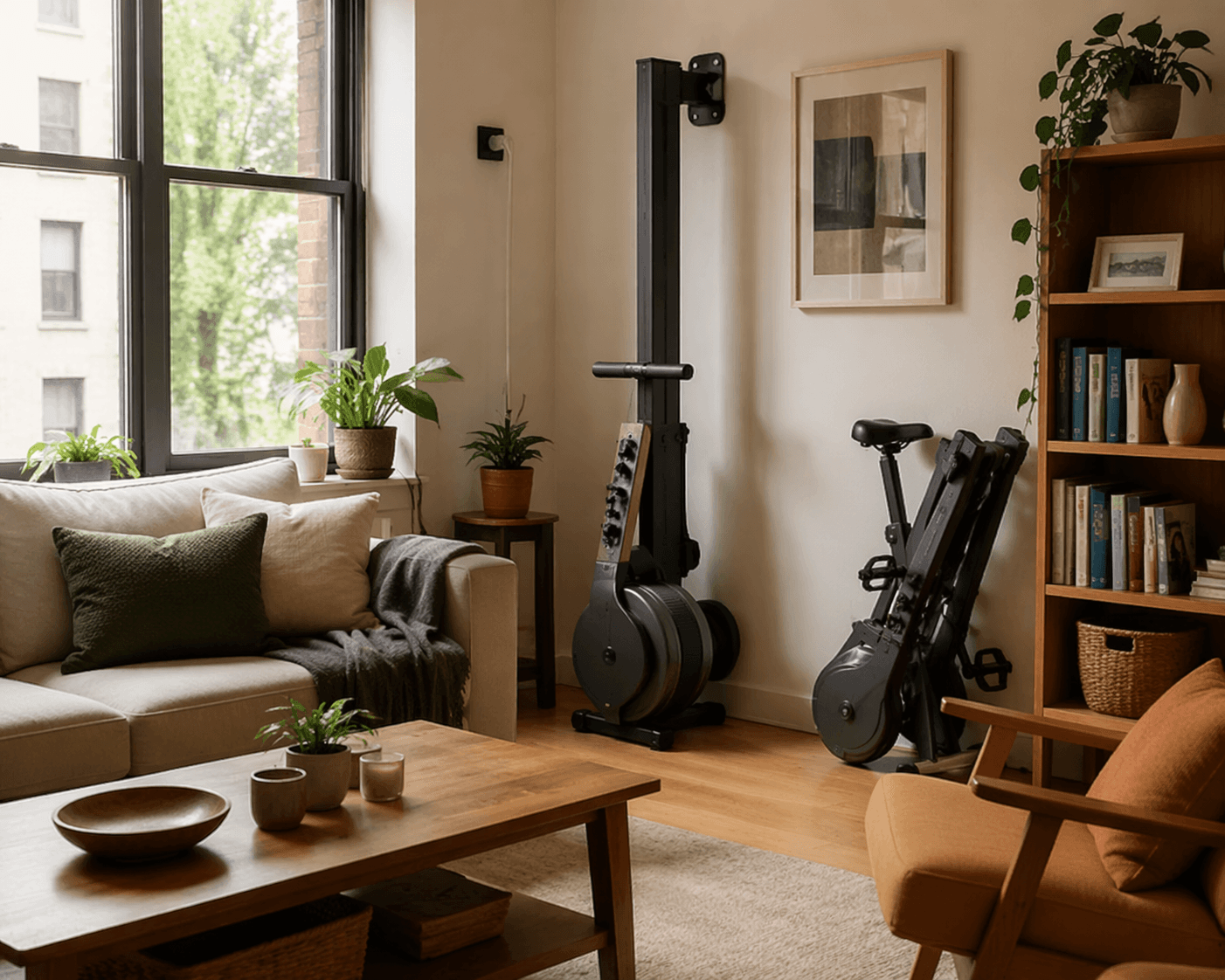
A living-room corner changes the calculation because the equipment no longer has to vanish completely. It still has to behave. A walking pad is often the most useful upgrade here because it turns spare minutes into low-impact movement without requiring the bounce, stride length, or ceiling clearance of running.
Walking pads are usually described as low impact because one foot remains in contact with the belt through most of the gait cycle. Hypervibe’s analysis places walking pads around 2 out of 5 for joint load. [2] That does not make them silent. A motor, belt, footfall pattern, and floor structure can still carry sound, especially in upstairs apartments. This is where “low impact” and “quiet enough” overlap, but they are not identical.
The living-room-corner setup works best when the walking pad has one normal parking place: under a sofa, against a wall, or behind a console table. Add a resistance band system on a door anchor or stored in a basket, and the corner can cover both steady cardio and basic strength. If the pad has to be dragged from a bedroom closet every time, it may belong mentally in Tier 2, even if it technically fits in the room.
For apartment floors, use placement as a filter before brand. Avoid shared-wall corners when possible, put the machine on a stable mat, and keep the belt maintained so it does not add avoidable squeaks or rubbing. For a deeper pass on floor protection, this is where a dedicated guide to home gym flooring for small spaces and apartments is more useful than another product roundup.
Tier 4: Dedicated corner
Once one corner can stay assigned to fitness, compact rowers and compact ellipticals become much more interesting. They ask for more room than an under-desk machine, but they pay back with fuller movement and higher potential output.
A compact elliptical is the easier sell for many joint-sensitive users because the motion is guided, upright, and familiar. Hypervibe lists compact ellipticals around 2 out of 5 for joint load and roughly 350–550 kcal per hour for a 70 kg reference person. [2] Garage Gym Reviews’ compact equipment testing lists the Bowflex Max Trainer M6 at 46 inches long by 26 inches wide, compared with an average standard elliptical length of about 62 inches. [3] That difference is exactly the kind of measurement that matters in a room where the sofa already won.
A rower is the more demanding choice, both physically and spatially, but it has one excellent small-space trick: vertical storage. Garage Gym Reviews notes the Concept2 RowErg at 57 pounds, with vertical storage reducing its footprint to about 2.5 square feet. [3] That does not mean every rower belongs in every apartment. It means a long machine can become a narrow stored object if the user can safely tip it up and has a wall zone where it is not in the way.
The output trade-off is real. Hypervibe’s analysis gives rowing machines a roughly 400–700 kcal-per-hour range for a 70 kg reference person and a joint-load score around 1 out of 5. [2] But rowing also asks for technique, coordination, and a tolerance for repeated leg drive. Someone coming back from joint pain may still need professional guidance, especially if symptoms are active or unexplained. The machine can be low impact and still be the wrong starting point.
Rower or elliptical in a corner?
| Choose the rower if... | Choose the compact elliptical if... |
|---|---|
| You want higher whole-body cardio potential and can store it vertically. | You want a more familiar upright motion with less technique learning. |
| You have enough clearance to row without hitting furniture. | You need the machine to stay usable without changing the room layout. |
| You can tolerate the sound profile of the resistance type you choose. | You are prioritizing steady, repeatable sessions over peak output. |
Tier 5: Multi-purpose room
A multi-purpose room can handle larger gear, but it still should not become a graveyard of almost-folded equipment. This is the tier for a folding treadmill plus adjustable kettlebells, or a similar cardio-and-strength pairing that can support longer sessions without forcing the room to become a permanent gym.
The treadmill is the noisiest candidate in this guide because even walking adds repeated belt contact and footfall transfer. It may still be the right choice for someone who wants indoor walking with handrails, predictable pacing, or weather-proof consistency. But in an apartment, a folding treadmill should be chosen with the downstairs neighbor in mind: machine weight, deck feel, placement, and matting all matter.
Adjustable kettlebells add strength without a rack of weights, but the low-impact version of kettlebell training is controlled. Deadlifts, goblet squats to a box, carries, and presses make more sense here than ballistic moves if noise and joint comfort are the constraints. If the room is above another apartment, even setting the bell down becomes part of the workout design.
Noise is a selection criterion, not an afterthought
There is no decibel table in the available research comparing every machine type in a lab-controlled apartment floor. So the honest version is softer: magnetic resistance machines generally tend to be quieter than air-resistance or fan-resistance machines, while treadmills and walking pads add motor and belt noise on top of foot contact. That is enough to use noise as a buying filter, but not enough to promise silence.
Consumer Reports advises matching cardio machines to fitness goals, available space, and practical use conditions rather than buying on features alone. [6] The American Academy of Orthopaedic Surgeons similarly emphasizes trying equipment when possible and considering whether it fits the user’s needs and home environment. [7] For small apartments, “home environment” includes the person downstairs, the person on a video call, and the person trying to eat dinner next to the folded bike.
- If you share walls or floors, favor magnetic bikes, under-desk ellipticals, and compact ellipticals before fan-based machines.
- If you choose a rower, check whether the resistance type matches your noise tolerance.
- If you choose a walking pad or treadmill, treat matting and placement as part of the purchase, not an accessory.
- If a machine rattles during setup, it will probably annoy you before it annoys anyone else.
For readers whose main constraint is sound, the equipment decision should connect directly to a routine. A quiet machine still needs quiet programming: steady walking, cycling intervals without stomping, controlled rows, and no-jumping circuits. The Complete Quiet Cardio Guide for Apartment Dwellers is the better next step once the equipment tier is clear.
Workout quality per square foot
A compact machine earns space in two ways: it either produces enough workout quality to justify a permanent footprint, or it disappears so easily that moderate output becomes acceptable. That is why the smallest setup is not automatically the weakest and the largest setup is not automatically the best.
| Equipment | Small-space role | Approximate output context | Storage reality |
|---|---|---|---|
| Under-desk pedaller | Turns seated time into low-friction movement | About 100–250 kcal/hr for a 70 kg reference person | Can live under a desk; lowest setup friction |
| Folding bike | Quiet cardio anchor for closet-storable setups | Recumbent-bike category about 300–500 kcal/hr for a 70 kg reference person | Good only if unfolding is fast and repeatable |
| Walking pad | Makes casual walking available indoors | Joint-load score around 2/5 in Hypervibe’s analysis | Best when it has a fixed parking place |
| Compact elliptical | Steady low-impact cardio in a dedicated corner | About 350–550 kcal/hr for a 70 kg reference person | Shorter models can fit where standard ellipticals cannot |
| Compact rower | Higher-output whole-body cardio | About 400–700 kcal/hr for a 70 kg reference person | Long in use; some models store vertically |
The table also shows why a single “best low-impact machine” is the wrong frame. A rower may have the highest listed output range here, but if it blocks a doorway or feels too loud at night, it loses. A pedaller may have the lowest output range, but if it adds 20 or 30 minutes of movement on days that would otherwise be completely sedentary, it may be the more successful small-space tool.
A tier-matched shortlist
If you are still measuring, do not start with model names. Start with the tier you can maintain on a normal weekday.
- Under-desk only: pedal exerciser or under-desk elliptical, plus resistance bands.
- Closet-storable: folding bike, adjustable dumbbells, and a clear two-minute setup path.
- Living-room corner: walking pad, band system, and a permanent parking spot.
- Dedicated corner: compact elliptical if you want simple steady cardio; compact rower if you want higher-output sessions and can manage storage.
- Multi-purpose room: folding treadmill plus adjustable kettlebells, with matting and noise control planned from the start.
Readers who are still unsure about room dimensions should use a space-first guide such as Compact Home Gym by Room Size. If the decision is between modular gear and a single compact machine, the comparison of all-in-one vs. separate equipment will be more useful than adding another machine to the cart. And if the room is ready but the habit is not, start with no-jumping cardio at home before buying upward.
Low-impact equipment works unusually well in small spaces because the same traits that reduce joint stress often reduce chaos: less jumping, less jarring, smaller movement patterns, and more machines that can fold, roll, or stand upright. The best setup is the quietest, lowest-friction combination you can repeat often enough to matter.
References
- Adult Activity: An Overview — CDC
- Best Low‑Impact Exercise Equipment for Seniors — Hypervibe
- Expert-Tested: The Best Compact Exercise Equipment (2026) — Garage Gym Reviews
- 13 best low impact exercise equipment for at-home workouts — Today.com
- Best Exercise Equipment for Arthritis — Arthritis Foundation
- Best Cardio Machines to Meet Your Fitness Goals — Consumer Reports
- Selecting Home Exercise Equipment — AAOS
Comments
Join the discussion with an anonymous comment.