
Searching for the best home exercise bike usually gives you a shelf of impressive machines: a studio bike with a polished screen, a compact folder, a recumbent model with a wide seat, maybe an air bike that looks ready to punish a garage athlete. The problem is not that those bikes are bad. The problem is that they are being asked to solve different lives.
A bike that is excellent for a rider who loves live classes can be a poor choice for someone who refuses another monthly fee. A bike that “fits” in a product photo can still block a bedroom path once you add workout clearance. A spin bike that feels athletic in a showroom can feel hostile to a back that does not like a forward lean.
So start by asking a less glamorous question: which constraint can eliminate the most wrong bikes fastest? For most buyers, the answer is one of five things: bike type, three-year cost, footprint, rider fit, or tech ecosystem.
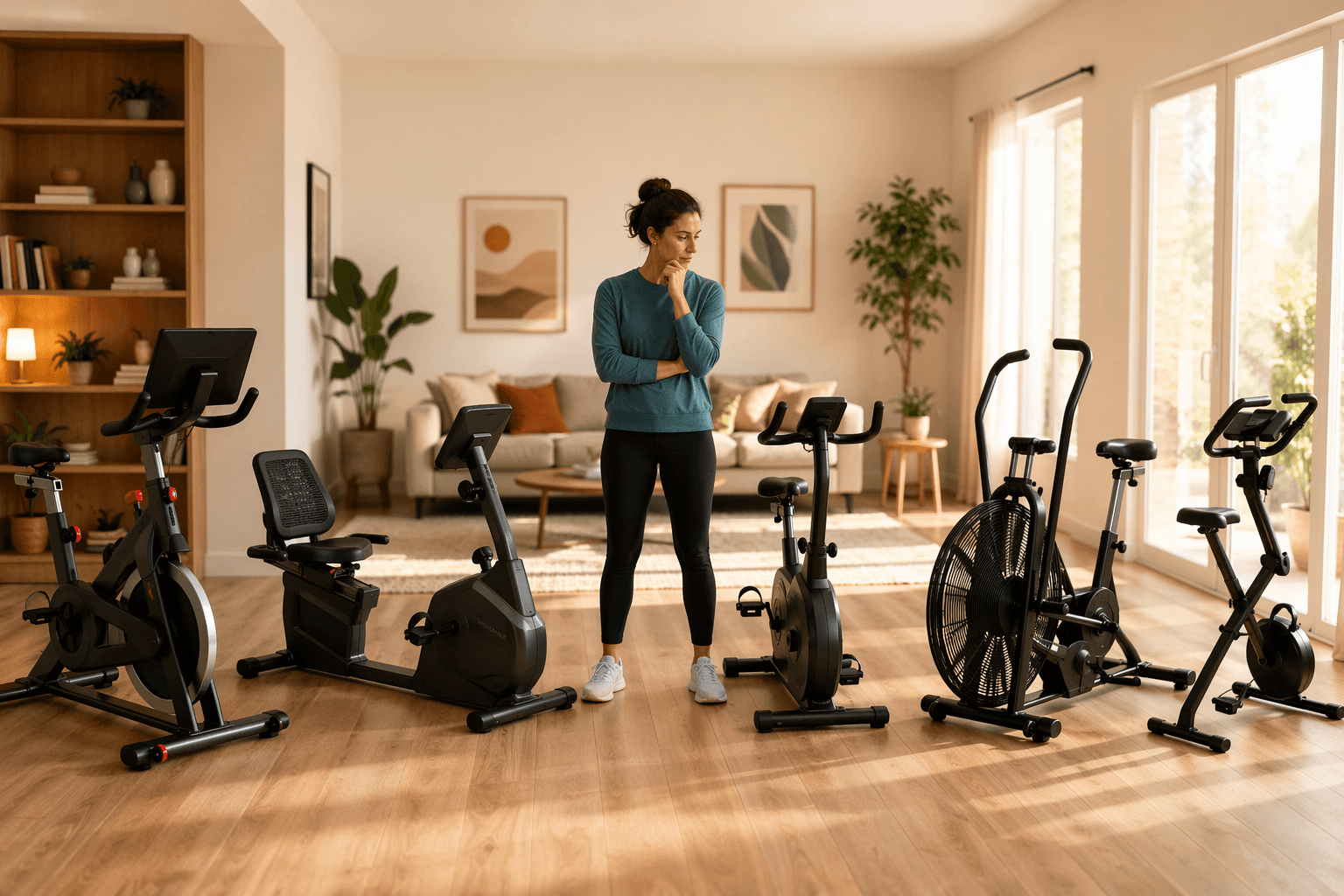
Use the first hard constraint as your filter
You do not have to evaluate every bike from every angle. If your ceiling is $700 total, a premium connected bike with a recurring membership is already mostly out. If your only open space is a corner beside a bed, a long recumbent may be unrealistic before you even compare resistance levels. If you need a step-through frame and back support, a spin bike should not be treated as the default upgrade.
| If your non-negotiable issue is… | Start by filtering for… | Likely bike categories to examine first |
|---|---|---|
| Class-style motivation, out-of-saddle riding, performance feel | Bike type and tech ecosystem | Spin/cycling bikes, connected bikes, BYOD cycling bikes |
| Back comfort, joint sensitivity, mobility, or rehab-oriented use | Rider fit and posture | Recumbent bikes, upright bikes |
| Strict apartment or bedroom space | Footprint, stored size, and noise | Folding bikes, compact uprights, some spin bikes |
| HIIT intervals and full-body conditioning | Workout style and noise tolerance | Air bikes, possibly spin bikes for lower-noise intervals |
| Avoiding long-term app costs | Three-year ownership cost | Non-connected bikes, BYOD bikes, optional-subscription models |
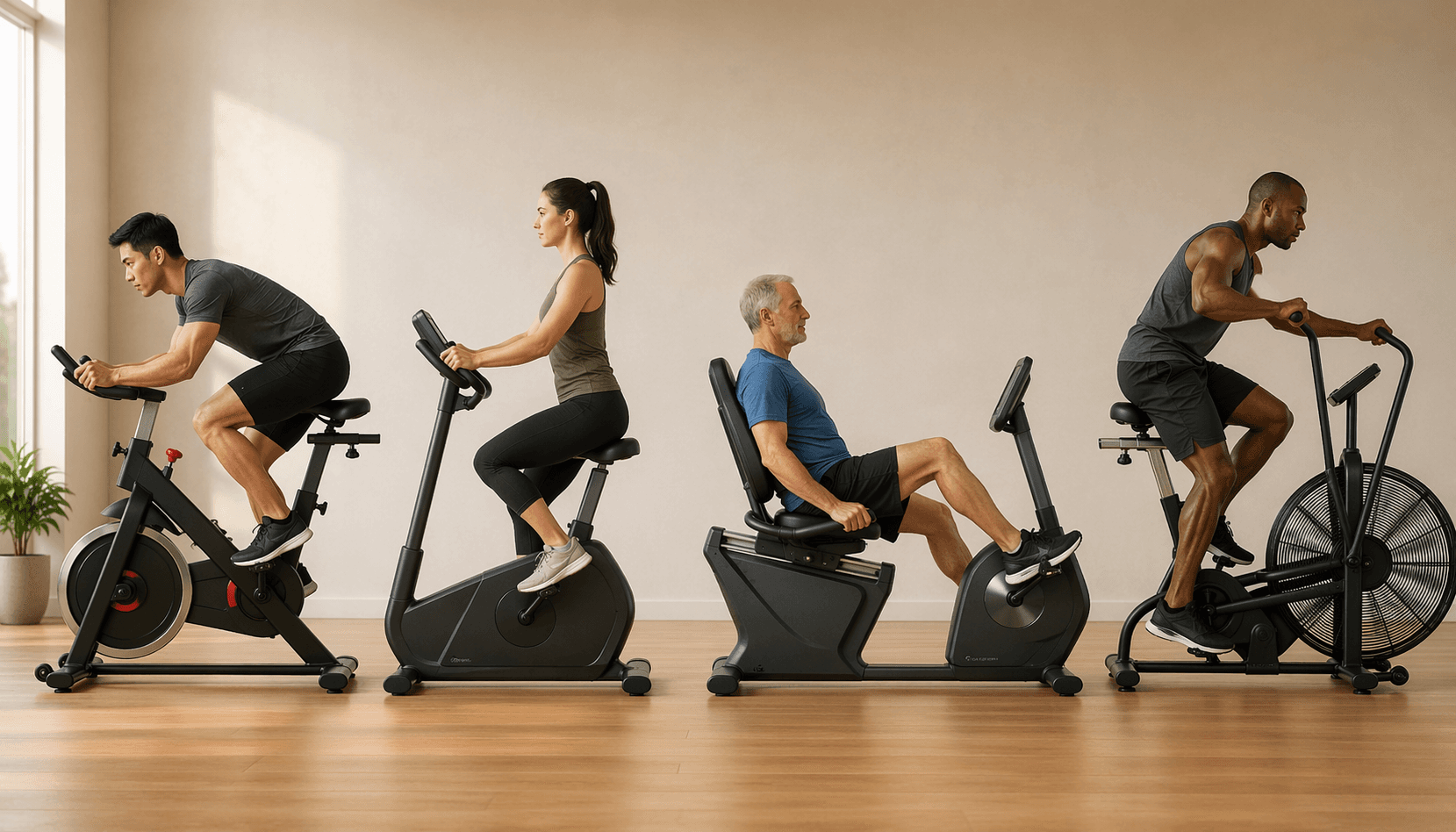
This is also why bike type belongs early, but not as a lecture in categories. A spin or indoor cycling bike is built around a more aggressive riding position and class-style training. A recumbent bike trades athletic posture for support, a larger seat, and easier access. An upright bike is the middle lane for general use. An air bike is for hard intervals and usually a garage or noise-tolerant room. A folding bike is a space solution first and a performance solution second.
If bike type is your main uncertainty, use this article to identify your likely lane, then go deeper with the exercise bike types decision framework. The important thing here is to avoid comparing a recumbent comfort bike and a studio cycling bike as if they were trying to do the same job.
The price tag is not the cost of owning the bike
Exercise bikes are especially good at making a purchase look simpler than it is. The box has one price. The ownership experience may have another.
Garage Gym Reviews’ pricing data puts the average exercise bike cost at about $1,409, but the more useful number is the three-year total: depending on the bike and subscription setup, ownership can land under $500 or climb above $3,500. [1] That spread is wide enough to change which bikes should be considered “budget” in the first place.
A simple three-year estimate should include:
- Bike purchase price, including shipping or delivery if applicable
- Required or strongly encouraged subscription fees
- Accessories you actually need, such as cycling shoes, a mat, tablet holder, or heart-rate monitor
- Secondhand fees or activation charges, if buying used
- The realistic risk that you stop paying for the app and lose the part of the bike that made it appealing
Subscription cost is where many buyers misread the deal. Wirecutter lists Peloton’s membership at $44 to $50 per month, a level that can overtake the purchase price of some bikes within a couple of years. [2] That does not make Peloton a bad purchase for a rider who uses the classes consistently. It does mean the bike should be judged as a hardware-and-service purchase, not just a piece of equipment.
The secondhand market needs the same treatment. A used bike may lower the upfront price, but Peloton’s $95 activation fee for secondhand owners still belongs in the cost calculation. [2] That fee is not relevant if you are buying new or choosing a different ecosystem, but it matters for the exact buyer who is shopping used to keep costs down.
At the other end of the connected-fitness spectrum, bikes such as the Schwinn IC4 and Bowflex C6 are often attractive because they pair magnetic resistance, 100 resistance levels, Bluetooth, and optional app use rather than locking the whole experience behind one built-in screen. [2][3] The tradeoff is that you bring your own tablet or phone and accept a less seamless setup.
If subscription math is already making your shortlist wobble, pause here and run the numbers before reading more reviews. The deeper breakdown in exercise bike subscription costs decoded is useful once you know whether a monthly fee is a motivator, a tolerable cost, or a dealbreaker. For the broader risk of paying into a platform you may later resent, see the guide to exercise bike subscription lock-in.
A quick ownership-cost test
Before deciding that one bike is “only” a few hundred dollars more than another, multiply any monthly subscription by 36. Add that to the bike price. Then ask whether the bike still looks like the better value if you cancel the subscription in year two.
That last question is not anti-tech. A good class platform can be the difference between using the bike and ignoring it. But if the screen is the reason you are buying the bike, the screen’s ongoing cost is part of the bike.
“Fits in my home” means three different things
A bike’s footprint is not just the rectangle printed in the product specs. In a real room, there are three sizes: the stored size, the workout size, and the living-with-it size.
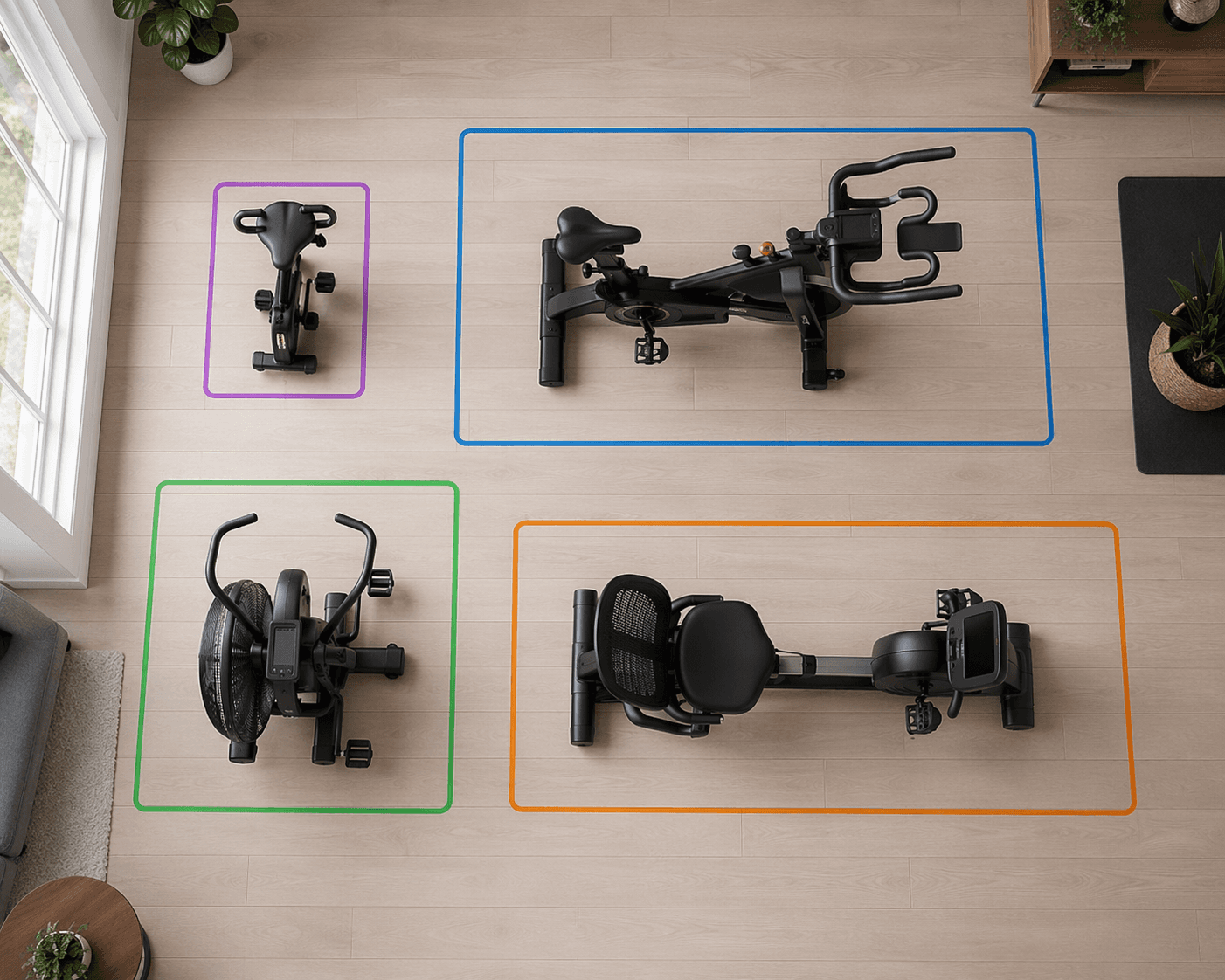
Outdoor Gear Lab’s measured dimensions show why this matters. A folding bike such as the Marcy Foldable can occupy about 4 square feet unfolded and about 1.24 square feet folded, while recumbent bikes can exceed 12 square feet. Spin bikes commonly need roughly 8 to 9 square feet. [3] Those are measured examples, and manufacturer dimensions can differ, but the category pattern is useful: recumbents get long, spin bikes are compact but not tiny, and folders win storage by accepting compromises elsewhere.
Stored size matters if the bike has to disappear after workouts. Workout size matters because knees, elbows, handlebars, screens, and fan arms need clearance. Living-with-it size matters because a bike that technically fits can still make the room annoying enough that you stop wanting to use it.
Noise belongs in the space calculation too. Garage Gym Reviews testing found air bikes producing 76 to 83 dB at high intensity, roughly the kind of noise that can become a problem in an apartment, shared wall, or late-night household. [1] An air bike may be ideal in a garage and miserable above a sleeping neighbor.
If your space is the first constraint, measure the room before falling in love with a console. Put tape on the floor for the bike, then add clearance where your body moves. If the bike will fold, measure where it folds to and where it will actually live. The more specific small-space and apartment exercise bike guide is the next stop if compact storage is your deciding factor.
Rider fit is not a minor spec
Exercise bike reviews often drift toward screens, resistance, and class libraries. The rider’s body has less patience for that. If the seat cannot adjust to your height, if the weight capacity is too close to your actual body weight, or if the posture aggravates your back, the bike has already failed.
Check four fit specs before treating a bike as a contender:
- Height range: whether the seat and handlebar positions match the actual riders in the household
- Weight capacity: not as a confidence booster, but as a safety and durability threshold
- Adjustability: seat height, fore-aft seat travel, handlebar height, and handlebar reach
- Posture: forward-leaning, upright, or reclined, and whether that position fits your back, hips, knees, and mobility
The Sole LCR is a useful example of why this filter matters: Garage Gym Reviews rated it 4.4 out of 5 and lists a 350-lb weight capacity with 40 resistance levels. [1] That capacity is meaningfully different from many spin bikes, which commonly cap in the 250- to 300-lb range. [1]
Posture is just as important. Wirecutter and Outdoor Gear Lab both note the forward-leaning nature of spin bikes, which can be a poor match for riders with back pain or limited mobility. [2][3] That does not make spin bikes inherently uncomfortable; it means they ask more of the rider’s position. For some people, that is exactly the appeal. For others, it is the reason the bike becomes a coat rack.
Recumbent bikes deserve more respect than they get in performance-heavy shopping guides. A supportive seat, reclined posture, and easier mounting can matter more than leaderboard features for seniors, rehab-oriented riders, people with balance concerns, or anyone trying to keep cardio low-impact. Readers comparing bikes around joint comfort may also want the broader low-impact exercise equipment guide.
For a more detailed look at home-bike specifications such as resistance type, flywheel feel, seat adjustment, and connectivity, use the exercise bike specs for home guide after you have already ruled out bikes that do not fit your body.
Tech should support the habit, not trap the purchase
Once the bike type, cost, space, and fit constraints are under control, the tech question becomes much easier: do you want the bike to provide the training experience, or do you want the bike to be a platform for apps you choose?
An integrated screen is best when you know you are motivated by instructors, structured programs, metrics, and a frictionless start. The upside is obvious: less setup, more polish, and fewer excuses. The downside is dependency. If the subscription rises, the class library stops appealing to you, or the brand changes features, the hardware may feel less valuable than it did on delivery day.
A BYOD setup—bring your own device—usually asks for more fiddling but gives you more control. The Schwinn IC4 and Bowflex C6 are examples of this hybrid approach, with Bluetooth support and optional access to services such as JRNY at $12 per month or Peloton Digital at $13 per month. [2][3] For a rider who wants flexibility more than a built-in screen, that can be the better compromise.
The mistake is treating tech as automatically premium. A screen can be a training tool, a recurring bill, a motivational engine, or an expensive decoration. Which one it becomes depends less on the bike than on how you actually behave after the first month.
How the filters change common buying situations
A few typical buying situations show why a universal winner is not useful.
| Buyer situation | First filter | What probably survives |
|---|---|---|
| Apartment renter with downstairs neighbors | Noise and footprint | Folding bike, compact upright, quiet magnetic spin bike; air bike only with strong noise tolerance |
| Retiree or rehab-oriented rider | Posture, access, and support | Recumbent bike first, upright bike second; spin bike only if posture and mounting are comfortable |
| Class-motivated rider who likes instructor energy | Tech ecosystem and three-year cost | Connected spin bike or BYOD cycling bike, depending on subscription tolerance |
| Budget buyer avoiding subscriptions | Three-year cost | Simple upright, folding bike, or Bluetooth-capable bike with optional apps |
| HIIT-focused athlete with garage space | Training style and noise | Air bike or sturdy spin bike, depending on whether full-body fan resistance matters |
If you want a more formal scoring approach after this first pass, the companion home exercise bike decision matrix can help compare the remaining options across budget, space, resistance, and subscription needs. It is more useful after the obvious misfits are gone.
Your shortlist should be small before you read model reviews
By the time you reach individual reviews, you should be able to say something like: “I need a quiet magnetic bike under my three-year budget,” or “I need a recumbent with a higher weight capacity and easy access,” or “I am willing to pay for a premium class platform because that is what keeps me consistent.” Those are much better shopping statements than “I want the best bike.”
Prices and subscription fees can change quickly, especially around sales periods. The figures above reflect the research available as of mid-2026, and current promotions may shift the math. Measured dimensions from testers can also differ from manufacturer spec sheets, so verify the current price, current membership fee, delivery requirements, and actual room clearance before buying.
The best home exercise bike is the one that survives your real limits: your body, your room, your budget, your tolerance for noise, and your willingness to keep paying for an app. Once those filters are honest, the field usually shrinks from dozens of bikes to two or three worth investigating.
References
- Best Exercise Bike — Garage Gym Reviews
- The Best Exercise Bikes — Wirecutter
- The Best Exercise Bike — Outdoor Gear Lab
Comments
Join the discussion with an anonymous comment.