
The problem with searching for the best elliptical machine for home is that most rankings ask one machine to win five different contests at once. A compact elliptical that fits beside a couch, a heavier machine with a smoother 20-pound-plus flywheel, and a connected trainer with a monthly subscription are not solving the same purchase problem.
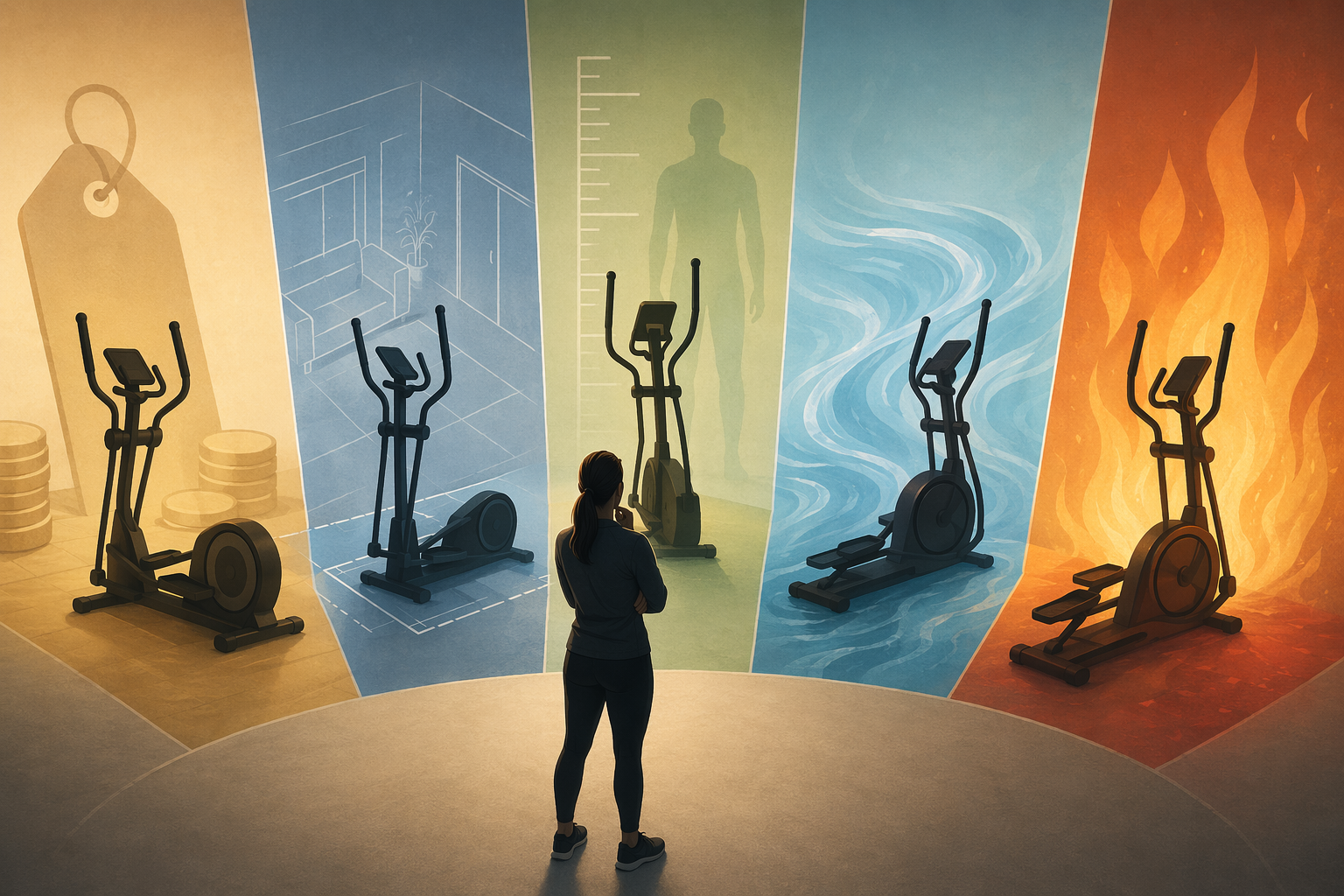
Start with the thing most likely to make you stop using it: price, floor space, stride fit, joint comfort, or workout intensity. That one constraint should filter the field before brand reputation, screen size, or a long list of resistance levels gets a vote.
If you are still deciding whether an elliptical belongs in your home gym at all, step back to Does a Home Elliptical Machine Fit Your Space, Budget, and Joints? first. This article assumes the answer is probably yes, and the question now is which compromise you can live with.
The Fast Constraint Map
| Your tightest constraint | Filter for this first | Models or model types to start with | Watch for |
|---|---|---|---|
| Budget | True cost: machine price plus subscription, delivery, and warranty risk | $0-$500 entry models, $500-$1,000 value models, $1,000-$1,500 midrange machines, $1,500+ premium machines | A cheap frame, short warranty, or paid app can erase the apparent deal |
| Floor space | Footprint, clearance, and whether the path through the room actually works | YOSUDA EM1 at 49.6 in x 24.4 in, Bowflex Max Trainer M6 at 46 in x 26 in, Sunny Health & Fitness at 55 in x 23 in | A small footprint still needs mounting room and usable space around it |
| Stride and body size | Stride length before console features | 18-20 in stride for many users from 5 ft 3 in to 6 ft 5 in; 14-16 in for some shorter users; 20 in+ for taller users | A wrong stride length makes every workout feel slightly off |
| Joint sensitivity | Smooth resistance, stable motion, low step-up height, and warranty strength | Magnetic resistance, 20 lb+ flywheel, lower step-up designs such as Merach E27 at 9 in | Budget flywheels in the 13-16 lb range can feel choppier |
| Workout intensity | Resistance range, programming, and whether the subscription is worth paying for | Premium connected models, stronger resistance systems, incline or interval-focused machines | Compactness is less useful if you outgrow the challenge quickly |
That table is not a shortcut around comparison shopping. It is the order of operations. A tall user should not fall in love with a compact short-stride unit. A renter with one viable corner should not start with a large premium frame. A buyer at the edge of their budget should not treat a $39-per-month training platform as a decorative add-on.
If Budget Is the Constraint, Price the Machine You Will Actually Own
Elliptical pricing looks cleaner in a spreadsheet than it does in a living room. Average cost clusters around $1,299, but useful home choices spread across entry, value, midrange, and premium tiers rather than gathering around one perfect price point.[1][2]
| Budget range | What to expect | Best fit |
|---|---|---|
| $0-$500 | Compact frames, simpler consoles, shorter warranties, lighter flywheels | A buyer who needs basic low-impact movement and accepts some choppiness |
| $500-$1,000 | Better value zone with more usable resistance and sturdier construction | A first serious home elliptical purchase |
| $1,000-$1,500 | Smoother mechanics, stronger warranties, more polished ergonomics | A household expecting regular use from more than one person |
| $1,500+ | Premium build, connected programming, higher-end resistance systems | A committed user who wants coaching, intensity, or a more durable long-term machine |
The cheap machine is not automatically the wrong machine. A $0-$500 elliptical can be a reasonable answer for someone who wants to walk indoors without loading the knees and does not need aggressive intervals. The risk is that budget machines often get thin exactly where daily use exposes them: lighter flywheels, shorter warranties, and movement that feels uneven once the novelty wears off.
Warranty is part of price. A Sole E25 with lifetime frame and lifetime flywheel coverage is a different ownership proposition from a compact budget model such as the YOSUDA EM1 with a one-year total warranty.[2][3] That does not make the Sole the universal winner; it means the buyer should know whether they are paying for a longer service horizon or simply spending more for features they may not use.
Subscriptions also belong in the budget line, not in the entertainment line. Connected platforms can add roughly $10 to $39 per month, with JRNY commonly discussed in the $10-$20 range and iFIT at $39 per month in current pricing references.[1][2] If the machine feels incomplete without classes, that monthly cost is part of the elliptical.
For a deeper ownership-cost pass after you have narrowed the machine type, use Best Home Gym Cardio Equipment: A 3-Year Total Cost Comparison. If the only way a better-built model works is secondhand, Where to Find Used Fitness Equipment Near You is the more useful next stop than pretending every buyer can stretch into the same new-machine tier.
If Space Is the Constraint, Measure the Room Before You Read Another Feature List
A home elliptical does not fail in an apartment because its Bluetooth menu is underwhelming. It fails because the user has to angle around it every time they cross the room, or because the moving handles make a technically acceptable footprint feel bigger during use.
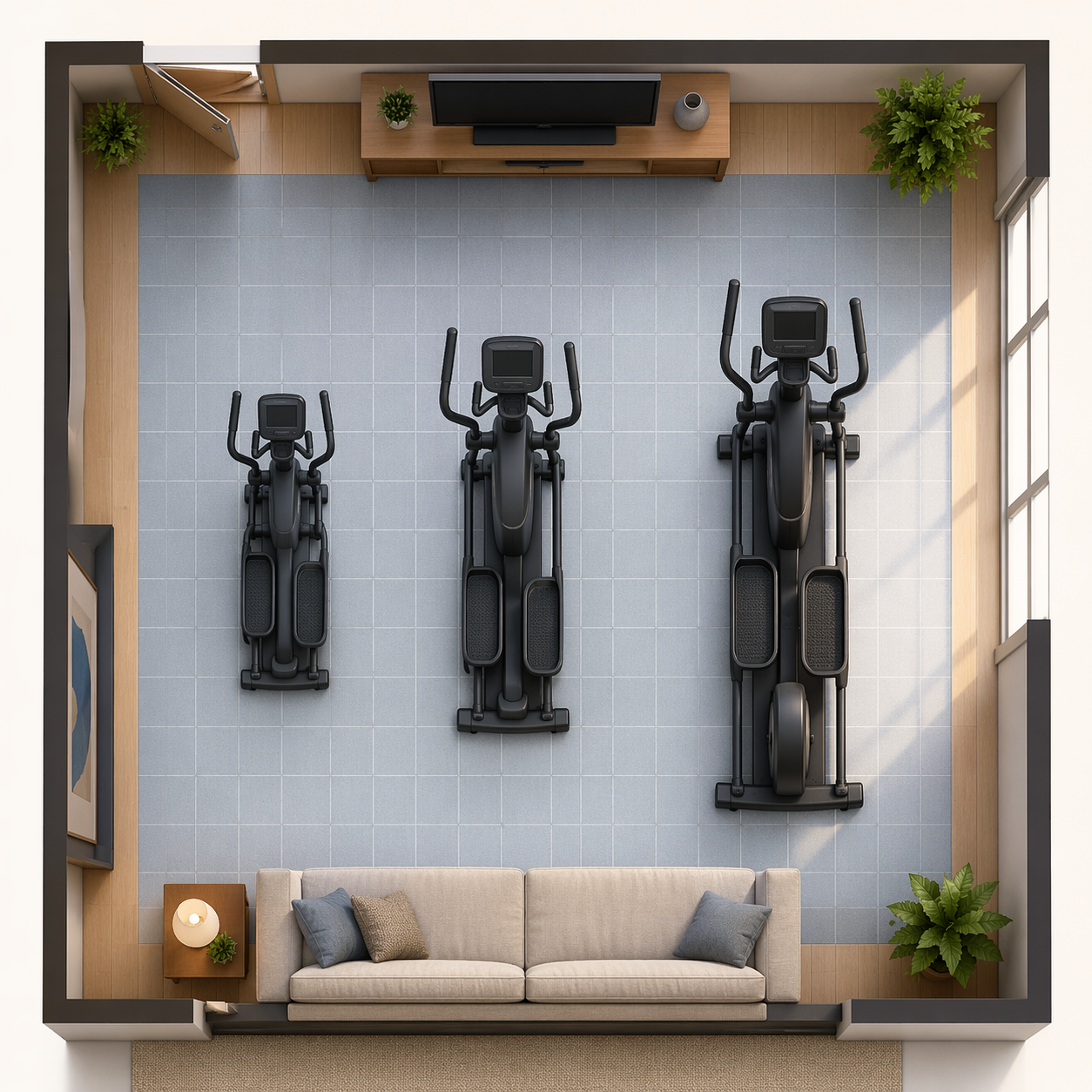
The compact numbers are concrete enough to matter. The YOSUDA EM1 is listed at 49.6 inches by 24.4 inches. The Bowflex Max Trainer M6 comes in at 46 inches by 26 inches. A Sunny Health & Fitness compact option is listed at 55 inches by 23 inches.[1][3][4] Those are not tiny in the way a yoga mat is tiny, but they are meaningfully different from full-size elliptical frames.
The decision is not just length times width. Add the path you need to mount the machine, the reach of moving handles, the ceiling height if the pedal path raises you noticeably, and the route from delivery point to final room. A box that technically fits through the front door can still become a hallway problem.
Step-up height matters in small spaces, too, because cramped placement gives you less margin for awkward mounting. The Merach E27 is noted with a 9-inch step-up height, while the Schwinn 490 is noted at 15.5 inches.[4] That difference can matter for ceiling clearance and for users who dislike stepping high onto a moving platform.
A compact elliptical is most defensible when floor space is truly the scarce resource. If you have a dedicated spare room, do not let compactness outrank stride quality, smooth resistance, or warranty coverage. If you live in a one-bedroom apartment, start with the footprint and then ask which of the compact models you can tolerate mechanically.
Apartment buyers comparing ellipticals with other small cardio options should also look at Compact Home Exercise Equipment: A Constraint-Based Guide for Apartment Dwellers and Home Gym Cardio Equipment for Small Spaces. Sometimes the best elliptical for home is no elliptical, at least not in that room.
If Stride Fit Is the Constraint, Your Height Gets a Vote
Stride length is one of the first specs worth checking because it changes the feel of every minute on the machine. A range around 18 to 20 inches is commonly treated as workable for many users from about 5 feet 3 inches to 6 feet 5 inches, while shorter users may be more comfortable around 14 to 16 inches and taller users may need 20 inches or more.[1][3]
This is not about matching a chart perfectly. It is about avoiding a motion pattern that makes you shorten your natural step, overreach, or feel like the pedals are dictating an awkward rhythm. The wrong stride does not always announce itself as pain. Sometimes it shows up as workouts you keep cutting short.
Drive design also changes the feel. Front-drive, rear-drive, center-drive, and hybrid ellipticals can produce noticeably different stride sensations and body positions.[1][5] A rear-drive machine may feel more elongated to some users, a center-drive design may feel more upright, and hybrid designs may blend elliptical motion with stepper-like mechanics. The labels are less important than the fact that two machines with similar price tags can move very differently under the same body.
For households with multiple users, stride fit should be judged by the person most likely to be poorly served by the default. If one user is much shorter or taller than the others, an adjustable or more forgiving stride path is worth more than an extra entertainment feature. This is also where buying locally can help; Which Local Store Should You Buy Fitness Equipment From? is useful if a five-minute test ride could prevent an expensive mismatch.
If Joint Comfort Is the Constraint, Smoothness Is Not a Luxury Feature
Ellipticals appeal to many home users because they keep the feet on pedals and generally reduce impact compared with running. Expert discussions around elliptical training often point to lower impact on knees, hips, and ankles, which is why the category comes up for people thinking about injury rehab, arthritis, pregnancy, or simply lower-impact cardio.[4]
That does not turn an elliptical into medical equipment, and it does not make every elliptical equally joint-friendly. A machine with a choppy pedal path can defeat the point of buying low-impact cardio in the first place. Magnetic resistance is strongly preferred for smoother, quieter operation, and a flywheel around 20 pounds or heavier is commonly recommended for stable movement. Budget models with 13- to 16-pound flywheels can feel jerkier.[1]
If joint sensitivity is the deciding constraint, look for three things before you look at the screen: magnetic resistance, enough flywheel mass to keep the stroke even, and a pedal path that feels natural at your height. Then check step-up height and handle position. A low-impact category still has high-annoyance details.
Calorie estimates should stay in their lane here. Harvard Health estimates that a 185-pound person burns about 378 calories in 30 minutes of general elliptical use at moderate intensity.[6] That is useful context for elliptical training as cardio, not evidence that one home model burns more calories than another.
If Intensity Is the Constraint, Do Not Overvalue Compactness
Some buyers are not trying to sneak in gentle movement during bad weather. They want intervals, climbing-style efforts, progressive resistance, and a machine that still feels challenging after the first few months. For that buyer, resistance range and programming depth matter more than shaving a few inches from the footprint.
This is where connected premium models can make sense, as long as the subscription is not treated as optional when it is central to the experience. If coach-led sessions, adaptive programming, or interval libraries are the reason you are buying the machine, price the subscription as part of the machine. Current references place major connected platforms in the roughly $10-$39-per-month range, depending on service and plan.[1][2]
Resistance quantity alone is not enough, either. The lower levels need to be usable for warmups, and the higher levels need to feel smooth rather than sticky. A strong frame, stable pedal track, and better resistance system are more important for hard workouts than a console that looks impressive while the machine rocks under load.
What to Do When You Have More Than One Constraint
Most real buyers have at least two constraints. The useful move is not to average them. Rank them by failure risk.
Small Budget Plus Small Space
Start with footprint, then cap the price. A machine that fits the budget but blocks the room will not become more usable because it was inexpensive. The YOSUDA EM1 and similarly compact budget options belong on the first-pass list because the footprint is real, but the one-year total warranty and likely entry-level feel should stay visible in the decision.[3]
If the room is flexible but the budget is not, widen the search to used midrange machines. A sturdier used elliptical can be a better daily object than a new unit that feels rough after the return window closes, assuming condition, transport, and warranty tradeoffs are acceptable.
Tall User Plus Joint Sensitivity
Do not let the joint-friendly label distract from stride length. A taller user who needs 20 inches or more of stride will not be helped by a smooth compact model that forces a clipped motion.[1][3] Filter for stride first, then for magnetic resistance, flywheel weight, and a stable frame.
This is one of the cases where trying the machine is disproportionately valuable. Joint comfort depends on the combined effect of stride, pedal spacing, handle position, and resistance feel. A spec sheet can eliminate obvious mismatches, but it cannot fully prove comfort.
Shorter User Plus Premium Budget
A larger budget should not automatically push a shorter user toward a bigger stride. Some shorter users may prefer 14- to 16-inch stride lengths, depending on their natural gait and comfort.[1] A premium machine with a long, dramatic pedal path can be the wrong kind of expensive.
Intensity Seeker Plus Subscription Fatigue
If you know you will cancel the app after the first billing cycle, do not buy as if the app will carry your training. Prioritize onboard resistance range, manual interval control, and mechanical quality. A connected machine can still be worthwhile without a subscription, but only if the base machine is strong enough to use on its own.
Beginner Buyer Plus Unclear Commitment
If you are building a first home gym and are not sure how the elliptical fits with strength equipment, mobility work, or other cardio, do not treat the machine as an isolated purchase. Best Home Exercise Equipment: A Phased Purchase-Sequence Guide and Home Gym Equipment for Beginners: A Decision Framework by Budget and Space can help decide whether this should be the first big item or a later upgrade.
A Defensible Shortlist Beats a Universal Winner
Build the shortlist in this order:
- Name the constraint most likely to make the elliptical fail in your home.
- Eliminate every model that fails that constraint, even if it reviews well.
- Check the second constraint: usually budget, footprint, stride, or smoothness.
- Separate machine cost from subscription cost.
- Compare warranty terms only after the machine already fits your body and room.
For readers who want a second pass through the same problem with a broader comparison structure, How to Pick the Best Elliptical for Your Home pairs well with this constraint-first method.
The best home elliptical is the one that clears the constraint most likely to make you stop using it. For one buyer, that is the compact model that leaves the living room usable. For another, it is the smoother flywheel and stronger warranty. For another, it is the machine whose monthly programming cost is worth paying because it keeps workouts hard enough to repeat.
References
- How Much Does an Elliptical Cost?, Garage Gym Reviews, https://www.garagegymreviews.com/how-much-does-an-elliptical-cost
- Best Ellipticals, BarBend, https://barbend.com/best-ellipticals/
- Best Elliptical Machines for Home, Garage Gym Reviews, https://www.garagegymreviews.com/best-elliptical
- The Best Elliptical Machine, The New York Times Wirecutter, https://www.nytimes.com/wirecutter/reviews/best-elliptical-machine/
- The Best Elliptical Machines, Verywell Fit, https://www.verywellfit.com/best-ellipticals-4159145
- Calories burned in 30 minutes for people of three different weights, Harvard Health Publishing, https://www.health.harvard.edu/diet-and-weight-loss/calories-burned-in-30-minutes-for-people-of-three-different-weights

Comments
Join the discussion with an anonymous comment.