You probably do not need to compare every piece of best home gym equipment on the market. You need to rule out the wrong categories first. A cable machine that looks perfect in a review can be a nuisance in an apartment corner; a rack and barbell can be a great buy in a garage and a terrible one in a spare bedroom with a low ceiling; a smart gym can be overpriced for one person and the only reason another person trains three times a week.
Start with three questions, in this order: How much can you spend without pretending future-you will be more motivated than current-you? Where will the equipment actually live? What kind of training do you want to repeat for the next year?
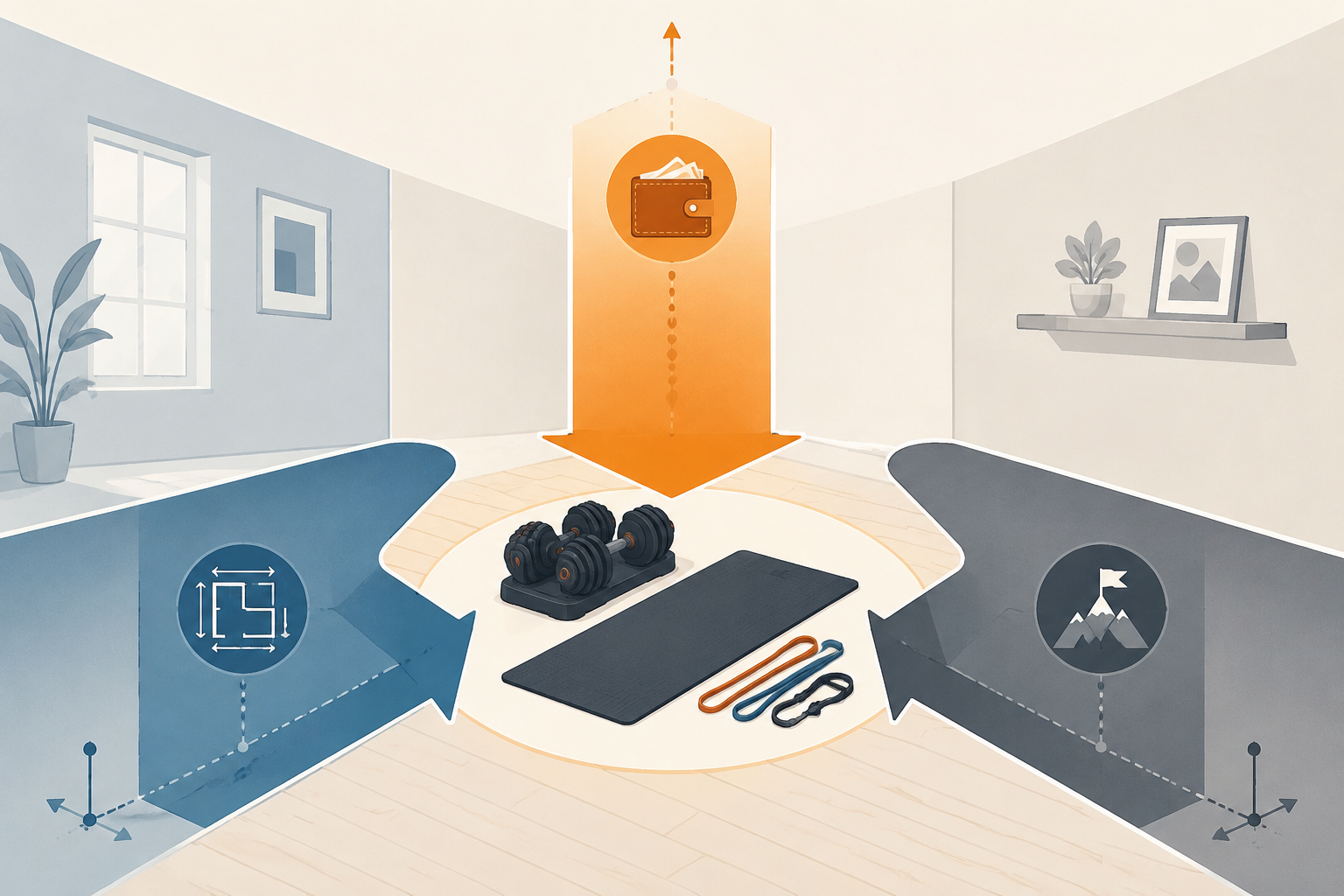
| If your main constraint is | Start by comparing | Usually skip for now |
|---|---|---|
| Under $500 | Adjustable dumbbells, resistance bands, mat, jump rope | Smart gyms, large machines, full rack packages |
| $500–$2,000 | Rack, barbell, plates, bench, heavier adjustable dumbbells | Premium all-in-one systems unless space is the bigger issue |
| Over $2,000 | Functional trainer, smart gym, rack-and-cable setup | Single-purpose machines unless they match a very specific goal |
| Apartment corner | Quiet, stowable, low-impact equipment | Droppable weights, tall racks, loud conditioning tools |
| Garage | Rack, barbell, plates, sled alternatives, larger cable options | Delicate equipment if climate or dust is uncontrolled |
| Guided training need | Smart gym, app-connected system, coached dumbbell program | A bare rack if you do not know what to do with it |
That table is not the full decision, but it does the useful first cut. Most buyers can narrow from dozens of products to two or three equipment categories before reading a single product roundup.
Budget First, Because It Stops Fantasy Shopping
Home fitness is a crowded category. The home gym equipment market was valued at USD 12.4 billion in 2025 and is projected to reach USD 19.8 billion by 2035; conventional equipment still accounted for 73.3% of the market, while smart equipment accounted for 26.7% in the market summary from GM Insights.[1] That does not tell you what to buy. It does explain why every search result feels like a fight between old-school iron and subscription-connected screens.
For a normal household, budget is the first honest filter. Not because cheaper is always better, but because a home gym purchase has to survive rent, storage, noise, and the awkward reality that exercise habits are built after the box arrives, not before.
Under $500: Build a Starter Setup That Can Still Grow
Under $500 is not a fake home gym budget. It is the right budget for a beginner, an apartment dweller, a returning exerciser, or anyone who is not yet sure whether strength training, HIIT, or general fitness will stick. Cleveland Clinic recommends starting with basic home equipment before making a larger investment, and the practical version of that advice is simple: mat, resistance bands, adjustable dumbbells if possible, and a jump rope if your floor and neighbors can tolerate it.[2]
- Choose resistance bands when you need low-cost pulling work, travel-friendly training, or joint-friendly accessories.
- Choose adjustable dumbbells when you want the most useful strength tool in the least space.
- Choose a mat when floor work, mobility, stretching, or bodyweight training will be part of the routine.
- Choose a jump rope only if impact noise and ceiling clearance are not problems.
The mistake in this tier is buying too many small things because each one feels cheap. A drawer full of handles, sliders, novelty bands, and ankle straps is still clutter. If the goal is general fitness, a pair of adjustable dumbbells plus bands usually beats a pile of single-purpose gadgets.
If your budget is much tighter than $500, it is worth using a budget-tier guide before shopping category pages. A more granular breakdown of what small budgets actually buy is available in What Your Home Fitness Budget ($50 to $1,000+) Actually Buys.
$500–$2,000: The Useful Middle Most Articles Rush Past
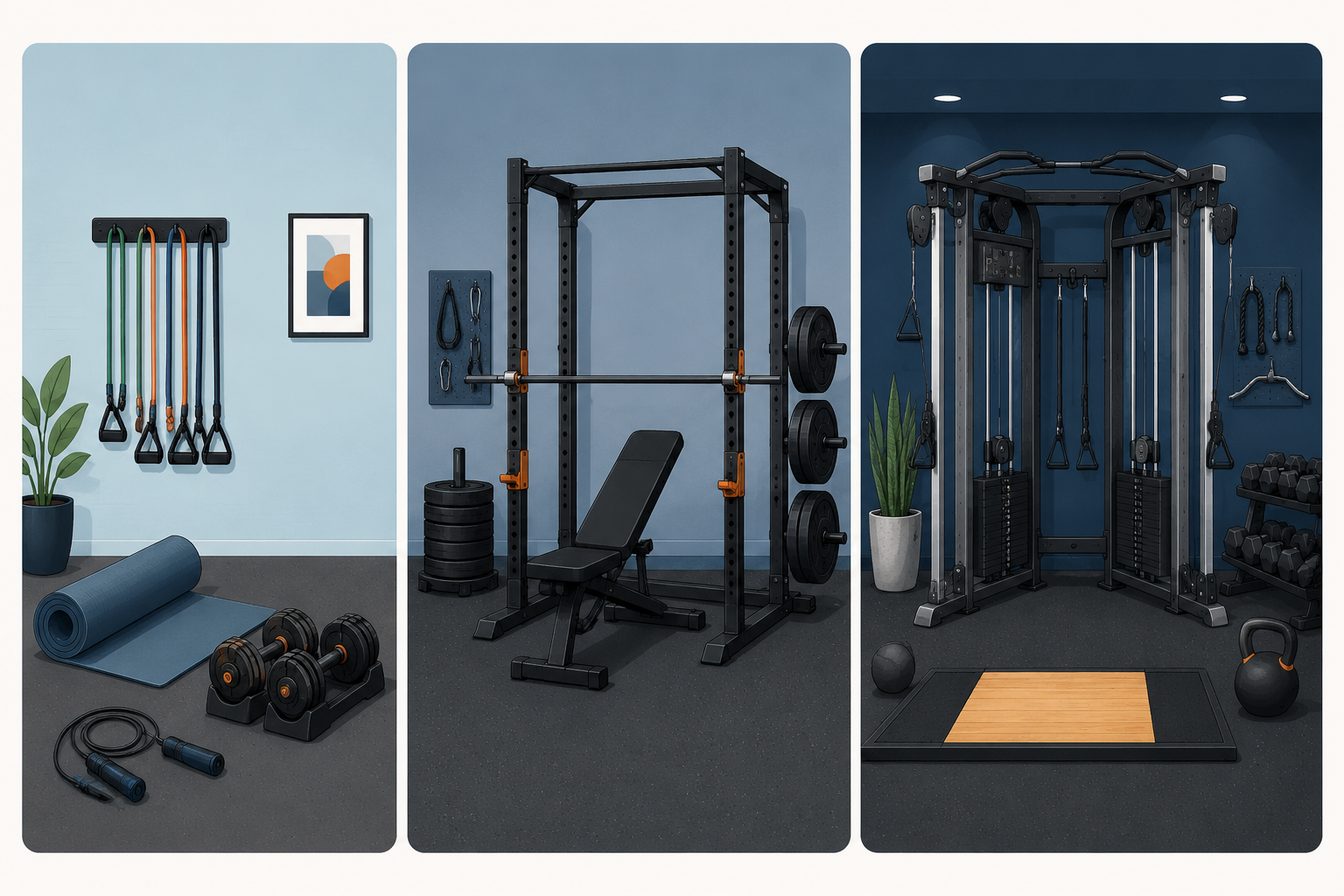
This is the messy middle where many real homes land. You may not want a luxury smart gym, but you also want more than bands. In this range, the decision usually comes down to one of three paths: a rack-and-barbell setup, heavier adjustable dumbbells with a bench, or a compact cable solution.
A rack, barbell, plates, and bench make sense if you want progressive strength training and have the space to load, lift, and move safely. One example budget stack places a REP PR-1100 rack at $380, a Synergee barbell at about $180, 260 pounds of bumper plates at about $570, and an adjustable bench at about $220, for roughly $1,350 before taxes, shipping, flooring, or storage. Prices were last verified in June 2026 and are subject to change.
That setup can be excellent. It can also be too much if the room has a low ceiling, the user hates barbell training, or plates will be stacked behind a laundry basket because there is no storage plan. A simpler dumbbell-and-bench setup often fits a spare bedroom better and still supports presses, rows, split squats, Romanian deadlifts, carries, curls, lateral raises, and plenty of beginner-to-intermediate training.
Garage Gym Reviews reported an average home gym machine cost of $1,855 based on testing more than 50 machines, which is a useful warning against assuming “machine” means budget-friendly.[3] At this budget, separate equipment often gives you more flexibility than a single all-in-one machine, unless that machine solves a space or guidance problem that separate pieces do not.
For a deeper price-by-price comparison, use Home Gym Cost Breakdown: What $500 to $5,000+ Actually Buys You in 2026 before committing to a cart.
Over $2,000: Pay for Solved Problems, Not for Impressiveness
Above $2,000, the best home gym equipment is rarely “more stuff.” It should solve a specific problem: guided programming, fast exercise changes, shared use by multiple people, cable training without a commercial machine footprint, or a nearly complete strength setup in one dedicated area.
This is where functional trainers, smart gyms, and rack-and-cable systems belong. A smart gym such as Tonal 2 can make sense for someone who wants coaching-like structure and is willing to accept a hardware price and an ongoing subscription; current pricing places Tonal 2 at $4,295 plus $60 per month as of June 2026, with pricing subject to change. Speediance-style systems are often discussed for their lower-friction setup and no-subscription positioning, but any “no subscription” claim should be rechecked at publication because software pricing can change.
The trap in this tier is buying an identity too early. If you are not already drawn to coached screen workouts, a smart gym may become a very expensive coat rack. If you do not enjoy barbell lifts, a premium rack package will not fix that. If you love cable work and hate rearranging attachments, a functional trainer may be the boring-looking purchase that actually gets used.
Readers deciding between a single integrated system and separate pieces should compare the five-year ownership picture, not just the checkout price. The tradeoff is covered in more detail in All-in-One Home Gym vs. Separate Equipment: 5-Year Total Cost of Ownership.
Space Is the Veto, Not a Detail
After budget, measure the actual room. Not the hopeful room. Not the floor area before the desk chair rolls back, the garage bikes come off the wall, or the closet door opens. The usable training zone includes the equipment footprint, your body, the path of the bar or cable arms, plate changes, bench movement, and a little human clumsiness.
Apartment Corner
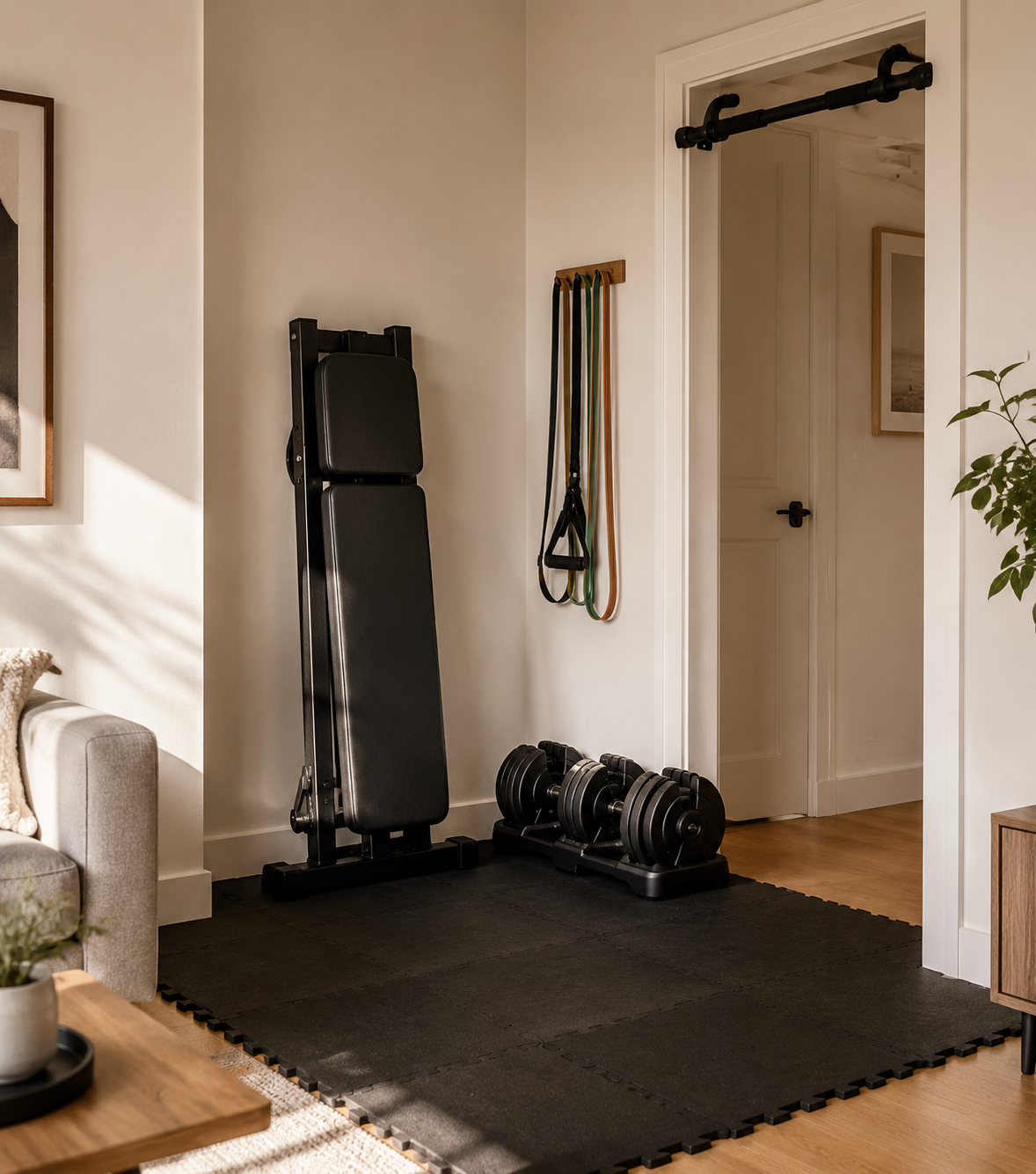
An apartment corner usually favors adjustable dumbbells, bands, a folding bench, a mat, and quiet conditioning. The neighbor downstairs matters. So does the person who has to look at the equipment every day. If the setup cannot be stowed or at least made visually tolerable, it will start feeling like furniture you resent.
Avoid assuming a rack is impossible, but be strict. Ceiling height, bar path, plate storage, and safe re-racking matter more than whether the rack technically fits against a wall. Manufacturer clearance recommendations are useful starting points, not independent proof that the setup will feel good in your exact room.
Spare Room
A spare room is often the most deceptive space. It looks open until the desk, guest bed, closet swing, and storage bins are included. This room often works best with adjustable dumbbells, a bench, bands, and maybe a compact cable trainer or foldable rack if the room is truly dedicated.
If the room must stay multipurpose, choose equipment that clears the floor quickly. A beautiful setup that takes fifteen minutes to drag out and put away will lose to a less complete setup that starts in thirty seconds.
Garage
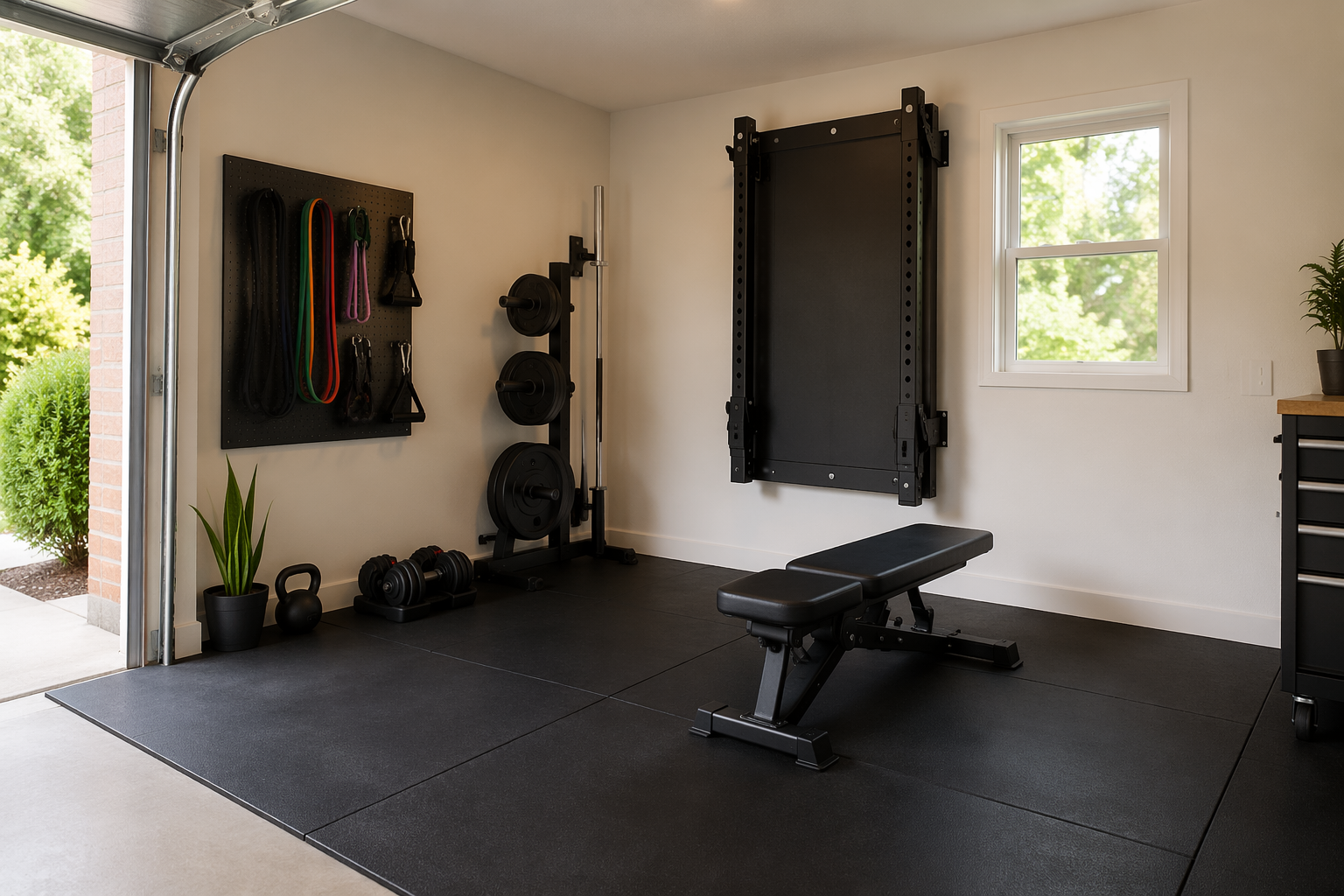
A garage gives you the best chance of making a rack, barbell, plates, and larger cable equipment work. It also brings its own problems: temperature, dust, moisture, lighting, uneven floors, and shared storage. Bikes, tools, holiday bins, and cars do not politely disappear because a product page called something compact.
REP Fitness’ small-space guidance emphasizes compact and wall-mounted configurations, which is the right way to think about garages and tight rooms: use vertical storage where it is safe, keep the lifting lane clear, and avoid letting accessories spread until the gym becomes a storage project.[4]
For a room-by-room planning approach, see Compact Home Gym by Space Tier: What You Can Build in 10, 30, 50, or 100 Square Feet or the phased setup plan in How to Build a Compact Home Gym in 3 Phases.
Match the Equipment to the Training You Will Actually Repeat
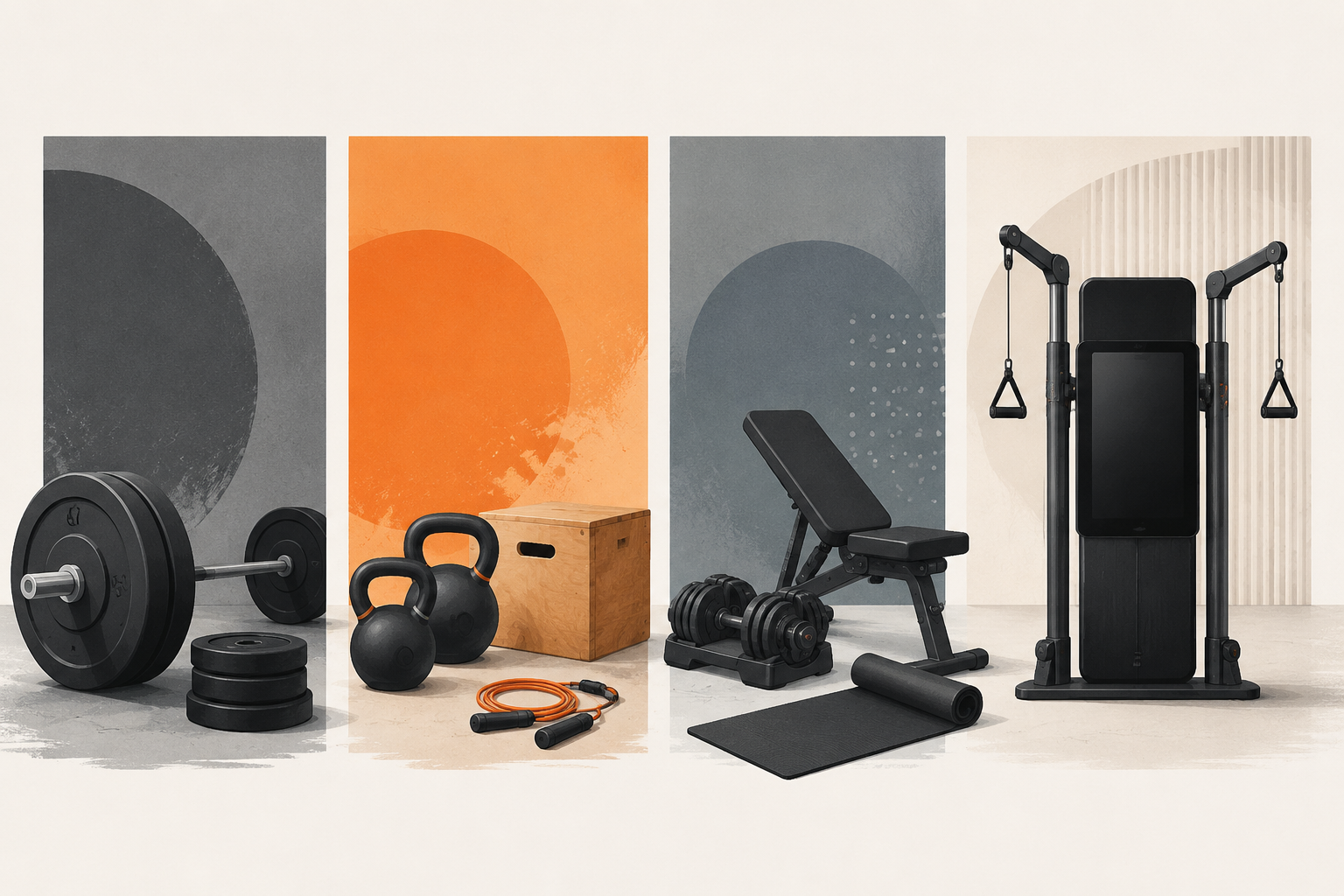
Many beginners do not know their primary training style yet. That is normal. If you are unsure, start with general fitness: adjustable dumbbells, bands, a mat, and a bench if space allows. That setup keeps several paths open instead of locking you into barbell strength, HIIT, or guided digital training before you have enough evidence.
If Your Goal Is Strength
Strength training rewards equipment that can progress in small, repeatable jumps. The classic answer is a rack, barbell, plates, and bench. It is not glamorous, but it is durable and expandable. Add dumbbells, a cable attachment, or specialty bars later if training history proves you need them.
For a garage lifter or a dedicated spare room, a rack setup is often the best long-term category. For an apartment lifter, heavy adjustable dumbbells and a bench may be the better first move. You lose some maximum loading, but you gain quiet, storage, and fewer arguments with the building.
If Your Goal Is CrossFit or HIIT
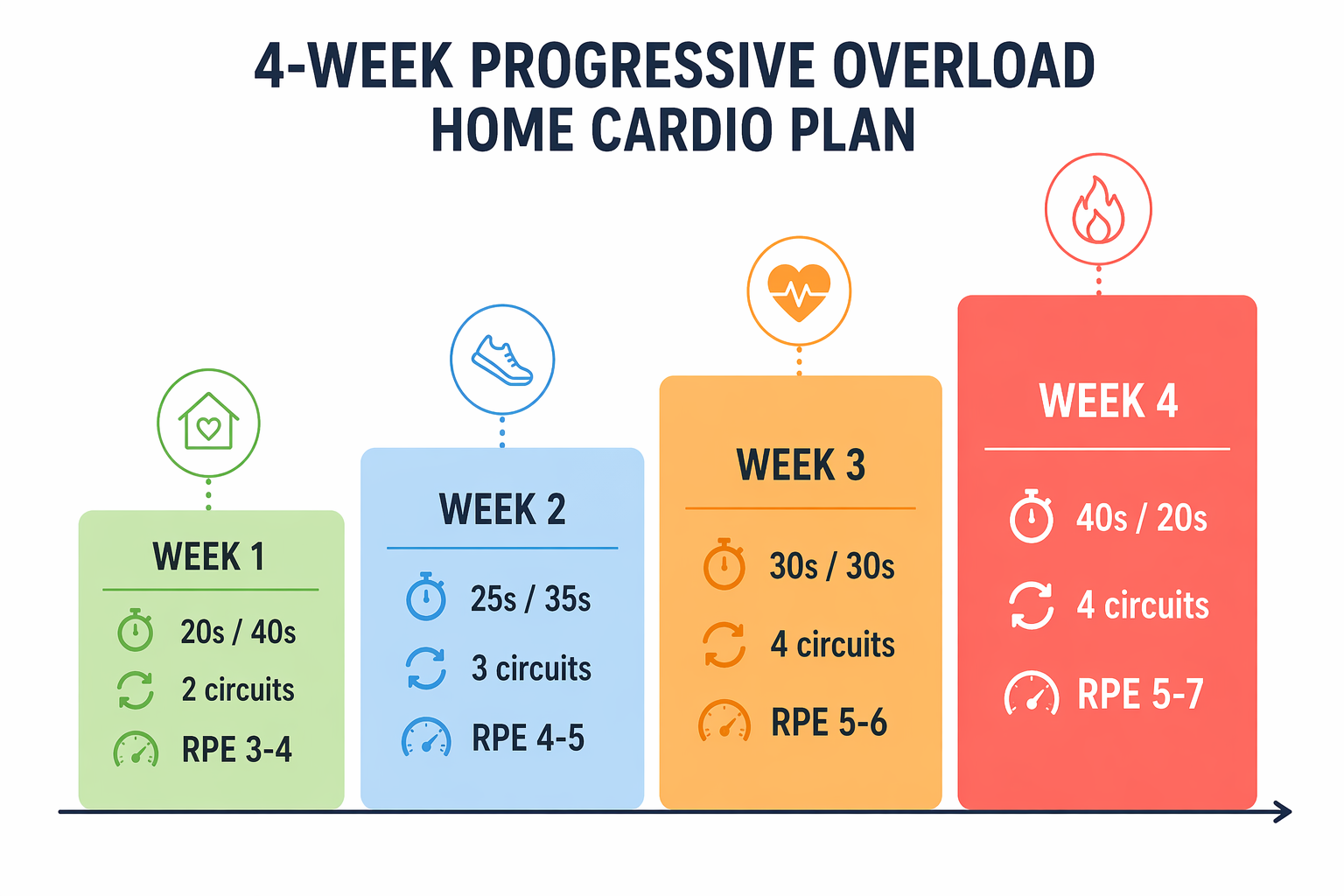
CrossFit-style and HIIT training need open floor more than they need a complicated machine. Kettlebells, dumbbells, a jump rope, a plyo box, a pull-up option, and a barbell can all fit the category, but the room decides how much intensity is realistic. Burpees, box jumps, skipping, and dropped weights are not neutral household events.
If you train in a garage, this category can expand quickly. If you train above someone else’s ceiling, choose quieter conditioning: step-ups instead of box jumps, carries instead of jumps, controlled dumbbell circuits instead of dropped barbell cycling.
If Your Goal Is General Fitness
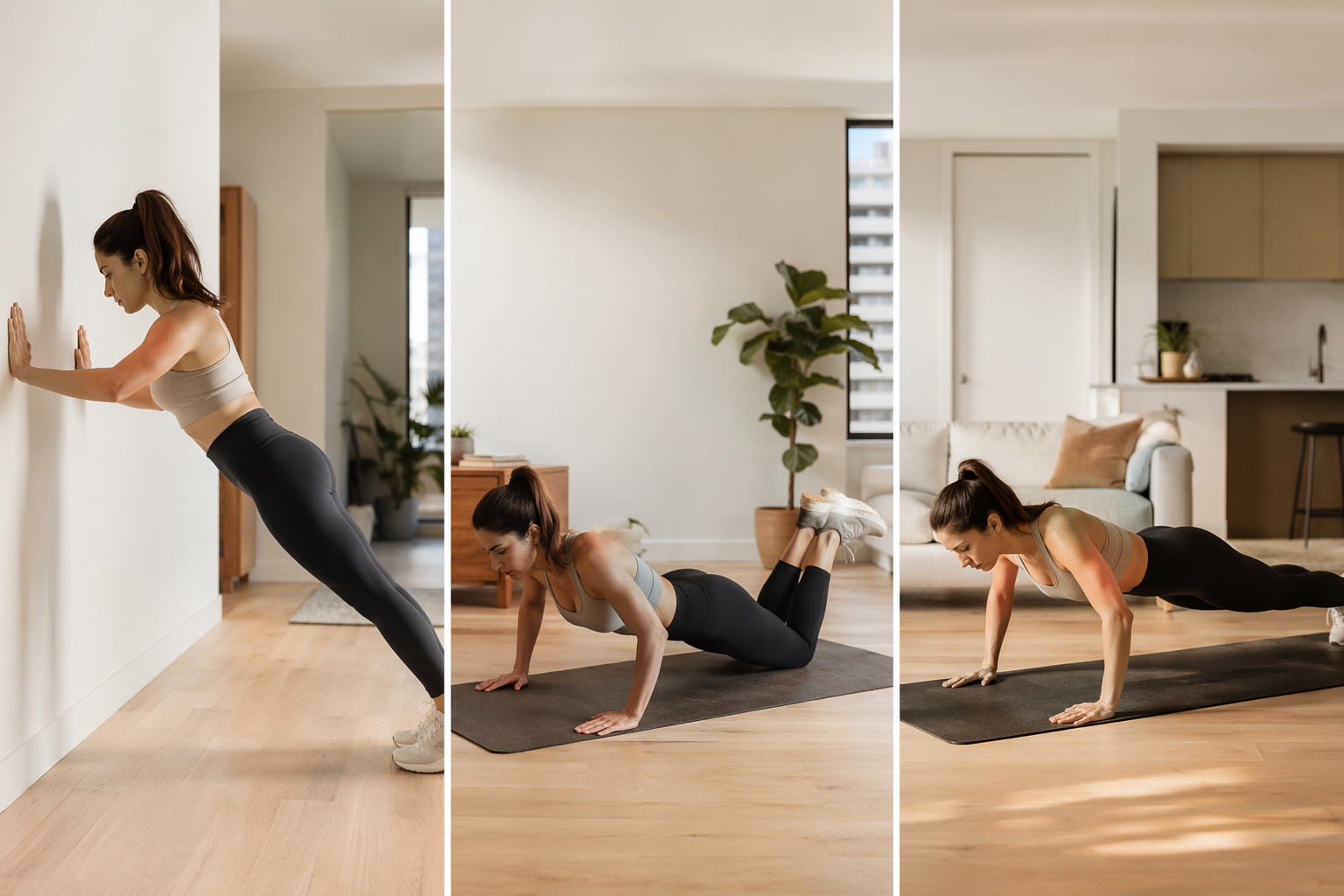
General fitness is not a lesser goal. It is the category for people who want to get stronger, move better, manage weight, support health, and not turn one room into a specialized training cave. Adjustable dumbbells, a bench, bands, a mat, and one conditioning option cover a lot of ground.
This is also the safest default for households with two users. One person can follow dumbbell strength workouts; another can do mobility, circuits, or low-impact cardio. The equipment does not force everyone into the same training identity.
If Your Goal Is Guided Convenience
Guided convenience is easy to underrate if you already know how to train. For someone who needs structure, automatic weight selection, form cues, class progression, or the feeling that a session is waiting, a smart gym can solve a real adherence problem. The ongoing cost is not a footnote; it is part of the product.
That is why smart gyms belong in the shortlist only when guidance is the point, not when they simply look cleaner than traditional equipment. If you are comparing smart and traditional setups, the better question is not which one is more advanced. It is which one removes the obstacle that has actually kept you from training. The tradeoffs are explored further in Smart Home Gym vs. Traditional Setup.
Where 2026 Product Roundups Help
Product roundups are most useful after you know the category. Garage Gym Reviews’ 2026 testing is helpful for comparing machines, average costs, and tested product impressions within a narrowed shortlist.[3] BarBend’s 2026 home gym machine coverage gives another view of machine-heavy options, especially when you are already considering all-in-one systems.[5] Outdoor Gear Lab’s 2026 exercise equipment testing can help cross-check smaller equipment categories and general fitness tools.[6]
Use those lists to choose between products, not to decide who you are as an exerciser. A highly rated functional trainer, rack, smart gym, or adjustable dumbbell set is still wrong if it fails your budget, room, or training-style test.
| Your situation | Best categories to compare next | Reason |
|---|---|---|
| Beginner, unsure goal, under $500 | Adjustable dumbbells, bands, mat | Keeps strength, mobility, and general fitness open |
| Apartment, wants strength | Adjustable dumbbells, folding bench, bands | Reduces noise and storage problems |
| Garage, wants strength | Rack, barbell, plates, bench | Supports progressive loading and long-term expansion |
| Spare room, general fitness | Dumbbells, bench, bands, compact cardio option | Works in a multipurpose room without dominating it |
| Needs coaching-like structure | Smart gym or guided app-connected setup | Solves programming and adherence friction |
| Over $2,000, wants versatility | Functional trainer or rack-and-cable setup | Adds cable training without buying many separate machines |
If you want a shorter version of this same sorting process, use Which Home Gym Equipment Should You Buy First? A Decision Framework. Beginners who want more hand-holding can start with Home Gym Equipment for Beginners: What to Buy First (And What to Skip).
Run the Payback Math Before You Buy
The average U.S. gym membership anchor is about $65 per month, or $780 per year, from the 2024 U.S. Health & Fitness Consumer Report.[7] That makes the rough payback question concrete: a $500 starter setup can pay back quickly if it replaces a membership; a $1,500 rack-and-dumbbell setup may sit around the two-year mark; a $4,000-plus smart gym with a monthly subscription has a much longer and more conditional payback.
The honest version of the math includes subscriptions, flooring, delivery, taxes, replacement parts, and the possibility that you still keep a gym membership for classes, machines, swimming, or community. It also includes the value of time saved if the home setup removes the commute and makes training easier to start.
A home gym often can pay for itself within 2–4 years against a gym membership, but only if it gets used. The best next purchase is usually not the most complete gym. It is the category that fits your budget, survives your room, and supports the kind of training you are most likely to repeat.
For a more detailed calculator-style comparison, use Home Gym vs. Gym Membership: The Complete Cost-Breakdown Calculator for 2026.
References
- Home Gym Equipment Market, GM Insights, https://www.gminsights.com/industry-analysis/home-gym-equipment-market
- Best Home Gym Equipment, Cleveland Clinic, https://health.clevelandclinic.org/best-home-gym
- Best Home Gyms (2026) Personally Tested, Garage Gym Reviews, https://www.garagegymreviews.com/best-home-gyms
- How to Build an Amazing Home Gym in a Small Space, REP Fitness, https://repfitness.com/blogs/inspiration/how-to-build-an-amazing-home-gym-in-a-small-space
- Best Home Gym Machines of 2026, BarBend, https://barbend.com/best-home-gyms/
- Best Exercise Equipment of 2026, Outdoor Gear Lab, https://www.outdoorgearlab.com/topics/fitness/best-exercise-equipment
- 2024 U.S. Health & Fitness Consumer Report, U.S. Health & Fitness Consumer Report, 2024
Comments
Join the discussion with an anonymous comment.