Searching for fitness equipment for sale is easy. Buying equipment that still makes sense six months later is harder. The browser tab does not know whether your ceiling is low, whether your landlord cares about noise, whether you will actually run indoors, or whether the rack you like leaves enough room to load plates safely.
Before comparing brands, narrow the search through three filters: your all-in budget ceiling, your usable floor dimensions, and your primary training goal. If one of those is vague, the shopping cart usually gets vague too.
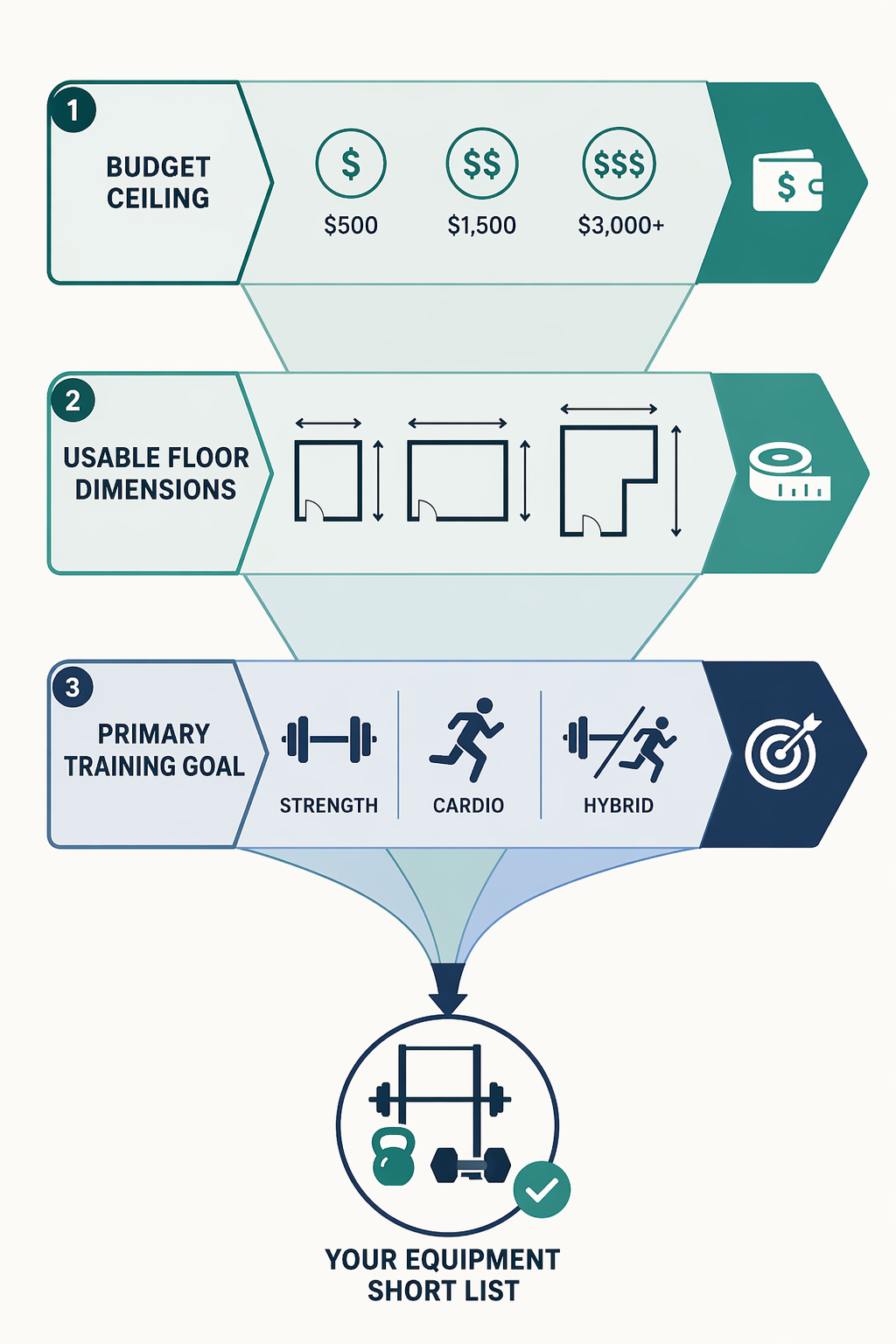
| Before you shop | What to decide | Why it matters |
|---|---|---|
| Measure the space | Usable training area, ceiling height, door swing, storage, and clearance | Equipment dimensions alone do not tell you whether you can move, load, lift, or step off safely. |
| Set the all-in budget | Equipment plus flooring, shipping, assembly, accessories, and subscriptions | A good advertised price can become a bad purchase once the real total appears. |
| Name the training goal | Strength, cardio, hybrid, sport-specific, or general fitness | Different goals point toward different equipment categories, not just different models. |
| Choose new or used | Durable low-electronics gear versus electronics-heavy machines | Used can be smart, but not every used bargain carries the same risk. |
| Compare categories first | Rack versus dumbbells, treadmill versus bike, compact system versus separate pieces | Brand comparison comes after the category makes sense. |
First, decide whether buying equipment is actually the right move
A home gym can be a good financial decision, but only if you use it. Garage Gym Reviews places a typical home gym setup around $1,500 to $2,500, based on reader-submission-style observations rather than a formal universal market average.[1] That range is useful because it describes what many practical first setups feel like: not bargain-bin, not luxury, and usually built around a few durable pieces.
The return-on-investment comparison is tempting. The Health & Fitness Association reported a national average gym membership cost of $65 per month in 2024, or $780 per year.[2] Against that benchmark, a $1,500 to $2,500 home gym can roughly pay for itself in a few years. But that is not a universal promise. Your local gym may be cheaper, your household may share a membership, or your preferred training may require equipment that costs more than a simple home setup.
Use the math as a permission slip to think long-term, not as a reason to buy fast. If you currently train consistently and want to remove commute time, a home setup has a strong case. If you are trying to buy motivation, start smaller. A mat, bands, adjustable dumbbells, or a used bench will teach you more about your actual habits than a room full of equipment.
Set the budget by tier, not by wish list
The first budget mistake is pricing the main item and ignoring the system around it. A $900 treadmill is not a $900 decision if it needs delivery, a mat, a surge-protected outlet, a subscription, and two people to get it downstairs. A $700 rack is not a $700 decision if you still need a barbell, plates, collars, flooring, storage, and enough clearance to use it.
| Budget tier | What it can realistically support | Good first direction | Watch closely |
|---|---|---|---|
| $300-$1,000 | A basic setup built around bodyweight, bands, a mat, adjustable or fixed dumbbells, a pull-up bar, or one simple cardio piece | General fitness, beginner strength, small-space training | Cheap cardio machines, unstable benches, and buying too many small accessories at once |
| $1,000-$3,000 | A stronger mid-range build with a bench, adjustable dumbbells, starter rack, barbell setup, or entry-level cardio machine | Strength-focused beginners, hybrid users, households sharing equipment | Shipping, plate costs, flooring, and whether the room can actually hold the setup |
| $3,000-$6,000 | A fuller dedicated home gym with a quality rack, plates, barbell, bench, storage, and possibly a dedicated cardio machine | Consistent lifters, garage gyms, spare-room gyms, serious hybrid training | Overbuilding before training habits are stable and underestimating layout |
| $6,000+ | Commercial-grade equipment, premium cardio, smart gyms, connected strength systems, or highly finished multi-user spaces | Committed households, advanced trainees, buyers replacing multiple memberships | Subscriptions, repairs, proprietary parts, moving logistics, and resale uncertainty |
The $300 to $1,000 tier is not a failure tier. For many first-time buyers, it is the cleanest test of what will actually be repeated. If your workouts are mostly dumbbell strength circuits, mobility, walking, or short conditioning sessions, a compact setup can outperform an expensive machine you resent making room for.
The $1,000 to $3,000 tier is where the decisions start to matter more. You can build around adjustable dumbbells and a real bench, choose one cardio machine, or start a barbell setup. You usually cannot do all of those well without compromises. This is where a buyer should slow down and choose the training identity of the room.
The $3,000 to $6,000 range can create a genuinely capable dedicated gym. It can also create an expensive storage room if the layout is guessed from product photos. At this level, draw the room, mark clearance zones, and price the boring parts before falling in love with the centerpiece.
$6,000 and up is not automatically wasteful. A premium treadmill, connected strength system, or commercial-grade rack can make sense for someone who trains often and knows exactly what they want. The risk is that high-end equipment often brings high-end dependencies: freight delivery, assembly, software subscriptions, service calls, and less flexibility if your training changes.
If you want a narrower beginner path before building a cart, the home gym equipment for beginners framework walks through budget and space choices without assuming you are ready for a full dedicated gym.
Measure the usable space, not the empty room
A room that measures 10 by 10 feet on paper is not automatically a 10-by-10-foot gym. Closets, doors, windows, radiators, low ceilings, sloped floors, parked cars, storage bins, and walkways all steal training space. The number that matters is the space where you can move safely with the equipment in use.
| Space type | Useful planning size | Equipment that tends to fit | Common mistake |
|---|---|---|---|
| Apartment corner | About 6x6 ft usable | Adjustable dumbbells, bands, foldable bench, mat, compact bike, vertical storage | Buying equipment that stores well but needs more room during use |
| Spare room | About 10x10 ft | Bench and dumbbells, compact cable system, small rack if clearances work, rower or bike | Forgetting door swing, ceiling fan height, and plate-loading room |
| Garage bay or section | About 12x14 ft | Rack, barbell, plates, bench, storage, sled alternatives, cardio machine if layout allows | Letting storage creep into the lifting zone |
| Basement | Potentially generous floor area, but ceiling height controls the plan | Dumbbells, bench, cable systems, low-profile racks, cardio depending on headroom | Assuming overhead presses, pull-ups, or treadmill incline will clear the ceiling |
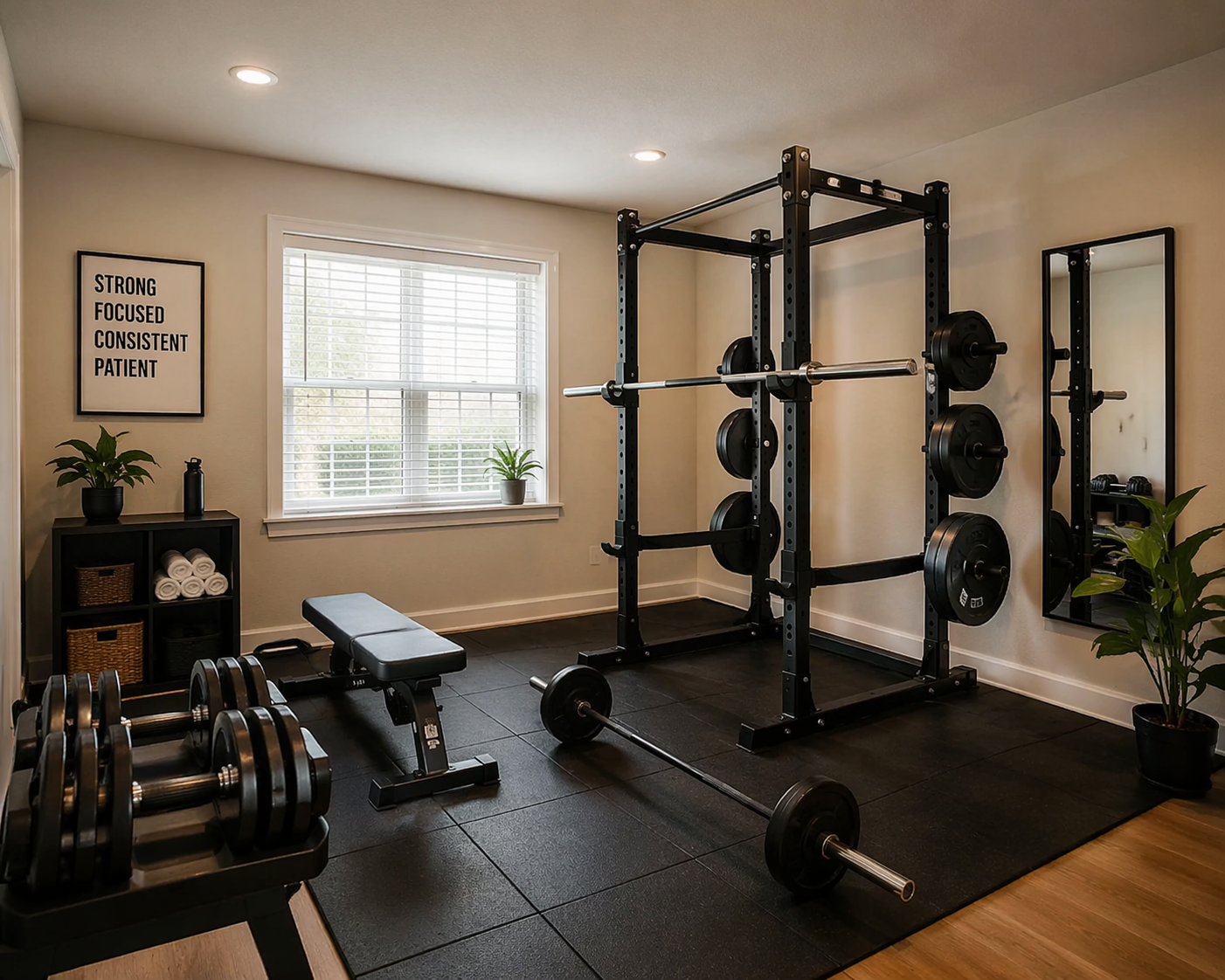
Measure the equipment footprint, then measure the work zone around it. A bench needs space to walk around. A barbell needs side clearance so plates can be loaded without scraping walls. A treadmill needs step-off space. A rower needs its full rail length in use, not just its storage footprint. A cable machine needs the path your arms and attachments travel through.
Small-space buyers should be especially suspicious of product photos shot in wide rooms. If your usable training area is closer to an apartment corner, start with the home fitness equipment for small spaces guide or the space-tiered small equipment guide before looking at full-size systems.
Match the equipment category to the training goal
The right equipment short list depends on what you want the room to make easier. A strength buyer, a cardio buyer, and a general-fitness beginner should not be shopping from the same mental list, even if the same sale page shows them all the same products.
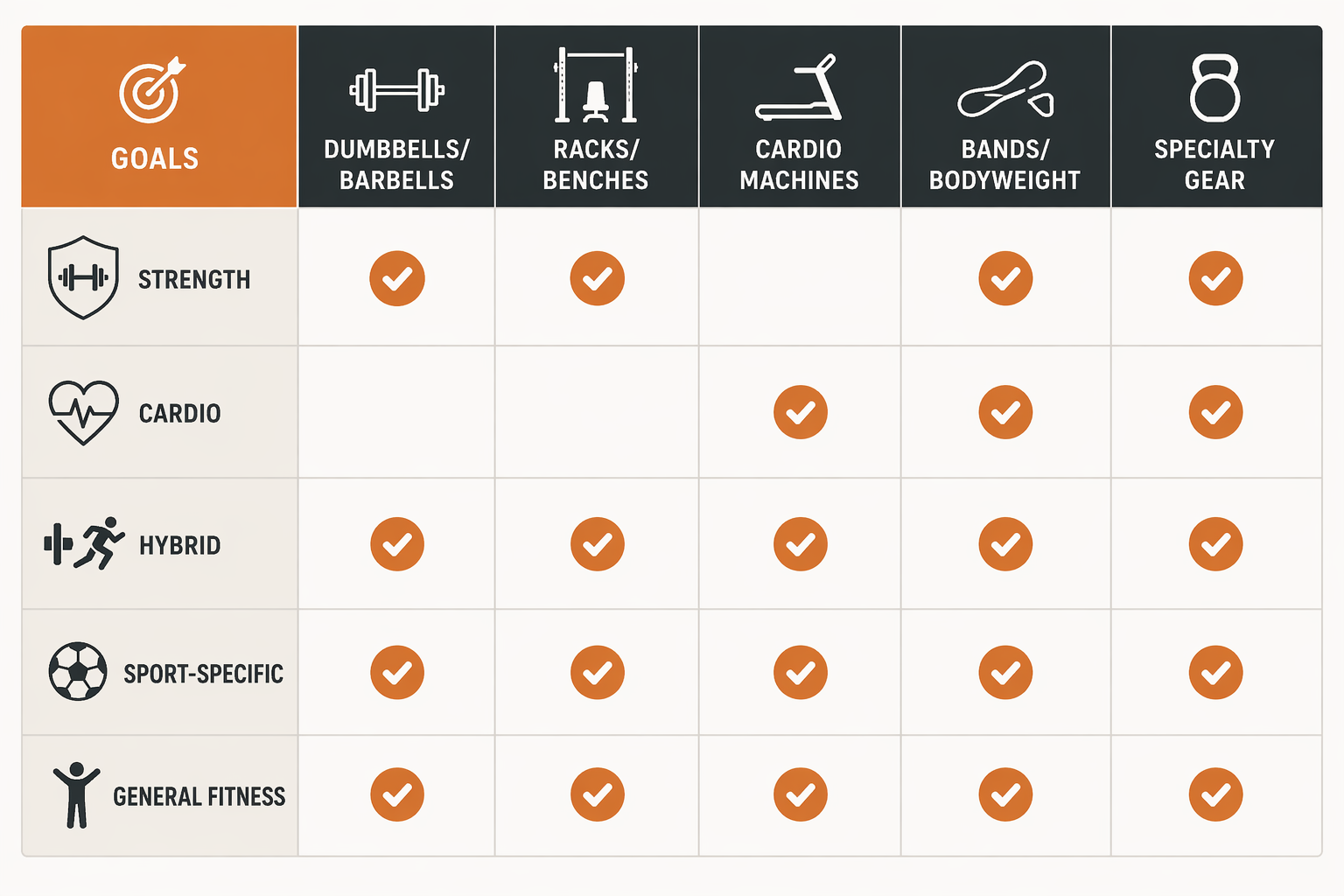
| Primary goal | Best first categories | Usually delay | Why |
|---|---|---|---|
| Strength | Adjustable dumbbells, bench, barbell, plates, rack, pull-up option | Premium cardio, many accessories, smart mirrors | Progressive loading and safe setup matter more than variety. |
| Cardio | Treadmill, bike, rower, elliptical, jump rope, walking pad if space is tight | Heavy strength stations unless strength is a second goal | The machine should match the movement you will repeat, not the one that looks most complete. |
| Hybrid | Dumbbells or rack plus one cardio machine, or a compact functional trainer | Duplicate machines and specialty strength pieces | The room needs a clean split between lifting, conditioning, and storage. |
| Sport-specific | Goal-specific strength tools, mobility gear, conditioning equipment, specialty pieces only when justified | Generic all-in-one systems that do not match the sport demand | Training transfer matters more than filling the room. |
| General fitness | Mat, bands, adjustable dumbbells, bench, compact cardio, simple storage | Large racks, plate-loaded machines, high-subscription systems | Consistency and low friction beat maximum capability at the start. |
Strength equipment rewards durability. A good bench, rack, barbell, and plates can stay useful for years because the basic job does not change. The question is not whether a rack looks serious; it is whether your space allows safe loading, unracking, benching, squatting, and storage.
Cardio equipment rewards fit and repetition. If you dislike running, a treadmill with a better console will not fix that. If low-impact work is the point, a bike, rower, or elliptical may earn its footprint more reliably. Also check the use case that product photos hide: noise, ceiling height on incline, power access, step-on height, and how the machine feels after twenty minutes, not just two.
Hybrid buyers need restraint. It is easy to build a room that is half lifting area, half cardio area, and fully annoying to use. Pick the anchor first: either strength with a small cardio add-on, cardio with a modest strength station, or a compact system that handles enough of both. If you are deciding among complete systems, the home gym equipment systems comparison is the better next page than a generic sale search.
If the main uncertainty is what to buy first, use a purchase sequence rather than a wish list. The first-equipment decision framework helps separate anchor purchases from nice-to-have add-ons, and the phased purchase-sequence guide is useful when you want to build over time instead of buying the whole room at once.
Use new versus used as a risk decision
Used equipment can be one of the best ways to stretch a first-home-gym budget. Brazyn Life’s 2026 analysis says used fitness equipment can save 40% to 70% versus retail, depending on equipment type, condition, and local market.[3] That number should be treated as a possibility, not a guarantee.
The safest used buys are usually low-electronics items: dumbbells, weight plates, barbells, benches, racks, kettlebells, and simple storage. Scratches matter less than structural damage. With these items, you can inspect the welds, sleeves, pads, hardware, rust, and wobble without needing a service history.
Used treadmills, connected bikes, smart gyms, and subscription-based machines deserve more skepticism. Motors wear. Belts need maintenance. Screens fail. Proprietary parts can be expensive or unavailable. A machine that was a bargain in the seller’s garage can become a project once it is in your basement.
| Equipment type | Used buying confidence | Inspection priority |
|---|---|---|
| Dumbbells, plates, kettlebells | High | Weight accuracy, rust, cracks, grip condition |
| Barbells | Medium to high | Straightness, sleeve spin, knurling, rust, end caps |
| Benches and racks | Medium to high | Frame integrity, pad condition, wobble, hardware, stated weight rating |
| Treadmills and motorized cardio | Lower | Motor, belt, deck, incline, noise, maintenance history, moving logistics |
| Smart gyms and connected machines | Lower | Account transfer, subscription terms, screen, sensors, parts, warranty status |
Local buying can make inspection and pickup easier, especially for heavy strength equipment. If you are deciding between specialty fitness stores, big-box retailers, used marketplaces, and local dealers, continue with which local store to buy fitness equipment from before arranging delivery.
Add the hidden costs before you decide the deal is good
The price on the product page is only the start. Home gym purchases often pick up costs in places that feel secondary until they arrive: flooring, shipping, freight delivery, assembly, accessories, storage, maintenance, subscriptions, and sometimes electrical or room changes.
- Flooring: protect the floor, reduce noise, and match the surface to what you drop or move.
- Shipping and freight: large racks, machines, and plates can change the real price quickly.
- Assembly: some equipment is manageable alone; some is not worth assembling without help.
- Accessories: collars, attachments, mats, storage, heart-rate straps, and maintenance supplies add up.
- Subscriptions: connected equipment may require ongoing payments to keep the experience you expected.
Flooring is the hidden cost beginners most often want to skip, then regret. The right choice depends on what the room has to tolerate. A yoga mat is not deadlift flooring. Thin foam tiles are not a platform. A treadmill mat is not a full lifting solution. For the flooring decision, use what home gym flooring you need depends on what you drop instead of guessing from product photos.
A practical buying order
This is the order that keeps a first home gym from turning into a pile of unrelated equipment.
- Write down the training you already do or will realistically repeat: lifting, walking, cycling, rowing, mobility, circuits, sport prep, or general movement.
- Measure the usable space in feet, including ceiling height, storage zones, doors, outlets, and clearance for the equipment in motion.
- Set an all-in budget, then reserve part of it for flooring, delivery, assembly, accessories, and subscriptions.
- Pick the anchor category: dumbbells, rack and barbell, cardio machine, compact system, or general-fitness kit.
- Decide whether new or used fits the category’s risk profile.
- Compare specific models only after the category survives the budget, space, and goal filters.
Seasonal sales can help, but timing should not rescue a bad match. A discounted machine that does not fit your room, your budget, or your training is still expensive. If a sale deadline pressures you to skip measuring, the discount is doing exactly the wrong job.
From broad search to short list
A useful equipment short list should be boringly specific. Not “best home gym equipment.” More like: “adjustable dumbbells and a foldable bench under $1,200 for a 6-by-6-foot apartment corner,” or “rack, barbell, plates, bench, and flooring under $3,000 for a garage space with enough ceiling height.”
If you are still comparing across categories, use the broader budget, space, and goals equipment guide. If space is the main constraint, use the compact home gym decision guide. If you already know you want a connected or all-in-one setup, move to the systems comparison rather than restarting with a generic sale query.
The right first purchase is the one that survives all three filters: it fits the all-in budget, it fits the usable space, and it serves the training you will actually repeat. After that, brand comparison becomes useful. Before that, it is mostly noise.
References
- Garage Gym Reviews reader-submission home gym cost estimate, Garage Gym Reviews
- 2024 report on average gym membership cost, Health & Fitness Association, 2024
- 2026 analysis on used fitness equipment savings, Brazyn Life, 2026
Comments
Join the discussion with an anonymous comment.